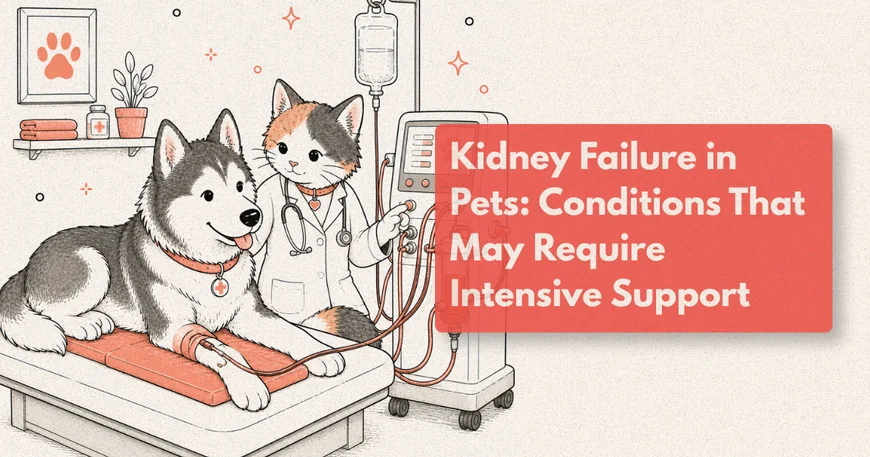
Veterinary specialist performing an intravenous fluid assessment on a cat in an ICU setting
The kidneys are quiet organs. Unlike a coughing chest or a swollen abdomen, renal disease does not announce itself dramatically until a substantial proportion of functional tissue has already been lost. In cats, this biological feature creates a particular clinical challenge: the most common form of kidney disease in the species is chronic, progressive, and routinely asymptomatic until the terminal stages of nephron loss.
What to Know
Chronic kidney disease affects approximately 30-40% of cats over 10 years of age (JVIM, 2022). Anuric or severely oliguric acute kidney injury in cats carries in-hospital mortality of 55-70% without extracorporeal renal support (JVIM, 2021); targeted ICU management combined with dialysis shifts survival to discharge rates to approximately 40-55%.
Recognising when renal disease has crossed into a crisis requiring intensive intervention is one of the most consequential decisions in small animal medicine. The window between a metabolically compensated patient and one in life-threatening uraemic crisis can be narrow, particularly in cats whose stoic physiology suppresses overt signs until advanced disease is established. What follows is a clinical overview of the mechanisms, decision points, and specialist support options available when a pet's kidneys require more than standard outpatient management.
Kidney Disease in Pets: Acute Crisis or Chronic Decline
Renal failure is not a single condition. The distinction between acute kidney injury (AKI) and chronic kidney disease (CKD) fundamentally shapes prognosis, treatment strategy, and the intensity of support required.
AKI is defined as a sudden decline in glomerular filtration rate over hours to days. It is potentially reversible if the underlying cause is identified and removed early, and if supportive care is instituted before irreversible ischaemic or toxic damage accumulates. The most common causes in cats include lily plant and ethylene glycol ingestion, ureteral obstruction, pyelonephritis, and hypoperfusion secondary to anaesthesia, haemorrhage, or systemic sepsis. In dogs, leptospirosis, grape or raisin ingestion, and NSAID toxicity account for a significant proportion of AKI presentations at referral centres.
CKD is defined by persistent structural or functional abnormality lasting more than three months, and is classified using the International Renal Interest Society (IRIS) staging system. This framework uses serum creatinine, SDMA, and the urine protein-to-creatinine ratio to categorise disease from Stage 1 (early, minimal clinical signs) through Stage 4 (advanced uraemia, often requiring intensive management). By the time a cat reaches IRIS Stage 3 or 4, nephron loss exceeds 66% and 75% respectively; the remaining functional mass cannot compensate for any additional acute insult without substantial deterioration.
Acute-on-chronic AKI, where a patient with pre-existing CKD sustains an acute insult, carries the most guarded prognosis of all presentations. A 2023 JVIM analysis found that cats presenting with acute-on-chronic renal decompensation had significantly higher in-hospital mortality than those with pure AKI or stable CKD alone, and required substantially longer hospitalisation periods before any assessment of renal recovery could be made.
Kidney Failure in Cats: Why Felines Are Especially Vulnerable
Feline CKD is among the most consistently encountered diseases in companion animal medicine. Prevalence data from multiple referral populations find that CKD affects approximately 30-40% of cats over 10 years and over 50% of cats over 15 years (JVIM, 2022). The precise aetiology remains incompletely characterised: feline CKD appears to result from a convergence of renal fibrosis, protein-energy malnutrition, systemic hypertension, and persistent low-grade inflammation rather than a single primary insult.
Several species-specific vulnerabilities make feline nephrology demanding. Cats have an obligate protein requirement that creates ongoing nitrogenous load through normal metabolism. Their urine concentrating ability is generally superior to that of dogs, but this capacity is lost early in CKD, making dehydration a consistent risk that owners may not appreciate until the cat has begun losing body condition. Concurrent hypertension, present in approximately 20-65% of cats with CKD depending on disease stage (JVIM, 2021), accelerates glomerular damage and poses independent risks to the eyes, brain, and heart.
Hypokalaemia is a frequently underappreciated complication of feline CKD. Potassium depletion arises from reduced dietary intake, increased renal and gastrointestinal losses, and the polyuria characteristic of moderate to advanced disease. Plasma potassium below 3.0 mEq/L produces clinically recognisable cervical ventroflexion and generalised muscle weakness; subclinical hypokalaemia in the 3.0-3.5 mEq/L range nonetheless impairs renal tubular function and contributes to disease progression. Supplementation is a routine component of advanced CKD management.
The acutely decompensating cat with CKD typically presents in uraemic crisis: profoundly depressed, hypothermic, with an ammonia-tinged breath odour, oral ulceration, and either profound oliguria or a paradoxical polyuria that masks the severity of glomerular dysfunction. Bloodwork typically reveals creatinine well above the Stage 4 threshold of 5.0 mg/dL, severe metabolic acidosis, elevated phosphate, and concurrent anaemia of chronic renal disease.
The cats most likely to reach veterinary attention at a survivable stage of acute decompensation are those whose owners have maintained regular monitoring under a nephrology-aware clinician. A cat with a documented creatinine trend, a six-monthly weight record, and a known appetite baseline gives the clinical team far more to work with than one presenting for the first time in uraemic collapse with no prior bloodwork history.
The ICU Phase: Stabilising a Pet in Renal Crisis
When a pet arrives in acute renal crisis, the immediate priority is haemodynamic stabilisation and correction of the metabolic derangements that pose the most immediate life threat. Uraemic crises are characterised by severe metabolic acidosis, hyperkalaemia, fluid volume dysregulation, and often concurrent cardiovascular compromise.
Intravenous fluid therapy is the cornerstone of AKI management. Isotonic crystalloids, typically lactated Ringer's solution or Plasma-Lyte A, are administered to correct hypovolaemia and restore renal perfusion pressure. The critical distinction in ICU-level renal management is between the oliguric and anuric patient. A patient producing less than 0.5 mL/kg/hour of urine despite adequate fluid resuscitation has entered oliguric AKI; production below 0.1 mL/kg/hour constitutes anuric AKI. Both states require management beyond fluid therapy alone.
A 2022 JVECCS prospective cohort study found that initiation of aggressive fluid therapy within 6 hours of AKI diagnosis was associated with a significantly improved creatinine trajectory at 48 hours and a lower rate of progression to anuria compared to cases managed with delayed or conservative fluid administration.
Continuous cardiac monitoring, hourly urine output measurement via indwelling urinary catheter, blood pressure monitoring, and repeated electrolyte assessment form the minimum monitoring infrastructure for ICU-level renal care. Hyperkalaemia above 6.5 mEq/L with electrocardiographic changes requires immediate intervention: calcium gluconate for cardioprotection, followed by dextrose-and-insulin infusion or sodium bicarbonate to shift potassium intracellularly while more definitive management is arranged.
Anti-emetics, gastrointestinal protectants, and analgesic support address the uraemic gastroenteropathy and mucosal ulceration that cause significant patient suffering. Early nasoenteric tube feeding is introduced where possible, since prolonged fasting accelerates catabolism, worsens uraemia, and reduces the likelihood of spontaneous appetite recovery once the acute crisis resolves.
Chart 1: Survival to Discharge in Cats with AKI by Treatment Approach
Chart 2: CKD Prevalence in Cats by Age Bracket
Nephrology Support: The Specialist's Role in Complex Cases
Veterinary nephrology as a recognised specialty sits within the broader discipline of internal medicine, with board certification through the American College of Veterinary Internal Medicine (ACVIM). A specialist nephrology consultation adds most value in three scenarios: diagnostic uncertainty about the primary renal diagnosis, management of Stage 3 or 4 CKD requiring multi-drug protocols, and decisions around extracorporeal renal support.
In diagnostically complex cases, renal biopsy under ultrasound guidance provides histopathological characterisation that cannot be inferred from bloodwork alone. The distinction between immune-mediated glomerulonephritis, amyloidosis, and tubulointerstitial nephritis has direct therapeutic implications: glomerulonephritis may respond to immunosuppressive therapy, while amyloidosis carries a more guarded prognosis regardless of treatment intensity. JVIM guidelines recommend renal biopsy when proteinuria is significant (urine protein-to-creatinine ratio above 2.0) and urine sediment examination or infectious disease screening has not identified a reversible cause.
Phosphate management is the cornerstone of CKD progression control. Elevated serum phosphate drives renal secondary hyperparathyroidism, which accelerates nephron loss through mineralisation and fibrosis. A 2022 JVIM prospective study found that cats maintained with serum phosphate within IRIS target ranges (below 4.5 mg/dL in Stage 2, below 5.0 mg/dL in Stage 3) showed a significantly slower rate of creatinine progression compared to cats with uncontrolled hyperphosphataemia. Achieving these targets typically requires a combination of phosphate-restricted diet and intestinal phosphate binders.
The most commonly overlooked nephrology intervention in cats is blood pressure control. Systemic hypertension in a CKD cat is not a secondary problem to be addressed after renal management is established; it is an independent accelerator of glomerular damage, and delayed treatment is measurable in creatinine trajectory within months. Amlodipine at 0.625 mg per cat orally every 24 hours is the first-line treatment for feline hypertension; the majority of cats achieve target systolic pressure below 160 mmHg with this dose alone.
Dialysis in Pets: When the Kidneys Need Direct Assistance
Renal dialysis in veterinary medicine exists along a spectrum from peritoneal dialysis, which can be performed in most well-equipped referral centres, through intermittent haemodialysis (IHD) and continuous renal replacement therapy (CRRT), which require specialist facilities and dedicated vascular access.
Dialysis is indicated when AKI is refractory to medical management: persistent anuria or oliguria despite adequate fluid resuscitation, life-threatening hyperkalaemia unresponsive to pharmacological management, severe uraemic encephalopathy, or fluid overload that precludes continued fluid therapy. These indications are absolute rather than aspirational; dialysis in this context is bridging support, buying time for renal recovery rather than replacing renal function permanently.
Intermittent haemodialysis uses a semipermeable membrane to remove uraemic solutes and excess fluid from blood passing through an extracorporeal circuit. It is highly effective at rapid solute clearance and is the modality of choice when a rapid reduction in uraemia is required. A 2022 JVIM analysis of cats receiving haemodialysis for AKI at referral centres found survival to discharge rates of approximately 40-55%, with the best outcomes in cats where the primary cause was reversible (toxin ingestion or infectious aetiology) and the worst in those with acute-on-chronic presentations.
Peritoneal dialysis uses the peritoneal membrane as a dialysis surface, with dialysate instilled into the abdominal cavity via a percutaneously placed catheter. It achieves slower solute clearance than haemodialysis but is substantially more accessible, requiring no extracorporeal circuit or specialised blood pump equipment. A 2020 JVECCS review found that peritoneal dialysis achieved adequate uraemic control in approximately 60-70% of cases where IHD facilities were unavailable, representing a meaningful survival option for cats managed at general referral centres without nephrology-specific infrastructure.
Citation capsule: Haemodialysis for cats with anuric or severely oliguric AKI achieved survival to discharge rates of 40-55% in a 2022 JVIM referral centre analysis. Where haemodialysis is unavailable, peritoneal dialysis achieves adequate uraemic control in approximately 60-70% of cases, providing a clinically meaningful bridging option at general referral centres (JVECCS, 2020).
Recovery and Long-Term Monitoring After Acute Kidney Injury
Not all pets that survive an acute renal crisis recover normal renal function. The distinction between complete, partial, and non-recovery determines long-term management strategy and quality of life.
Complete recovery, defined as return of creatinine to pre-injury baseline within four to six weeks, is most common in toxin-induced AKI where the insult was recognised early and removed before irreversible tubular necrosis occurred. Partial recovery, with stabilisation at a new higher creatinine baseline, is the most frequent outcome; these patients effectively become CKD patients and are managed under the IRIS staging framework. Non-recovery, where progressive renal deterioration continues despite full supportive care, indicates irreversible nephron loss and requires palliative management focused on quality of life.
Follow-up for AKI survivors typically includes bloodwork and urine analysis at two, four, and eight weeks post-discharge, with monitoring frequency adjusted according to IRIS CKD staging guidelines thereafter. Phosphate, potassium, blood pressure, and urine protein-to-creatinine ratio are the key parameters tracked at each assessment. Body weight and muscle condition score, recorded consistently at home and at each visit, are sensitive early indicators of declining renal reserve that often precede measurable bloodwork changes.
What are the early signs of kidney disease in cats that owners should watch for?
Early CKD in cats is frequently silent, but subtle signs often precede laboratory changes by months. Increased water intake and urination, a gradual reduction in appetite, unexplained weight loss, and reduced grooming are the earliest owner-observable indicators. Because creatinine requires 75% nephron loss to rise above the reference range, cats with early CKD often have normal routine bloodwork; SDMA, which detects kidney disease significantly earlier, should be included in any senior screening panel. Annual bloodwork for cats over 7 years and six-monthly checks from age 10 onward give the best chance of early detection.
When does a cat with kidney disease need to be hospitalised?
Hospitalisation is indicated when a CKD cat shows acute decompensation: acute-onset vomiting, profound depression, inability to stand, hypothermia, or a dramatic change in urination pattern. A serum creatinine that has increased by 0.3 mg/dL or more within 48 hours, even if still within the historical range, indicates IRIS AKI Grade 1 and warrants immediate assessment. Cats that are vomiting or inappetent cannot be managed effectively with oral medications and fluids and typically require in-hospital intravenous support.
Is kidney dialysis available for cats and dogs in veterinary medicine?
Yes. Intermittent haemodialysis is available at a small number of university teaching hospitals and specialist referral centres. Peritoneal dialysis is more widely available and can be performed at most well-equipped referral practices. Dialysis in veterinary medicine serves as bridging support, buying time for renal recovery in AKI cases rather than providing long-term renal replacement as in human medicine. Costs are significant and the treatment is intensive, typically requiring multi-day hospitalisation with round-the-clock monitoring.
Can a cat with IRIS Stage 4 CKD have a good quality of life?
Stage 4 CKD carries a guarded prognosis, but a subset of cats can maintain acceptable quality of life for weeks to months with appropriate management. Appetite stimulants, anti-nausea medications, subcutaneous fluids administered at home, phosphate restriction, and blood pressure control are the pillars of Stage 4 management. The key assessment is the owner's quality of life evaluation, conducted honestly with guidance from the clinical team. Validated feline quality of life tools help structure these conversations around observable, measurable parameters rather than subjective impressions.
What is the difference between kidney failure and kidney disease in pets?
Kidney disease is an umbrella term covering any structural or functional abnormality of the kidneys, from early Stage 1 CKD detectable only on SDMA testing through to advanced Stage 4 disease. Kidney failure specifically refers to the inability of the kidneys to perform their essential functions adequately: waste removal, fluid balance, electrolyte regulation, and hormone production. A pet can have kidney disease without being in kidney failure; by the time kidney failure is clinically evident, substantial nephron loss has already occurred, which is why early detection through routine screening matters so much.
When the Kidneys Ask for Help
Renal disease in pets does not present a single clinical problem; it presents a spectrum, from the early asymptomatic cat whose SDMA is quietly rising to the anuric dog in uraemic crisis requiring ICU-level support and dialysis. Managing that spectrum well requires early detection, a clear understanding of when outpatient management has reached its limits, and access to specialist nephrology support when intensive intervention is indicated.
The cats and dogs that fare best are not necessarily those with the least severe disease; they are those whose owners sought assessment early, maintained monitoring consistently, and acted promptly when deterioration began. The kidneys cannot regenerate lost nephrons, but with the right support, the remaining functional tissue can be protected for far longer than untreated disease would allow.
Cessna Lifeline Veterinary Team
Cessna Lifeline Veterinary Hospital is a multi-clinic veterinary group serving Bengaluru, Gurugram and Navi Mumbai, offering general consultation, preventive care, diagnostics, surgery, rehabilitation and emergency support. Articles published under this profile are written and clinically reviewed by our team of veterinarians and specialists.