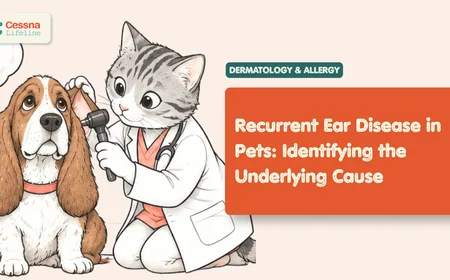
Why Does My Dog Keep Getting Ear Infections?
Repeated ear infections in an adult dog usually point to an allergy underneath. Why the L-shaped canal traps trouble, and why the same drops stop working.
Recurrent ear infections in dogs are almost never a new infection each time. The bacteria and yeast your vet treats are passengers. Something underneath is keeping that ear canal warm, swollen and damp, and in a dog over a year old with repeated trouble in both ears, that something is usually allergic skin disease. Treat the infection and the ear clears. Leave the allergy alone and the ear fills up again within weeks. That is the whole pattern, and it explains why the fourth course of drops works less well than the first.
Most owners are told their dog has an ear infection, given drops, and sent home. The drops work, and that advice is not wrong. But an ear infection in a healthy canal is an unusual event, because a normal dog's ear is a hostile place for microbes. It is lined with migrating skin, coated in waxy antimicrobial secretions, and self-cleaning. For yeast or bacteria to take hold and stay, that defence has to fail first. Finding out why it failed is the difference between managing a dog's ears for life and fixing them.
This article covers what actually sits underneath recurrent otitis, why your dog's ear anatomy works against you, how to tell yeast from bacteria, what you can safely do at home, and the signs that mean an ear needs seeing today rather than next week.
What to Know Recurrent ear infections are a symptom of something else, and in adult dogs with both ears affected that something is usually allergy. The canine ear canal is L-shaped, deep and warm, which traps moisture and makes humidity, monsoon damp and swimming significant risk factors. A smear under the microscope is what tells your vet whether the problem is yeast, bacteria or both, and it changes the choice of treatment. Never put hydrogen peroxide, surgical spirit, vinegar, coconut oil or any home remedy into a sore ear, because the eardrum may be perforated and some substances cause permanent deafness. A head tilt, loss of balance, flicking eye movements or sudden severe pain needs veterinary attention the same day.
Why Do Ear Infections Keep Coming Back?
Veterinary dermatologists think about ears using four separate categories, and once you see them laid out, recurrence stops being mysterious.
Primary causes start the disease in an otherwise normal ear. Allergy dominates this list. Atopic dermatitis, which is an inherited tendency to react to environmental allergens such as house dust mites, storage mites, pollens and moulds, inflames the lining of the ear canal exactly as it inflames the skin between the toes. Food-related allergy does the same thing. In a proportion of allergic dogs the ears are the first site affected and sometimes the only obvious one, which is why an owner can be told their dog has no skin problem while standing next to a dog whose ears have flared six times. Other primary causes include ear mites, a grass seed or other foreign body, hormonal disease such as hypothyroidism, and, uncommonly, a polyp or tumour growing in the canal.
Predisposing factors do not cause disease on their own. They make the ear easier to infect. Pendulous ears that lie flat over the canal opening, narrow canals, hair growing inside the canal, water from swimming or bathing, high ambient humidity, and over-enthusiastic cleaning all belong here.
Secondary infection is what you see and smell. Yeast, usually Malassezia, and bacteria, usually Staphylococcus at first, multiply in an inflamed canal because the conditions suit them. These organisms live on normal skin in small numbers. They become a problem when the environment changes in their favour.
Perpetuating factors are the changes the disease causes in the ear itself, which then keep it going. Repeated inflammation thickens the canal lining. Glands enlarge and produce more wax. The canal narrows, so ventilation drops and drops cannot reach the bottom. Over years, the cartilage can calcify into a rigid tube. Infection can track through a damaged eardrum into the middle ear, where topical medication does not reach.
Here is why that framework matters to you. Drops treat the secondary infection. They do nothing about the primary cause and nothing about the perpetuating changes. A dog whose allergy has never been identified will keep producing the conditions for infection, and each episode makes the canal a little worse than the one before. Owners often describe this as the drops working less well over time. The drops have not changed. The ear has.
What Does the Inside of a Dog's Ear Canal Actually Look Like?
The human ear canal is a short, almost horizontal tube. A dog's is not, and this single anatomical difference drives a large part of the problem.
A dog's external ear canal runs downwards from the opening for some distance, then turns inward almost at a right angle before reaching the eardrum. It is a long L. Debris, wax and fluid collect at the bend and at the bottom of the horizontal section, which is precisely where you cannot see and cannot reach. Gravity works against drainage rather than for it. When you look into a dog's ear from above, you are seeing the vertical canal only. The part that matters most is around the corner.
This is also why an otoscope matters, and why a vet will sometimes want to examine a painful ear under sedation. You cannot assess the horizontal canal or the eardrum through a swollen, debris-filled vertical canal with a conscious, head-shy dog. A proper examination answers three questions that change treatment entirely: is the canal narrowed, is there a foreign body or mass, and is the eardrum intact.
That last question is not academic. Several effective ear medications, including some aminoglycoside antibiotics, can damage the inner ear if they pass through a ruptured eardrum. So can several household substances owners pour in with good intentions. A vet who cannot see the eardrum will choose treatment more cautiously, which is one reason home remedies in a sore ear are a genuinely bad idea rather than simply an ineffective one.
The ear canal also has a self-cleaning mechanism. The lining migrates outwards, carrying wax and debris with it, rather like a slow conveyor belt. Chronic inflammation disrupts this. So does frequent, aggressive cleaning. An ear that is cleaned every day with cotton buds is an ear whose natural clearance has been broken and whose surface has been scratched.
Which Dogs Are Most at Risk, and Does Bengaluru Weather Matter?
Conformation is the first thing a vet looks at. Some ears are built badly for the job.
| Risk factor | Breeds commonly affected | Why it matters |
|---|---|---|
| Heavy, pendulous ear flaps | Cocker Spaniel, Basset Hound, Labrador Retriever, Golden Retriever | The flap seals the canal opening, raising temperature and humidity inside |
| Narrow or stenotic canals | Shar Pei, Pug, French Bulldog, Bulldog | Less ventilation, poorer drainage, harder to medicate |
| Hair growing within the canal | Poodle, Shih Tzu, Lhasa Apso, Cocker Spaniel | Traps wax and moisture against the lining |
| Allergic skin disease | Labrador, Golden Retriever, German Shepherd, Boxer, Shih Tzu | The commonest primary cause of recurrent otitis in adult dogs |
| Frequent swimming or bathing | Any water-loving dog | Water in the canal softens the skin barrier |
| Erect, open ears | Indian pariah dogs, most mixed breeds with upright ears | Lower baseline risk, though allergy can still cause otitis |
The breed mix in Bengaluru makes this relevant. Labradors, Golden Retrievers, Cocker Spaniels, German Shepherds, Pugs and Shih Tzus are all common here, and every one of them appears somewhere on that list. A floppy-eared, allergic Labrador living in a humid climate is close to a worst case on paper.
Climate does real work too. Bengaluru is milder than much of the country, but the monsoon months bring weeks of high humidity, and an ear canal that never fully dries out is an ear canal with a softened, permeable lining. Dogs walked through wet grass pick up both moisture and plant material. Dogs bathed more often in the warm months get water in their ears more often. We see a reliable rise in otitis cases through the monsoon and again when the pollen load shifts, which is also when allergic skin disease tends to flare.
None of this means a dog with floppy ears is destined for trouble. Plenty of spaniels never have a single infection. It means that when a dog with these features does start having infections, the conformation explains why the episodes are severe and the allergy explains why they repeat.
Is It Yeast, Bacteria or Something Else?
You cannot answer this by looking, and the smell is only a hint. The answer comes from a smear of ear discharge examined under a microscope, which takes a few minutes in the consulting room and is the single most useful test in ear disease.
What the smear shows changes the plan, because yeast and bacteria need different drugs, and rod-shaped bacteria need a different approach again.
| What is found | Typical appearance of discharge | What it usually means | Treatment implication |
|---|---|---|---|
| Malassezia yeast | Brown, waxy, greasy; sweetish smell | Commonest secondary organism in allergic ears | Topical antifungal; look for the allergy underneath |
| Cocci (round bacteria) | Creamy, pale yellow, softer | Usually Staphylococcus; early bacterial overgrowth | Topical antibiotic, generally responds well |
| Rods (rod-shaped bacteria) | Green-yellow, copious, often with ulceration | Often Pseudomonas; frequently resistant | Culture advised; aggressive cleaning and targeted therapy |
| Ear mites | Dry, dark, crumbly, resembling coffee grounds | Otodectes; common in puppies and rescued dogs | Specific parasiticide, and treat other household pets |
| Mixed yeast and bacteria | Variable, often malodorous | Long-standing, poorly controlled disease | Combination therapy, and reassess the primary cause |
| Inflammatory cells only | Watery, red, little debris | Allergy or irritant without established infection | Anti-inflammatory treatment, not antibiotics |
The last row matters more than it looks. A red, itchy, almost clean ear is often pure allergic inflammation. Giving antibiotics for that treats nothing and selects for resistance. A vet who takes a smear can tell the difference. A vet who cannot examine the ear is guessing, and so is anyone reaching for leftover drops from a previous episode.
Rods are the result to take seriously. Pseudomonas infections tend to be painful, foul-smelling and resistant to several common antibiotics. They often develop in ears that have already had repeated courses of treatment. These cases need a culture, thorough cleaning of the canal, and sometimes examination under anaesthesia.
Why Is My Dog Still Scratching After Treatment?
There are a handful of explanations, and they are worth going through in order, because the next step depends on which one applies.
The course was too short. Ear infections frequently need longer treatment than owners expect, and stopping when the ear looks better leaves a residual population that regrows. Finishing the course and attending the recheck is not a formality. The recheck exists so a second smear can confirm the organisms have actually gone rather than simply reduced.
The drops are not reaching the problem. A canal narrowed by chronic inflammation, or packed with wax and debris, blocks medication from reaching the horizontal section and the eardrum. In these ears, cleaning under sedation before medicating makes the difference between failure and resolution.
The organism has changed. An ear treated repeatedly for yeast can end up colonised by resistant bacteria. The dog looks the same to you. The microscope shows something completely different.
The infection has moved inward. If the eardrum has been breached, infection can establish in the middle ear. Otitis media often behaves like treatment-resistant otitis externa, because topical drops do not reach behind the eardrum. Persistent pain, head shaking that will not settle, or a dog who keeps relapsing within days of finishing treatment raises this possibility, and it usually needs imaging and examination under anaesthesia to confirm.
The primary cause has never been addressed. This is the most common answer by a wide margin. The ear responds to every course of treatment and relapses every time, because nothing has changed about the allergy driving it. Owners sometimes conclude the treatment is failing. The treatment is working exactly as well as it did the first time. It is simply treating the wrong layer of the problem.
The itch is not infection at all. A dog whose ear is clear on cytology but still scratching is telling you the inflammation is allergic. That needs anti-inflammatory or immunomodulating treatment, allergen avoidance where possible, and a proper dermatology workup. More antibiotics will not touch it.
If your dog has had two or more infections in a year, ask for the conversation about the underlying cause rather than another course of drops. That conversation is where the recurring cycle is actually broken.
What Can I Safely Do at Home?
Plenty, as long as you know the boundary between useful home care and harm.
Useful:
- Check both ears weekly. Lift the flap, look at the canal opening, and smell. You are looking for redness, discharge, odour and new sensitivity. Changes caught early are far easier to treat.
- Dry the ears after swimming or bathing. Wipe the visible part of the canal with cotton wool. A veterinary drying ear cleaner is reasonable for dogs who swim regularly, if your vet has confirmed the eardrums are intact.
- Clean only with a product made for dogs' ears, and only when advised. Fill the canal, massage the base of the ear for several seconds until you hear it squelch, let the dog shake its head, then wipe away what comes up. You are flushing the canal, not scrubbing it.
- Finish every course and attend the recheck. This matters more than any product you can buy.
- Keep a simple diary. Dates of flare-ups, which ear, what the weather was doing, any diet change. Patterns that are invisible episode by episode become obvious over a year, and a diary often identifies seasonality faster than any test.
Avoid:
| Do not use | Why |
|---|---|
| Cotton buds inside the canal | Push debris around the bend, traumatise the lining, and can damage the eardrum |
| Hydrogen peroxide | Irritant, damages healing tissue, leaves moisture behind |
| Surgical spirit or rubbing alcohol | Severely painful on inflamed or ulcerated skin |
| Vinegar or lemon solutions | Acidic and painful in an inflamed ear; unsafe if the eardrum is perforated |
| Coconut oil, mustard oil or other household oils | Trap debris, feed yeast, and make later examination harder |
| Leftover drops from a previous episode | The organism may have changed; wrong drug, wrong dose, possible harm |
| Human ear drops | Not formulated for the canine canal and not safe with a ruptured eardrum |
The single most important item on that list is the leftover drops. It is the most common thing owners do, it feels sensible, and it is how straightforward yeast infections become resistant bacterial ones. If an ear has flared again, the right move is a smear, not the bottle in the fridge.
One more frequent question: hair in the canal. Routine plucking is no longer recommended for every hairy-eared dog, because pulling hair from an inflamed canal causes micro-trauma and can make things worse. Some dogs genuinely benefit, others do not. Ask your vet to advise for your individual dog rather than following a blanket rule from a grooming parlour.
When Does an Ear Infection Become an Emergency?
Most ear infections are uncomfortable rather than dangerous. A few are genuinely dangerous, and those are the ones to recognise.
See a vet the same day if you notice:
- A head tilt that persists, or a dog walking in circles
- Loss of balance, stumbling, or falling to one side
- Eyes flicking rhythmically from side to side
- Sudden deafness, or no response to familiar sounds
- Facial asymmetry: a drooping lip, drooping eyelid, or an eye that will not blink
- Severe pain, crying when the ear is touched, or refusal to let the head be handled at all
- A swollen, fluid-filled ear flap that has ballooned over hours or days
- Blood or pus running from the canal
The first four point towards the middle or inner ear. Infection that penetrates the eardrum can reach the structures controlling balance, and the signs that follow look neurological because they are. These cases need prompt assessment, imaging and often treatment under anaesthesia. Left alone, they can leave permanent balance problems or hearing loss.
Facial nerve signs happen because that nerve runs close to the middle ear. A dog that suddenly cannot blink on one side needs the eye protected as well as the ear treated.
A ballooned ear flap is an aural haematoma, caused by violent head shaking rupturing small blood vessels so that blood collects between the ear cartilage and the skin. It is painful and it needs draining, and if the underlying ear infection is not treated at the same time, it simply refills.
For everything else, book an examination within a few days rather than waiting. An ear infection does not improve on its own, it hurts the entire time, and each untreated episode adds to the thickening that makes the next one harder to treat.
How Do Vets Break the Cycle for Good?
The honest answer is that recurrent otitis is usually managed rather than cured, because the allergy underneath is a lifelong condition. But managed well, it can mean a dog who has no infections for years instead of four a year. That is a meaningful difference, and it is achievable in most dogs.
The work happens in a sequence.
Settle the current episode properly. Cytology, appropriate topical treatment, pain relief where the ear is sore, and cleaning under sedation if the canal is blocked. A recheck smear confirms the ear is genuinely clear and not merely quieter.
Establish the primary cause. This is the step that gets skipped. It involves a full dermatological history, examination of the whole skin rather than just the ears, ruling out parasites, considering a strict elimination diet of eight to twelve weeks if the pattern suggests food involvement, and blood testing for hormonal disease in the right dog. A dog with recurrent otitis in one ear only, particularly with no skin signs elsewhere, deserves careful examination for a foreign body, polyp or mass.
Treat the allergy, not just the ear. Options for atopic dermatitis include targeted anti-itch medication, allergen-specific immunotherapy based on testing, and environmental measures such as reducing dust mite exposure. Which combination suits a given dog is a clinical decision, and it often takes a few months of adjustment to find. Dogs on effective allergy control usually stop having ear infections, which tells you a great deal about what was causing them.
Build a maintenance routine. For many dogs this means a cleaning schedule tailored to their ears, a maintenance topical product during high-risk months, drying after swimming, and planned rechecks rather than emergency visits. The aim is to catch a flare while it is still redness, before it becomes discharge.
Consider surgery only at the end of the road. A small number of dogs reach a point where the canal has calcified and narrowed so severely that no medication can reach the diseased tissue. These ears are permanently painful and permanently infected. Total ear canal ablation with lateral bulla osteotomy removes the canal entirely. It sounds drastic and it is major surgery, but for a dog living with end-stage ear disease it often delivers the first real comfort in years. The dogs that reach this point are nearly always the ones whose primary cause went unaddressed for a long time, which is the strongest argument for investigating early.
Owners sometimes ask whether all this investigation is worth it for ears. It is, for a straightforward reason. Chronic otitis is painful. Dogs hide pain well, and the behavioural changes it causes, including irritability, restlessness at night and reluctance to be touched around the head, are frequently attributed to age or temperament. Resolving the ears often gives an owner back a dog they thought had simply become grumpy.
Frequently Asked Questions
Why does my dog keep getting ear infections?
Repeated infections usually mean an underlying allergy is keeping the canal inflamed, and the bacteria or yeast simply move into an ear that has become a good place to live. Ear shape, humidity and swimming make it worse. Until the allergy is managed, each course of drops buys a few weeks.
Can I clean my dog's ears at home?
Cleaning helps when the eardrum is intact and your vet has approved the product. Fill the canal with a proper veterinary ear cleaner, massage the base of the ear, let the dog shake, then wipe the visible part only. Cotton buds push debris deeper and cause damage, so keep them out.
How can I tell if it is yeast or bacteria?
Looking and sniffing will not tell you reliably. Yeast overgrowth tends to give a brown, waxy discharge and a sweetish odour, while bacterial infection is often creamy or yellow-green. Both can look identical in a sore, swollen ear. A smear of discharge examined under the microscope settles the question in minutes.
Does a food change fix recurrent ear infections in dogs?
Sometimes. A dog whose ears flare all year round, with no seasonal pattern and few other skin signs, is a reasonable candidate for a strict elimination diet of eight to twelve weeks. Treats and chews have to stop as well, or the trial proves nothing. Many dogs turn out to have environmental allergies instead.
Why do the drops stop working after a few rounds?
Three reasons come up most often. The organism changes, and resistant Pseudomonas replaces the yeast that was there first. The canal thickens with repeated inflammation, so drops no longer reach the bottom. Or infection has moved behind the eardrum into the middle ear, where topical treatment cannot follow it.
Is a head tilt serious?
Treat a persistent head tilt as urgent. Stumbling, circling, or eyes that flick from side to side suggests the infection has reached the middle or inner ear. Facial weakness and a drooping lip point the same way. Dogs with these signs need examining the same day, not at the next convenient appointment.
Will my dog need surgery?
Very few dogs need surgery. It becomes the honest option when the canal has scarred and calcified shut, so no medication can reach the diseased tissue and the ear is permanently painful. Total ear canal ablation removes the problem and the pain. Most dogs are far more comfortable afterwards.
Next Steps
If your dog has a head tilt, is losing balance, cannot blink on one side, has a ballooned ear flap, or is in severe pain, treat it as urgent and see a vet today. Those signs suggest the disease has gone deeper than the external canal, and the window for straightforward treatment is short.
If the ear is simply red, itchy, smelly or discharging, book an examination in the next few days and resist the temptation to use leftover drops or a home remedy in the meantime. Bring the ear untreated if you can, because a smear taken from a medicated ear is harder to interpret. If you have a record of previous episodes, bring that too. The dates alone often reveal the seasonal or dietary pattern that explains everything.
For any dog that has had more than one ear infection in a year, the useful appointment is not another course of drops. It is a proper dermatology workup to find the primary cause. Our team can examine the canals, take cytology on the spot, and set out a management plan built around your individual dog rather than a repeat prescription. Get in touch to book, and bring your diary.