
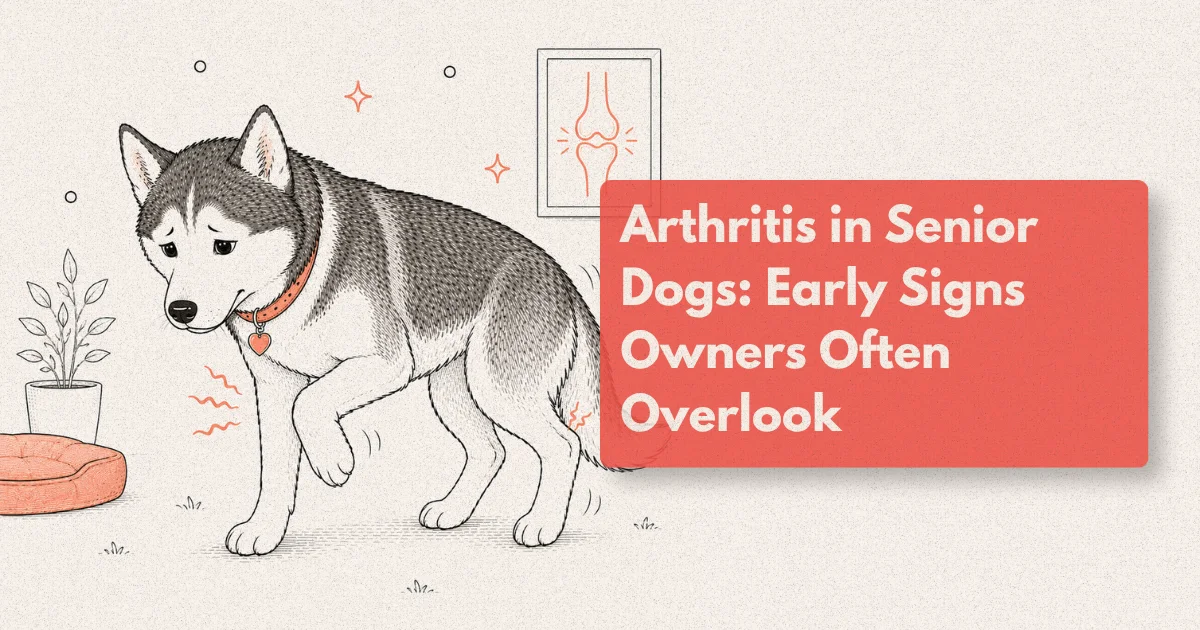
The most common chronic pain condition in senior dogs is also the one most consistently attributed to something else. Owners watch a nine-year-old Labrador slow on the morning walk, pause before the stairs, or stop jumping onto the sofa, and arrive at an explanation that feels reasonable: he is getting older. That interpretation is not wrong, but it is incomplete. In most cases, the behavioural change they are observing is not the inevitable consequence of age but a response to pain that is diagnosable, gradable, and treatable.
Canine osteoarthritis is estimated to affect approximately 20% of dogs over one year of age (Johnston, Veterinary Clinics of North America, 1997), with prevalence rising steeply with age. Bland (2015) reviewed available radiographic and clinical data and found that up to 80% of dogs over eight years show radiographic evidence of degenerative joint change. The clinical reality these figures describe is a condition of enormous prevalence that is still managed too late in too many patients because the early signs are not being recognised at the stage when early intervention is most effective.
What to Know
Osteoarthritis is the most prevalent chronic pain condition in dogs, affecting up to 80% of dogs over 8 years radiographically (Bland, The Veterinary Journal, 2015). Most owners attribute early signs to normal ageing. A structured arthritis in dogs assessment at the first signs of behavioural change enables pain management to begin before compensatory gait changes, muscle loss, and secondary joint involvement become established.
Why Arthritis Goes Unrecognised: The Masking Problem
Dogs do not verbalise pain. Their evolutionary history as social predators selected strongly against displaying weakness, and the behavioural repertoire they use to communicate discomfort is subtle, variable, and easily misread. A dog that vocalises when a painful joint is palpated is telling the clinician something directly. A dog that simply chooses to lie on the floor instead of the sofa is telling the owner something far easier to dismiss.
The conceptual barrier is the word “normal.” Once an owner frames a behaviour change within the category of normal ageing, it stops being a clinical signal and becomes background noise. Reluctance to rise from lying, slower pace on the lead, sleeping more, hesitation before steps, reduced interest in play, altered sitting posture with one leg extended, and difficulty grooming the hindquarters are all clinically meaningful early signs of musculoskeletal pain. They are also all behaviours that an owner without clinical framing will almost certainly attribute to the passage of time.
The veterinary contribution to this misrecognition problem is real. Studies consistently show that pain recognition and quality-of-life assessment in chronic canine conditions are underperformed at routine wellness visits (Epstein et al., JAAHA, 2015). Dogs that present for routine booster appointments in the absence of an acute complaint are rarely screened systematically for mobility change. The owner’s “he’s just getting old” is often accepted without the orthopedic screen that would establish whether there is a treatable cause for the functional decline.
From clinical practice: Dogs referred explicitly for “slowing down in old age” consistently produce the same pattern on structured examination: bilateral stifle or hip crepitus, pain response on deep hip extension, reduced range of motion in one or more joints, and mild but measurable hindlimb muscle atrophy. These dogs have been managing worsening osteoarthritis through behavioural compensation for months, sometimes longer. Introducing analgesia at this stage produces functional improvement that owners frequently describe as transformative but that could have been achieved earlier had the early behavioural signs been assessed clinically rather than attributed to age.
The Early Behavioural Signs: What to Look For
Recognising early dog arthritis symptoms requires a specific knowledge of what compensated musculoskeletal pain looks like in practice, because it rarely presents as obvious lameness. The Canine Brief Pain Inventory (CBPI), validated by Brown and colleagues (JAVMA, 2008), provides a structured framework for owners and clinicians to quantify pain severity and functional interference. Its value is that it makes explicit what owners are observing and translates qualitative impressions into measurable scores that can be tracked across visits.
Early signs that should prompt orthopedic assessment include: behavioural stiffness after rest, particularly on rising, that eases with gentle movement; reluctance to use stairs that was not present previously; altered gait on the first few minutes of a walk, improving as muscles warm; changes in posture during defecation; reduced jumping frequency or height; social withdrawal from play or interaction; altered sleep location, particularly a shift from raised surfaces to the floor; and any change in temperament, including low-level irritability, that the owner notices but cannot explain.
The last point deserves emphasis. Temperament change in a previously equable senior dog is one of the most consistently overlooked pain indicators. A dog that is mildly short-tempered with handling, reactive to contact in specific body regions, or reluctant to be groomed in areas that were previously accessible is giving a pain signal. Owners interpret it as personality change or “getting grumpy in old age.” Clinicians should treat it as a pain sign until proven otherwise.
Symmetric bilateral presentations are particularly deceptive. A dog with significant bilateral hip osteoarthritis may show no visible lameness because both hindlimbs are equally affected. The dog appears to move reasonably well, sits and rises with what looks like normal difficulty for an older dog, and presents no single limb that flags the problem. Gait scoring without a structured comparison to expected baseline mobility will miss this entirely.
Orthopedic Assessment: What a Diagnosis Actually Involves
Establishing a diagnosis of canine osteoarthritis requires more than a clinical impression. A structured orthopedic assessment covers visual gait analysis from multiple angles, standing posture and weight distribution, muscle mass comparison between limbs, range of motion assessment for all major joints, pain response on palpation and loading, and joint stability testing where indicated.
Radiography remains the standard imaging modality for confirming joint pathology. Periarticular osteophytes, joint space narrowing, subchondral sclerosis, and soft tissue thickening are all radiographically visible markers of degenerative joint disease. It is important to note, however, that radiographic severity does not reliably predict clinical pain severity. A dog with moderate radiographic changes may be in significant functional pain, while a dog with severe radiographic changes may be relatively functional if compensatory strategies have been effective. Clinical assessment and radiographic assessment must be integrated, not substituted for each other.
Force plate analysis and pressure-sensitive walkways, where available, provide objective, quantified measures of weight distribution and gait symmetry that are more sensitive than visual assessment for detecting subtle bilateral or compensated presentations. These tools are increasingly part of specialist orthopaedic and rehabilitation practice and are particularly valuable for monitoring treatment response over time.
Advanced imaging, including computed tomography (CT), is warranted in specific scenarios: joints where radiographic findings are ambiguous, suspected concurrent pathology (such as ligamentous rupture alongside osteoarthritis in the stifle), or surgical planning where three-dimensional anatomy is relevant. Magnetic resonance imaging is used for soft tissue assessment and articular cartilage evaluation in research and specialist contexts.
Pain Management in Dogs: The Multimodal Approach
Single-agent analgesia is not the standard of care for canine osteoarthritis. The multimodal pain management approach, which combines agents acting at different points in the pain pathway, produces better functional outcomes than any individual drug and allows lower doses of each component, reducing adverse effect risk.
The IVAPM/WSAVA pain management consensus (Epstein et al., JAAHA, 2015) establishes non-steroidal anti-inflammatory drugs (NSAIDs) as the foundational pharmacological component. Licensed veterinary NSAIDs are effective, predictable, and well-tolerated when used at appropriate doses in dogs without pre-existing renal or gastrointestinal disease. Baseline bloodwork before long-term NSAID use and periodic monitoring thereafter is standard practice, not a precaution reserved for visibly unwell patients.
Gabapentinoids (gabapentin, pregabalin) address the neuropathic pain component that is increasingly recognised as part of the chronic osteoarthritis pain experience. Central sensitisation, in which the nervous system amplifies pain signals from an arthritic joint beyond what the peripheral tissue damage would predict, is well-documented in canine osteoarthritis and is poorly addressed by NSAIDs alone. Adding a gabapentinoid to the protocol specifically targets this component.
Monoclonal antibody therapies targeting nerve growth factor (NGF) represent a significant development in canine arthritis management. Frunevetmab (Librela), licensed by the EMA and other regulatory authorities, is administered by monthly injection and produces measurable improvements in pain scores and activity levels with a favourable adverse effect profile. It is particularly relevant for dogs in which NSAIDs are contraindicated or in which NSAID response has been incomplete.
Nutraceuticals, specifically omega-3 fatty acids at therapeutic doses and veterinary-grade glucosamine/chondroitin preparations, have evidence at varying levels of quality. Fish oil at doses supplying 40-100mg/kg EPA+DHA has the strongest evidence base among nutraceuticals, with Roush and colleagues (JAVMA, 2010) demonstrating significant ground reaction force improvements in dogs with hip osteoarthritis. These should be considered adjuncts to, not substitutes for, pharmacological management in clinical disease.
Weight management deserves particular emphasis as a non-pharmacological intervention with strong evidence. Mlacnik and colleagues (JAVMA, 2006) demonstrated that weight loss combined with physiotherapy in overweight dogs with osteoarthritis produced significantly greater improvement in ground reaction forces than physiotherapy alone. Every kilogram of excess body weight increases load on arthritic joints; weight reduction is analgesic in a direct biomechanical sense.
Canine Rehabilitation: What the Evidence Supports
Canine rehabilitation has developed substantially over the past two decades from a largely empirical set of physical techniques into a specialty with a growing evidence base, credentialled practitioners, and defined outcome measures. The relevance to osteoarthritis management is that pharmacological analgesia and rehabilitation are not alternatives but complements: analgesia enables movement, and structured therapeutic movement preserves muscle mass, improves joint proprioception, and maintains the functional capacity that determines quality of life.
Hydrotherapy, delivered either as underwater treadmill (UWTM) or pool swimming, is the most widely used rehabilitation modality in canine practice. The buoyancy of water reduces joint loading while allowing full range of motion and progressive muscle engagement. Monk and colleagues (Veterinary Comparative Orthopaedics and Traumatology, 2006) reviewed outcomes in dogs with osteoarthritis receiving UWTM therapy and found significant improvements in limb use scores and gait symmetry. UWTM is particularly appropriate for dogs in which weight-bearing exercise is poorly tolerated, as the percentage of body weight supported can be titrated by water depth.
Therapeutic exercises, including proprioceptive training (balance boards, cavaletti rails, wobble cushions), controlled leash walking programmes, and specific strengthening exercises targeting affected muscle groups, form the core of land-based rehabilitation. Therapeutic laser (class IV) is used for its anti-inflammatory and analgesic tissue effects and has accumulated a reasonable evidence base for superficial joint pathology. Neuromuscular electrical stimulation (NMES) is indicated for muscle atrophy in dogs with reduced voluntary movement secondary to pain.
Manual therapy, including joint mobilisation and soft tissue massage, is used to maintain range of motion and address secondary myofascial tension that develops as a compensatory consequence of altered gait. Dogs with hip osteoarthritis, for example, characteristically develop lumbar paraspinal tension from the postural adaptations they use to offload painful hip extension, and this secondary tension is independently uncomfortable and independently treatable.
A rehabilitation programme for a dog with osteoarthritis should be designed by a qualified canine rehabilitation practitioner and should include a measurable functional assessment at each session. Gait score, muscle mass measurements, pain score, and functional task performance (sit-to-stand, stair ascent, stepping over obstacles) are all trackable indicators that allow the programme to be adjusted as the dog responds.
Environmental Adaptation and Daily Life Management
The single most commonly overlooked component of arthritis management in dogs is environmental modification. Pharmacological analgesia and rehabilitation address the biological and functional dimensions of the disease, but the dog spends most of its time outside the clinic, navigating a home environment that was designed for humans and is often directly hostile to painful joints.
Slippery flooring is the first priority. A dog managing moderate hip osteoarthritis can navigate polished wood or tile in controlled conditions but accumulates significant joint loading and compensatory muscle work across the dozens of low-stakes movements it performs daily. Non-slip matting on key routes, particularly near food bowls, sleeping areas, and exit points, reduces the unconscious protective tension the dog carries through every step.
Raised food and water bowls reduce the need for neck extension and shoulder loading during eating, which is significant in dogs with forelimb OA. Orthopedic memory foam beds with low sides remove the need for a painful step-in and provide joint-conforming pressure relief during the prolonged rest periods that senior dogs require. Ramps or steps at furniture or vehicle access points allow a dog to maintain social connection, the sofa, the car, the bed, without the compressive joint load of jumping.
Lead management matters. An arthritic dog should not be managed on a collar and lead combination that creates neck tension during gait. A well-fitted harness with a front or back attachment point distributes load and allows more natural forward movement. Walk duration should be regular and moderate: daily consistent exercise maintains synovial fluid production and muscle condition better than intermittent longer walks with days of rest in between.
Seasonal variation in pain levels is well-documented by owners and has some supporting evidence in human and veterinary osteoarthritis literature. Dogs that are well-controlled in summer may need protocol review in cold, damp weather. This is not anecdotal: cold-induced changes in synovial fluid viscosity and periarticular tissue tension are real physiological phenomena, and owner reports of seasonal worsening should be taken seriously rather than dismissed.
When Early Intervention Changes the Outcome
The argument for recognising and treating canine osteoarthritis early is not primarily about the dog’s comfort today, though that matters enormously. It is about trajectory. Osteoarthritis is a progressive disease in which untreated pain drives compensatory movement patterns that load adjacent joints abnormally, accelerates muscle atrophy, and through central sensitisation, lowers the pain threshold over time. A dog that has been managing unrecognised OA for two years through behavioural compensation will not respond to analgesia as readily as one in whom treatment was initiated at the first signs of functional change.
Central sensitisation is the mechanism that makes early intervention most urgent. In chronic pain states, the dorsal horn of the spinal cord undergoes neuroplastic changes that amplify incoming pain signals. These changes are partially reversible if pain is adequately treated early; they become increasingly difficult to reverse as the sensitised state is maintained over time. This is the neurological basis for the clinical observation that dogs presenting late in the course of OA often require higher analgesic doses and more intensive multimodal protocols to reach the same functional endpoint as dogs treated earlier.
The practical message is straightforward. Senior dog health checks, ideally from seven years of age in large breeds and nine in small breeds, should include a structured mobility assessment. This does not require specialist equipment. Watching the dog rise from lying, walk on a lead, and negotiate a few steps provides enough information to identify functional decline that warrants further assessment. The Canine Brief Pain Inventory takes less than five minutes to administer and provides a scored baseline against which future visits can be compared. For a condition affecting the majority of senior dogs, this level of systematic screening is not excessive.
Frequently Asked Questions
What are the earliest signs of arthritis in dogs?
The earliest signs are usually behavioural: stiffness on rising from sleep that eases after a few minutes of movement, reluctance to jump onto furniture the dog previously used freely, hesitation before stairs, a shortened stride or altered gait in the first minutes of a walk, and low-level changes in temperament or social engagement. Visual lameness is typically a later presentation — by the time a dog is visibly lame at rest, the condition has usually been present and progressive for some time.
At what age do dogs typically develop arthritis?
Prevalence rises steeply with age, but arthritis is not exclusively geriatric. Large and giant breeds are particularly susceptible from middle age, with hip and elbow dysplasia as primary risk factors. Dogs with orthopaedic injury, surgery, or conformational abnormalities may develop secondary osteoarthritis earlier. Routine mobility assessment is worthwhile from 7 years in large breeds and 9 years in smaller breeds.
Is arthritis in dogs painful? Can they really hide it?
Yes, and yes. Dogs are effective at behavioural compensation, adapting movement to reduce loading on painful joints. This can look like normal movement to an owner who does not know what to look for. Structured clinical assessment including palpation, range-of-motion testing, and gait analysis consistently identifies cases that owner observation alone misses.
What does arthritis treatment involve day to day?
For most dogs, effective management combines a licensed NSAID given daily with food, environmental modifications (non-slip flooring, orthopaedic bed, ramps), controlled regular exercise at an appropriate pace, and where available a structured rehabilitation programme. Monitoring includes watching for NSAID-related adverse effects and tracking functional indicators at home between visits. Most dogs on appropriate multimodal management maintain good quality of life for years after diagnosis.
My vet recommended hydrotherapy. Is it really effective?
The evidence base for underwater treadmill therapy and pool hydrotherapy in canine osteoarthritis is moderate to good, with multiple studies demonstrating improvements in limb use, gait symmetry, and muscle mass. Buoyancy reduces joint load while allowing therapeutic movement. It complements analgesic medication rather than replacing it, and frequency and duration should be guided by a qualified canine rehabilitation practitioner.