
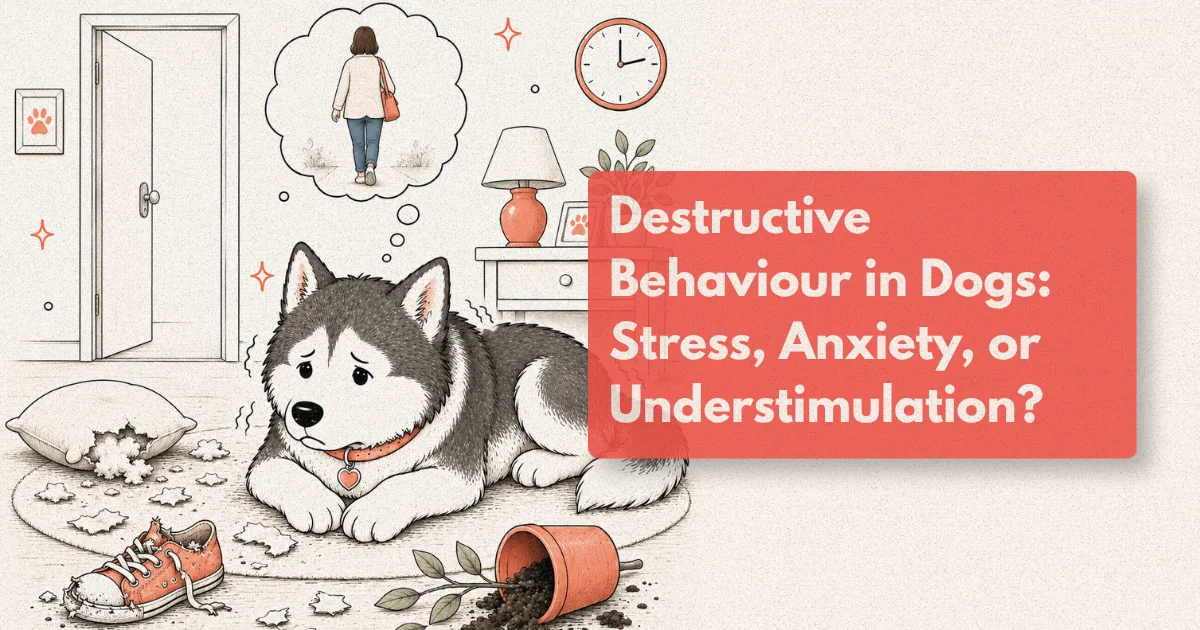
The damage is visible enough: the chewed skirting board, the dismantled sofa cushion, the scratched door frame. What’s far less visible is what caused it. And that distinction matters more than most owners realise, because a dog who destroys things when understimulated and a dog who destroys things out of separation anxiety require completely different responses. Treating topography without diagnosing root cause produces, at best, partial results.
Destructive behaviour is the most commonly cited reason for relinquishment of pet dogs in the UK and Ireland. It is also one of the most treatable presentations when assessed correctly. The first step is understanding that what looks like a behaviour problem on the surface is almost always a communication: the dog’s nervous system expressing something it cannot express any other way.
What to Know
Approximately 72% of dogs presenting with destructive behaviour have separation anxiety as a contributing factor, and 89% of those also vocalise when alone (Tiira & Lohi, Applied Animal Behaviour Science, 2015). Structured behaviour consultation with combined enrichment and pharmacological support produces measurable improvement in 89% of cases (Simpson et al., JAVMA, 2007). The root cause, not the behaviour itself, determines the path to resolution.
Reading What Destructive Behaviour Is Saying
A dog’s behaviour is always purposeful, even when the purpose is invisible. Before any management strategy can succeed, the presenting behaviour needs to be read in context: when it happens, what precedes it, how long it lasts, and what the dog’s physical state is before, during, and after the episode.
Three root causes account for the majority of destructive dog behaviour presentations in clinical practice. The first is anxiety, most often separation-related, where destruction functions as an oral displacement behaviour, a physical outlet for a nervous system in a state of threat. The second is understimulation, where an intact exploratory drive has no appropriate outlet and finds one in the available environment. The third is redirected frustration, often seen in high-drive breeds where physical and cognitive needs are not met, and arousal builds to a point where chewing or scratching becomes self-reinforcing.
What makes assessment complex is that these three root causes produce overlapping topographies. The dog chewing the doorframe could be anxious, bored, or both. The dog scratching the garden gate could be trying to escape out of separation distress, or trying to follow a scent trail because its foraging drive has nowhere else to go. Only systematic assessment separates them.
Blackwell and colleagues (Applied Animal Behaviour Science, 2008) found that 72% of owners with dogs showing fear-related and anxiety-related behaviours had not sought professional help. In many cases, the reason was not indifference. It was the assumption that the behaviour was a training problem rather than a clinical one.
When Anxiety Is the Engine
Anxiety-driven destructive behaviour has a characteristic profile. It tends to concentrate in the period immediately after the owner leaves, rather than being distributed across the day. It often accompanies other signs: vocalisation, pacing, self-directed behaviours, house soiling despite reliable toilet training, and refusal to eat when alone. Video assessment is often the single most informative diagnostic step: a camera left running when the owner departs will typically show the behavioural pattern within the first fifteen to thirty minutes.
Separation anxiety affects between 14% and 17% of dogs presenting to veterinary behaviour consultations (Overall & Dunham, JAVMA, 2002). Tiira and Lohi (AABS, 2015) found that among dogs with confirmed separation-related problems, destructive behaviour was present in 72% of cases, vocalisation in 89%, and soiling in 53%. These signs co-occur because they share a neurological origin: the activation of the threat-response system in an animal whose attachment figure is absent.
The neurological picture matters for management. A dog in an anxiety state is not making a calculated decision to chew the door. It is in a physiological condition where arousal is high, cortisol is elevated, and behavioural inhibition is suppressed. Punishment in this context is not only ineffective. It adds another aversive experience to an already aversive state, often worsening the anxiety trajectory over time.
From clinical practice: Video review regularly reveals something owners find surprising: dogs labelled as “bored destructors” are often not calm between episodes. They pace, whine intermittently, and return to the same spots repeatedly. The destruction is not the first sign of distress. It follows several minutes of clear anxiety indicators. The video changes the owner’s understanding entirely and changes the intervention that follows.
What distinguishes anxiety-driven destruction from understimulation-driven destruction most reliably is the temporal pattern. Anxiety-driven destruction clusters at departure and return transitions. Understimulation-driven destruction tends to be distributed across the day, involves a wider range of objects, and is typically accompanied by an otherwise calm resting state between episodes.
The Understimulation Diagnosis
A dog that receives adequate physical exercise but no cognitive engagement occupies a specific neurological state. The motivational systems are primed but unsatisfied. The exploratory drive, the foraging drive, and the social engagement drive are each intact and each seeking an outlet. When the environment provides none, the dog creates one from whatever material is available.
Tiira and Lohi (AABS, 2015) found that 72% of dogs presenting with problem behaviours, including destruction, had owners who described daily enrichment as low or moderate. Physical exercise alone was not protective. This finding aligns with what we know neurologically: physical exercise and cognitive engagement activate different neural pathways, and the absence of one is not compensated by the presence of the other.
Understimulation-driven destruction tends to be calm in character. The dog is not in distress. It is occupied. Items chewed are often selected for texture or residual scent rather than location. The dog typically rests before and after the episode and does not show the anticipatory anxiety indicators that precede anxiety-driven destruction. These distinctions matter diagnostically.
The same topographical behaviour (chewing furniture legs, for example) can stem from three completely different neurological states: anxiety-driven oral displacement, enrichment deficit where exploratory drive has no appropriate outlet, or a learned behaviour pattern that was inadvertently reinforced when the owner returned and inadvertently created a social interaction. Treating the topography without diagnosing which of these drives the behaviour produces partial results at best and, in the anxiety case, can make things worse.
Replacing one meal per day with a foraging delivery method, such as scatter feeding on a sniff mat or a frozen Kong, consistently reduces understimulation-driven destruction within one to two weeks in dogs without concurrent anxiety. The neurological explanation is simple: the exploratory drive is satisfied. The dog has no residual activation looking for an outlet.
What a Behaviour Consultation Involves
A behaviour consultation for destructive behaviour is not a training session. Its purpose is assessment: establishing which root cause drives the behaviour, whether anxiety, understimulation, or a combination, and building an intervention programme matched to that diagnosis.
A thorough consultation typically covers four areas. First, a detailed behavioural history: when the behaviour began, what the household configuration looks like, whether any changes preceded onset, and what management has already been attempted. Second, a functional assessment of the behaviour: video if available, owner description of the temporal pattern, and identification of any co-occurring signs. Third, an assessment of the dog’s current provision across the five enrichment domains: foraging, sensory, cognitive, social, and physical. Fourth, a review of the household’s capacity to implement and sustain a programme.
The Journal of Veterinary Behaviour (2022) found that structured behaviour consultations delivered by a certified animal behaviour consultant reduced owner-reported problem behaviours by 74% within twelve weeks. The improvement held at six months. What that data reflects is not magic. It reflects the difference between an owner trying to suppress a behaviour without knowing its cause, and an owner with a clear diagnosis and a protocol matched to it.
Referral to a veterinary behaviourist or certified clinical animal behaviourist is appropriate when: the behaviour has an established anxiety component, previous owner-directed management has not produced measurable change within four to six weeks, or the household complexity is significant (multiple dogs, children, recent major change). The behaviour consultation is not a last resort. It is the appropriate first response to a clinical presentation.
Anxiety Management: Building the Right Programme
Anxiety management in dogs is not a single intervention. It is a layered programme where each component addresses a different aspect of the anxiety profile. Getting the layers right, and applying them in the right order, determines whether the outcome is durable or temporary.
The first layer is environmental. Before any behaviour modification begins, the dog’s daily environment needs to provide enough cognitive engagement to keep the baseline arousal level manageable. An anxious dog in a chronically under-enriched environment is a dog whose threat system is already primed before any departure event occurs. Foraging enrichment, regular scent work, and predictable daily structure reduce that baseline.
The second layer is behaviour modification through systematic desensitisation to departure cues. This is gradual exposure to the triggers that precede owner absence (picking up keys, putting on shoes) in a context that does not lead to actual departure, repeated until the cues lose their predictive value. It is slow, requires consistency, and should not be rushed. Families that advance duration from five minutes to forty-five minutes in a week typically collapse weeks of progress.
The third layer is pharmacological support, where indicated. Simpson and colleagues (JAVMA, 2007) compared fluoxetine combined with behaviour modification against behaviour modification alone and medication alone. Combined treatment produced improvement in 89% of dogs, behaviour modification alone in 76%, and medication alone in 42%. The finding is clinically important: medication supports the modification programme. It does not replace it.
Situational anxiolytics, such as trazodone or gabapentin, have a role in high-arousal situations where longer-acting medication has not yet reached therapeutic effect. They don’t resolve the underlying anxiety, but they can prevent the acute events that otherwise interrupt the desensitisation process.
The timeline for anxiety management is longer than most owners expect. Fluoxetine takes four to six weeks to reach therapeutic plasma levels. Behaviour modification requires weeks of consistent practice before the dog’s neural associations change. Expecting resolution in two weeks is not realistic. Expecting substantial improvement in ten to twelve weeks with full programme adherence is.
When Anxiety and Understimulation Coexist
In practice, anxiety-driven and understimulation-driven destruction frequently occur together. This is partly a consequence of how the two states interact: a dog that is cognitively understimulated enters each day with higher residual arousal, which makes the anxiety response to departure more intense. The enrichment deficit amplifies the anxiety presentation.
Landsberg and colleagues (Behaviour Problems of the Dog and Cat, 2013) estimated that between 20% and 40% of destructive behaviour presentations have a combined primary anxiety and enrichment deficit component. That figure aligns with what behaviour consultations reveal regularly: dogs where enrichment alone would have resolved the behaviour if addressed earlier, but where chronic under-enrichment across months or years has allowed an anxiety pattern to become established alongside the deficit.
Managing the combined presentation requires sequencing the interventions correctly. Enrichment comes first, because improving cognitive provision reduces the baseline arousal level that anxiety responses build from. Behaviour modification follows, beginning only once enrichment is consistently in place and the dog’s daily arousal baseline is visibly lower. Pharmacological support is introduced in parallel with behaviour modification when the anxiety component is established enough to impede the modification process.
This sequencing is one reason self-directed owner management of combined presentations tends to produce slower results than professionally guided programmes. A behaviour consultation creates the map. Without it, the order of interventions is often guessed.
Frequently Asked Questions
How do I know if my dog's destructive behaviour is from anxiety or boredom?
The most reliable indicator is timing. Anxiety-driven destruction concentrates in the first 15-30 minutes after the owner leaves, often with vocalisation and pacing. Understimulation-driven destruction is distributed across the day with a calmer resting state between episodes. Short video recording during absences is the most informative diagnostic step.
Can punishment stop destructive behaviour?
No. Punishment applied after the fact has no corrective value because the dog cannot connect it to the behaviour during the owner’s absence. In anxiety-driven presentations, punishment worsens the anxiety. Positive reinforcement-based approaches consistently produce better outcomes and fewer adverse effects.
How long does it take for behaviour modification to resolve destructive behaviour?
Pure understimulation-driven destruction can show improvement within 1-2 weeks of structured enrichment. Anxiety-driven destruction with a behaviour modification programme typically shows substantial improvement in 10-12 weeks with consistent owner adherence. Pharmacological support can accelerate progress by reducing the arousal baseline.
At what age does destructive behaviour usually start?
Adolescence (6-18 months) is the most common onset window, coinciding with peak exploratory drive and maturation of fear circuitry. New-onset destruction in adult dogs typically signals an environmental or routine change. New-onset destruction in a senior dog warrants veterinary assessment to rule out pain and cognitive dysfunction.
What should I do if behaviour management isn't working after six weeks?
Seek a behaviour consultation with a certified clinical animal behaviourist or veterinary behaviourist. Six weeks without measurable improvement suggests an incorrect root cause assessment, an incomplete programme, or an anxiety component requiring pharmacological support. Structured consultations produce measurable improvement in 74% of cases within 12 weeks (JVEB, 2022).