
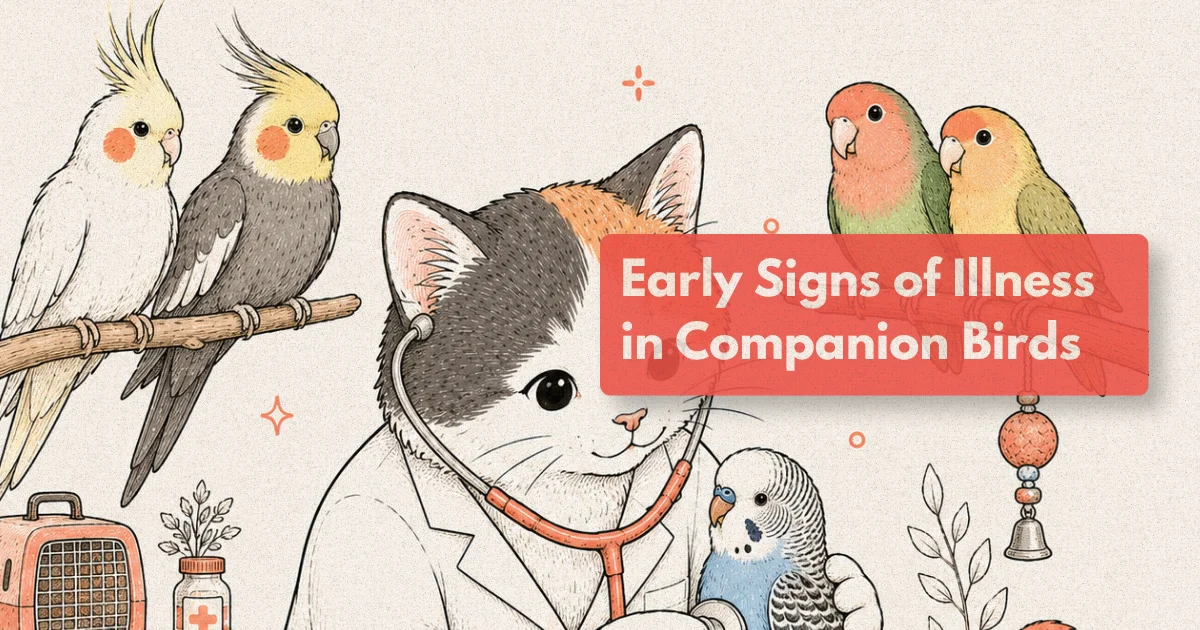
Companion birds are among the most rewarding animals to keep and among the most clinically challenging to assess. The core difficulty is one of evolutionary design: birds are prey species, and the biological imperative to conceal weakness from predators is deeply embedded. A parrot, cockatiel, or budgerigar that is unwell has strong instinctive pressure to behave as normally as possible for as long as possible. The bird on the perch that looks alert and is vocalising may already be in significant physiological distress, compensating by drawing on energy reserves that are limited. The bird that finally appears obviously unwell, fluffed and motionless on the cage floor, is often a bird that is hours from death rather than hours from the beginning of illness.
This masking phenomenon is the most important single fact in avian medicine, and it shapes every aspect of how a clinician and an owner should approach companion bird health. The early warning signs of illness in birds are behavioural and subtle; the late signs are physical and dramatic. An owner who waits for obvious signs is waiting far too long. A practitioner who does not actively elicit the history that reveals early signs will miss the window in which intervention has the best probability of success.
What to Know
In prey species including psittacines, clinicians estimate that a bird presenting with obvious signs of illness has typically been unwell for a minimum of 24 to 72 hours and in many cases longer (Harrison & Lightfoot, Clinical Avian Medicine, 2006). A sick pet bird showing fluffed feathers, reduced vocalisation, or changes in droppings requires same-day veterinary assessment: these are not mild early signs. In avian medicine, they are signs of a bird in active decompensation.
Why Birds Hide Illness Until It Is Critical
The prey species masking response is not a behaviour that birds choose or can easily override. It is a deeply wired response driven by the fact that, in the wild, a bird that appears weak is targeted by predators and expelled from the flock. Both consequences are lethal. The bird that looks normal survives. The instinct to maintain the appearance of normality under physiological stress is therefore not a cognitive decision but an automatic, survival-driven physiological state.
The practical clinical consequence is that the visible change from “normal” to “obviously sick” in a bird is far shorter than in most other species. A dog with early renal disease may show gradual, progressive changes over weeks or months before an owner is concerned enough to seek veterinary attention, and still have a reasonable prognosis at that point. A bird with early renal, hepatic, or infectious disease may show no observable change for days to weeks, then cross the threshold into visible illness rapidly as its compensatory capacity fails. By that crossing, the disease has already progressed significantly.
This is why experienced avian practitioners treat any departure from a bird’s individual normal as a clinical concern rather than a mild observation. The question that matters is not “is this bird obviously sick?” but “is this bird behaving exactly as it normally does?” If the answer to the second question is no, in any direction, the bird warrants assessment.
Behavioural Changes: The Earliest Warning Signs
Behavioural changes are the first category of signs to appear in a sick pet bird, and they are the changes most commonly dismissed by owners as “a bit off today” or attributable to environmental factors. Identifying these signs correctly requires that an owner knows their bird’s individual baseline well enough to detect deviations from it. This is an argument for attentive daily observation as an active health practice rather than a passive one.
Reduced vocalisation is one of the most consistent early signs of illness across psittacine species. A bird that normally greets its owner with vocalisations, participates in household noise, or engages in regular contact calls, and that has become quieter than its baseline without any environmental change to explain it, is a bird that warrants attention. The reduction does not need to be dramatic. A cockatiel that is normally noisy and has been quiet for a day and a half is showing a clinically meaningful change.
Altered sleep posture and duration. Healthy birds typically sleep on one foot with the other leg tucked against the body, head rotated to tuck the beak into back feathers. A bird sleeping on two feet with its feathers slightly puffed and eyes half-closed during normal waking hours is using a posture that reduces energy expenditure because it needs to. Increased sleeping during daylight hours, or sleeping in unusual locations (on the cage floor rather than a high perch), are both clinically meaningful changes.
Changes in food and water consumption. An increase or decrease in water intake may be apparent from water bowl levels, and polydipsia in a bird has the same diagnostic significance as in mammals, suggesting renal disease, diabetes mellitus, or psittacosis among other conditions. Reduced food consumption is often first apparent to owners as less debris below the food bowl or a less depleted seed or pellet dish. Complete anorexia in a bird is an emergency; partial or selective reduction in food intake warrants prompt assessment.
Reduced interaction and altered social engagement. A bird that normally solicits handling, responds to the owner’s presence, or participates in environmental activities and has become withdrawn, disinterested, or reactive is showing a behavioural change that reflects altered central nervous system or systemic function. This change is frequently attributed to “mood” or “being grumpy” by owners, particularly in parrots, which have complex and individually variable social behaviour. The clinician’s role is to establish whether the behavioural change is new and consistent or whether it fits a known pattern for the individual bird.
What Droppings Tell You: A Daily Diagnostic Window
The droppings of a companion bird are one of the most consistently informative and consistently underutilised clinical data sources available to the attentive owner. Avian droppings have three distinct components: the faecal component (the solid, typically green or brown central material produced by the intestinal tract), the urate component (the white or cream-coloured solid material representing uric acid excreted by the kidneys), and the urine component (the liquid fraction, which may be minimal or absent on absorbent substrates).
Changes in any of these three components carry diagnostic significance. Green or yellow discolouration of the urates is associated with hepatic disease, particularly hepatic lipidosis or chlamydiosis. Bright red blood in the droppings suggests intestinal, cloacal, or uterine haemorrhage. Frank bile staining, producing an overall bright lime-green discolouration of the droppings as a whole, is associated with hepatitis or significant systemic infection. Black or very dark faecal material may suggest digested blood from the upper digestive tract.
Changes in the urine fraction are equally informative. Polyuria, an increase in the liquid component of the droppings producing a large watery halo around the faecal and urate components, can reflect dietary change (fruit-heavy diets normally produce more liquid droppings), stress, renal disease, psittacosis, or diabetes. Establishing dietary context is essential before attributing polyuria to disease, but persistent polyuria on an unchanged diet warrants investigation.
Changes in faecal character, including undigested food material, changes in colour from the baseline, or abnormally small faecal amounts, reflect intestinal function. An owner who lines the cage with white paper and checks the droppings daily has a substantially better early-warning system than one using coloured substrates or not examining droppings regularly.
Respiratory Signs in Companion Birds
Respiratory signs in birds are anatomically and physiologically distinct from those in mammals, and recognising them correctly requires understanding that the avian respiratory system operates under different mechanical principles. Birds do not have a muscular diaphragm. Respiratory movement involves the entire thoracoabdominal region, with the air sac system acting as a bellows that moves air through the lung in a unidirectional flow pattern. Any condition that impairs air sac capacity or airway patency produces a pattern of increased respiratory effort that is characteristically visible as whole-body movement.
Tail bobbing is the most clinically important respiratory sign in companion birds and one of the most commonly missed by owners. Each respiratory cycle in a bird with laboured breathing produces a visible downward movement of the tail. This occurs because the bird is using accessory respiratory muscles to compensate for reduced air sac compliance or airway obstruction, and the mechanical effort of this compensation moves the tail. Tail bobbing at rest, not associated with vocalisation or movement, is a sign of respiratory compromise that requires urgent veterinary assessment.
Open-mouth breathing in a bird that is at rest and not overheated is an emergency sign. Birds resort to open-mouth breathing as a last-resort compensation for severe respiratory compromise. A bird breathing with its beak open at room temperature has very limited remaining respiratory reserve.
Voice changes are an early and often overlooked respiratory sign in psittacines. A parrot whose vocalisation quality has changed, whose voice is rougher, quieter, or altered in pitch, may have tracheal or syringeal disease. Aspergillosis frequently affects the syrinx and trachea before it becomes visible on imaging, and a voice change in a parrot from a humid or poorly ventilated environment is an indication for assessment including endoscopy and fungal culture.
Nasal discharge and perinasal staining are visible signs of upper respiratory tract disease. Rhinitis in birds produces a watery to mucoid discharge that may stain the feathers around the nares. Chlamydophila psittaci, the causative organism of psittacosis, commonly produces upper respiratory signs in addition to systemic signs, and any bird with nasal discharge should be screened for chlamydiosis given its zoonotic significance.
From clinical practice: The bird that is brought in “because it’s been a bit quiet for two days” and is found on examination to have a respiratory rate almost twice its expected resting rate, visible tail movement with each breath, and on auscultation a significant increase in respiratory noise over the caudal air sacs is one of the most instructive presentations in avian medicine. To the owner, the bird had been “a bit quiet.” To the bird, it had been under severe physiological stress for 48 hours, managing its air sac aspergillosis with the entire suite of compensatory mechanisms available to it. The tail movement had been present throughout, visible on video footage the owner had taken the day before, but neither they nor three people they had shown it to had recognised it as a clinical sign. Teaching owners to actively watch for tail bob at rest is one of the highest-yield single pieces of preventive education in companion bird medicine.
Weight Loss Without Visible Wasting
Weight loss is the clinical sign that, when present, most reliably indicates that a bird has been systemically unwell for a significant period. Birds are small, and the absolute weight changes that reflect clinically meaningful disease are correspondingly small: a budgerigar losing 5 grams has lost a significant fraction of its total body weight, but that loss is invisible to an owner who is not weighing the bird regularly.
The keel bone assessment provides a rough clinical estimate of body condition. In a bird at ideal body condition, the keel bone (the prominent central ridge of the sternum) is palpable but has roughly equivalent muscle mass on either side of it. A bird with muscle wasting severe enough to be palpable clinically has already lost a significant body mass. Moderate wasting, the phase in which intervention has the best return, is not detectable by keel palpation alone.
Crop assessment provides a functional measure of upper gastrointestinal motility. A crop that is not emptying within the expected time frame after feeding, remaining full or partially full hours after it should have emptied, indicates a problem with gastric motility, proventricular disease, or systemic illness producing reduced GI function. Crop stasis in a bird has similar implications to GI stasis in a rabbit: it is a sign of serious underlying disease until proven otherwise.
The home scale as a clinical instrument: Weekly body weight measurement at home using a digital kitchen scale is the single highest-yield change an owner of a companion bird can make to their health monitoring practice. A bird weighed every seven days, with the weight recorded in a simple log, will show a weight-loss trend that becomes detectable three to four weeks before any clinical sign is visible. In more than a decade of avian practice, some of the most successful early interventions have been in birds presented specifically because the owner’s weight log showed a 5 to 8% decline over three weeks, with no other sign. In several cases, the presenting weight at the time of examination was within normal range, but the trend revealed the disease trajectory that examination alone would have missed entirely. The cost of this tool is under five hundred rupees; the clinical intelligence it provides is comparable to a significant fraction of what a wellness blood panel achieves.
The Avian Emergency: Signs That Cannot Wait
Certain presentations in companion birds require immediate veterinary attention without any period of observation. These are signs that indicate a bird is in active decompensation, meaning its compensatory mechanisms have failed or are near failure, and the clinical window for effective intervention is very short.
A bird found on the cage floor is an emergency. Birds do not go to the floor voluntarily except for specific behavioural reasons; a bird sitting on the floor without a behavioural explanation is a bird that is too weak to maintain a perch position. Any bird found on the floor should receive emergency veterinary assessment the same day.
Active bleeding from any site requires immediate attention. Birds have a relatively small blood volume proportional to their body weight, and blood loss that would be minor in a mammal can be life-threatening in a small bird within a short period.
Prolapse of the cloaca, oviduct, or intestinal tissue is a surgical emergency. Exposed tissue desiccates rapidly, becomes contaminated, and sustains ischaemic damage within a short period of exposure. The tissue should be kept moist with sterile saline-dampened gauze during transport, and the bird should reach a veterinary facility as quickly as possible.
Trauma including predator attack, window collision, or escape injury should be assessed emergently. Birds frequently do not show the full extent of trauma-related injury immediately, due to adrenaline-mediated compensation, and may appear less severely affected at the time of the incident than they will within the following hour.
Suspected toxin ingestion, including heavy metal ingestion (zinc and lead from cage components, curtain weights, and paint), avocado, xylitol, or smoke inhalation, should be treated as an emergency regardless of the bird’s apparent clinical status at the time of owner concern.
Avian Wellness Screening: What an Annual Visit Should Include
The annual wellness examination for a companion bird should be designed to identify disease at a stage where intervention is meaningful, which in avian medicine means identifying disease before overt clinical signs appear. This requires a structured approach that goes beyond the physical examination.
A minimum wellness protocol for a healthy adult companion bird includes: a full physical examination with body weight and body condition score; choanal swab cytology and culture for respiratory tract assessment; cloacal swab for gram stain and culture; faecal examination for parasites and abnormal flora; and a targeted history review of husbandry, diet, environment, and any subtle behavioural changes the owner has observed. Blood sampling, providing a complete blood count and biochemistry panel, is indicated annually from middle age onwards and in any bird with any clinical concern, however subtle.
Species-specific screening warrants separate discussion. Psittacine beak and feather disease (PBFD), caused by circovirus, is highly contagious, incurable, and prevalent in many psittacine populations worldwide. DNA testing from whole blood or feather follicle samples provides diagnosis, and screening of any new bird before introduction to an established collection is standard in responsible aviculture. Polyomavirus screening similarly identifies birds that are shedding a potentially fatal pathogen before they show signs themselves.
Psittacosis screening by serology or PCR for Chlamydophila psittaci is important in any bird with respiratory signs, weight loss, or changes in droppings, and in birds from markets, rescue centres, or multiple-bird environments. Psittacosis is a notifiable zoonotic disease in most countries, and its clinical significance in human contacts, particularly immunocompromised individuals, makes its identification a public health as well as a clinical priority.
Nutritional assessment is part of every avian wellness visit. The companion bird diet has historically been seed-dominant, and nutritional deficiencies from seed-only diets, particularly hypovitaminosis A, are a consistent background factor in avian respiratory, reproductive, and immune health. A diet transition assessment, encouraging the owner toward a formulated pellet base with fresh vegetables as the primary components rather than seeds, is one of the highest-impact preventive recommendations in companion bird medicine.
Frequently Asked Questions
How do I know if my bird is sick?
The earliest signs are usually behavioural: reduced vocalisation, increased daytime sleeping, sleeping on two feet instead of one, reduced interaction, and changes in food or water consumption. Changes in droppings, altered urate colour, increased liquid, or decreased faecal volume are also early indicators. A bird showing any of these signs for more than 24 hours, or showing physical signs such as fluffed feathers, tail bobbing, or laboured breathing, should be seen by a veterinarian the same day.
What does tail bobbing in a bird mean?
Tail bobbing at rest means a visible downward movement of the tail with each breath when the bird is perched quietly. It indicates the bird is working harder than normal to breathe, using accessory muscles to compensate for reduced respiratory capacity. This is a sign of respiratory compromise requiring prompt veterinary assessment. It should not be confused with the normal tail movement that accompanies vocalisation.
Why do bird droppings change colour?
Dropping colour changes reflect changes in the three components: faeces, urates, and urine. Green or yellow discolouration of the normally white urate portion indicates liver disease or psittacosis. Bright red blood suggests intestinal or cloacal haemorrhage. Lime-green overall discolouration occurs with bile staining from hepatitis or anorexia. Diet also temporarily affects colour, and fresh berries or vegetables can cause changes that are not disease-related.
How often should companion birds see a veterinarian?
Healthy companion birds benefit from annual wellness examinations with an avian-experienced veterinarian. Larger psittacine species should transition to twice-yearly examinations from middle age onwards. Any bird showing behavioural changes, changes in droppings, or reduced food intake should be seen promptly regardless of when the last examination was. Finding an avian-experienced practitioner before an emergency occurs is important, as general practices may have limited avian diagnostic capability.
Can birds catch diseases from their owners or from other pets?
Yes. Psittacosis (Chlamydophila psittaci) is a zoonotic disease transmissible from birds to people. Birds and mammals do not share most species-specific infections, but birds in households with cats and dogs face stress and risk from predator proximity that can suppress immune function. Cat bites and scratches are bacteriologically serious for birds; even apparently minor cat-contact trauma requires veterinary assessment for Pasteurella contamination.