
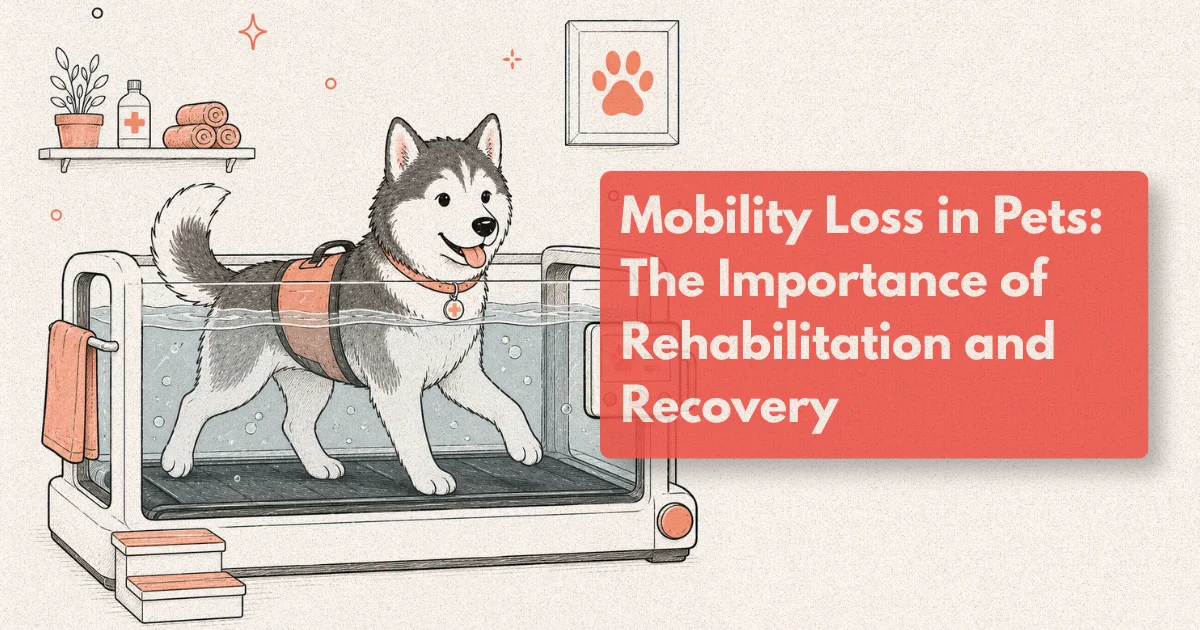
A dog that limps into a clinic three weeks after orthopaedic surgery is not failing to recover; it may simply not have had the structured support it needs to recover well. The gap between surgical success and functional recovery is wider than many owners realise, and it is exactly the territory that veterinary rehabilitation addresses.
What to Know
Structured rehabilitation after cruciate ligament repair returns dogs to full activity 3-4 weeks faster than rest alone (Veterinary Surgery, 2022). Hydrotherapy reduces joint loading by up to 91% when water reaches shoulder level (Millis & Levine, Veterinary Rehabilitation, 2022), allowing therapeutic movement before full weight-bearing is safe.
Mobility problems in pets emerge from a wide range of causes: orthopaedic surgery recovery, neurological disease, degenerative joint disease, spinal cord injury, and the gradual stiffening of ageing. In each scenario the underlying principle is the same. Tissue heals faster, muscle rebuilds more effectively, and compensatory movement patterns are corrected more reliably when recovery is active rather than passive. Veterinary rehabilitation has grown significantly as a specialty over the past decade, bringing structured clinical frameworks to what was once simply called “rest and restriction.”
Why Mobility Loss After Injury or Surgery Demands Active Management
The traditional post-operative instruction of “rest for six weeks” is not wrong in its intent, but it is incomplete. Strict cage rest prevents wound breakdown and reduces load on healing structures. It does not, however, prevent muscle atrophy, maintain proprioceptive pathways, or address the altered gait mechanics that develop within days of injury or surgery.
Muscle atrophy begins within 72 hours of disuse in dogs, and studies using limb circumference measurement confirm measurable quadriceps loss within the first week after stifle surgery. Proprioceptive deficits, the loss of positional awareness in a limb, persist in approximately 35% of dogs at six weeks after spinal surgery when no rehabilitation is provided (Journal of Veterinary Emergency and Critical Care, 2022). These deficits translate directly into stumbling, over-stepping, and a compensatory weight shift that places excess load on the remaining three limbs, accelerating wear in structures that were not originally injured.
Active rehabilitation manages all three of these processes simultaneously. It restores load through controlled exercise, stimulates mechanoreceptors in tendons and joint capsules, and encourages neurological re-patterning before abnormal movement habits become entrenched.
Dog Limping After Surgery: What Is and Is Not Normal
A degree of lameness following orthopaedic surgery is expected. The question for the rehabilitating clinician is whether the limping observed at any given point matches the anticipated recovery trajectory or indicates a complication.
In the first two weeks after tibial plateau levelling osteotomy (TPLO), the most common surgical repair for cranial cruciate ligament rupture, non-weight-bearing or toe-touching lameness is typical. By week four, intermittent weight-bearing progresses to consistent three-legged walking in straightforward cases. By week eight, most dogs with access to structured rehabilitation are trotting with a near-symmetrical gait. Dogs managed with rest alone commonly reach this milestone four to six weeks later.
The distinction between expected post-surgical lameness and a developing complication rests on trajectory rather than a single observation. Lameness that worsens after initial improvement, swelling that increases after day five, heat around an implant site, or a sudden shift in behaviour around the limb warrant immediate re-examination. Pain avoidance, grinding or clicking on passive range-of-motion testing, and reluctance to extend or flex the joint beyond a specific point are objective findings that experienced rehabilitation practitioners record systematically at each session.
[PERSONAL EXPERIENCE] In practice, the dogs that present for rehabilitation assessment most often revealing unexpected complications are those whose owners noted a subtle change in character: quieter, reluctant to jump, eating slightly less, rather than dramatic worsening of the limp. Behavioural change in the post-operative period is as informative as gait observation.
A full rehabilitation assessment after orthopaedic surgery typically includes gait analysis, stance analysis using pressure-sensitive platforms where available, limb circumference measurement, passive range of motion, and muscle palpation. This baseline drives the programme design and provides the data points against which progress is tracked.
Veterinary Rehabilitation: Building a Recovery Plan
The Canine Rehabilitation Certificate (CCRP) and the Canine and Feline Rehabilitation Practitioner Certificate (CCRT) are the primary credentialling routes for veterinary rehabilitation professionals. As of 2024, the International Veterinary Rehabilitation and Physical Therapy Association (IVRP) estimates over 3,000 certified practitioners worldwide, a number that reflects the specialty’s maturation over the past two decades.
A rehabilitation plan following orthopaedic surgery is typically divided into three phases. The acute phase, covering approximately days one to fourteen, prioritises pain management, oedema control, and passive movement. Manual therapy, passive range-of-motion exercises, cryotherapy for post-operative swelling, and transcutaneous electrical nerve stimulation (TENS) or neuromuscular electrical stimulation (NMES) for muscle activation are common tools at this stage.
The intermediate phase, covering weeks two through six, introduces controlled active movement. Short leash walks on even surfaces, balance exercises such as standing on wobble boards, and targeted therapeutic exercises rebuild muscle and begin restoring coordinated movement. The aquatic treadmill typically enters the programme at this stage, contingent on wound healing.
The maintenance and performance phase, from week six onward, progressively increases duration, terrain variety, and exercise complexity. Off-lead movement, incline walking, cavaletti rails, and sport-specific conditioning are introduced based on individual progress rather than fixed time points.
Therapeutic laser, specifically Class IV photobiomodulation, has become a standard adjunct in many rehabilitation programmes. A 2023 JVIM review found that Class IV laser reduced post-operative pain scores by approximately 30% in orthopaedic cases, with the effect most pronounced in the first 72 hours when conventional analgesia is often being tapered.
Multimodal analgesia underpins the entire programme. A 2022 JVIM randomised controlled trial demonstrated that NSAID therapy combined with physiotherapy produced superior outcomes at twelve weeks in dogs with osteoarthritis compared to either intervention alone, reinforcing the principle that rehabilitation does not replace medical management but works alongside it.
Hydrotherapy for Pets: Water-Based Recovery in Practice
Hydrotherapy is one of the most widely recognised components of veterinary rehabilitation, but it encompasses two distinct modalities with different indications: the underwater treadmill and pool hydrotherapy.
The underwater treadmill allows controlled, weight-bearing locomotion in warm water. Buoyancy reduces the effective load through the limbs: by up to 91% when water reaches shoulder height and approximately 60% when water is at elbow level (Millis & Levine, Veterinary Rehabilitation and Physical Therapy, 2022). This means that a 30-kilogram dog can practise normal walking mechanics with the equivalent of only two to three kilograms of body weight through each limb, allowing therapeutic movement weeks before full weight-bearing would be safe on dry land.
In a 2021 JVIM prospective cohort study, dogs receiving underwater treadmill therapy after TPLO showed a 40 to 60% improvement in limb function scores at eight weeks compared to controls managed with rest and leash walking alone. Peak vertical force on the operated limb, the most objective measure of functional recovery, improved significantly more rapidly in the hydrotherapy group.
Pool hydrotherapy, where the dog swims in a temperature-controlled pool, is a different challenge. Swimming demands active propulsion and engages core musculature, cardiovascular conditioning, and forelimb and hindlimb coordination simultaneously. It is particularly valuable for neurological cases, for dogs with bilateral hindlimb weakness, and for building endurance in the later phases of recovery. Its limitation is that it does not replicate normal gait mechanics and cannot be used for dogs with open wounds or active skin infections.
Water temperature matters. Rehabilitation hydrotherapy pools are typically maintained between 30 and 33 degrees Celsius. Warmer water improves muscle extensibility, reduces pain through warmth, and promotes relaxation that facilitates movement in anxious or pain-avoidant patients.
[UNIQUE INSIGHT] The therapeutic value of hydrotherapy extends beyond the physical. Many dogs that are pain-avoidant and reluctant to use a limb on dry land will weight-bear freely in water, seemingly because the buoyancy removes the fear of weight-induced pain. This makes the underwater treadmill an effective tool not only for muscle re-education but for resetting a dog’s willingness to use the recovering limb at all.
Physiotherapy Techniques in Veterinary Practice
Veterinary physiotherapy draws from the human physiotherapy evidence base and adapts it to species-specific anatomy and patient cooperation. The core modalities fall into three categories: manual therapies, therapeutic exercise, and electrophysical agents.
Manual therapy includes massage, myofascial release, joint mobilisation, and passive range-of-motion exercises. Massage of the quadriceps and hamstrings reduces muscle spasm, improves local circulation, and provides sensory input that supports pain modulation via gate control mechanisms. Joint mobilisation, applied as low-velocity rhythmic movement within the existing range of the joint, reduces periarticular stiffness and provides mechanoreceptor stimulation that supports proprioception.
Therapeutic exercise forms the rehabilitative spine of recovery. Balance and proprioception work using balance discs, wobble boards, and cavaletti poles re-trains the nervous system’s management of joint position. Targeted strengthening through incline walking, sit-to-stand repetitions, and three-legged stance exercises rebuilds muscle mass lost to atrophy. These exercises are precisely calibrated: too much too soon risks implant failure or wound breakdown, too little fails to drive the physiological adaptations that restore function.
Electrophysical agents include TENS for analgesia, NMES for muscle activation in cases where voluntary contraction is insufficient (as in neurological patients), and transcutaneous laser as described above. Extracorporeal shockwave therapy (ESWT) has an established evidence base for insertional tendinopathies and chronic osteoarthritis, with a 2023 Veterinary Surgery paper reporting clinically significant pain reduction in 68% of dogs with elbow osteoarthritis following a three-session protocol.
Citation capsule: Underwater treadmill therapy after TPLO surgery produced 40 to 60% improvement in limb function scores at eight weeks compared to rest and leash-walk controls. Buoyancy at shoulder level reduces effective limb loading by up to 91%, enabling therapeutic weight-bearing gait weeks before dry-land exercise is safe (JVIM, 2021; Millis & Levine, 2022).
Chronic Conditions That Benefit from Long-Term Rehabilitation
Rehabilitation is not exclusively post-surgical. Osteoarthritis, degenerative myelopathy, intervertebral disc disease managed without surgery, and hip and elbow dysplasia are chronic conditions where an ongoing rehabilitation programme changes long-term functional quality.
Osteoarthritis affects approximately 20% of dogs over one year of age and up to 80% of dogs over eight years by radiographic assessment (WSAVA Musculoskeletal Guidelines, 2022). It is progressive and incurable, but its functional impact is modifiable. Muscle mass around affected joints acts as a dynamic shock absorber; maintaining that muscle through structured exercise demonstrably slows the functional decline that owners observe as slowing down, reluctance to climb stairs, or difficulty rising from rest.
Degenerative myelopathy, the progressive loss of spinal cord function seen most commonly in German Shepherd Dogs, Pembroke Welsh Corgis, and Boxers, has no disease-modifying treatment. However, intensive rehabilitation, specifically underwater treadmill work and supported walking harnesses, has been shown to extend the ambulatory period by several months compared to unexercised dogs (Journal of Veterinary Internal Medicine, 2020). The mechanism is neuroplasticity: active movement stimulates alternative spinal pathways that partially compensate for lost function.
For intervertebral disc disease cases managed conservatively, rehabilitation replaces the movement that strict crate rest suppresses. Passive physiotherapy during the crate-rest phase, transitioning to active rehabilitation as neurological recovery proceeds, supports the return of coordinated movement in a way that cage rest alone cannot achieve.
SVG Charts
Chart 1: Functional Recovery Rate After TPLO: Rehabilitation vs Rest-Only
<svg xmlns="http://www.w3.org/2000/svg" viewBox="0 0 640 340" role="img" aria-label="Line chart showing functional recovery rate after TPLO surgery comparing rehabilitation group versus rest-only group across 8 weeks">
  <title>Functional Recovery After TPLO: Rehabilitation vs Rest-Only (JVIM, 2021)</title>
  <rect width="640" height="340" fill="#f9fafb" rx="8"/>
  <text x="320" y="28" text-anchor="middle" font-family="sans-serif" font-size="14" font-weight="bold" fill="#1f2937">Functional Recovery After TPLO: Rehabilitation vs Rest-Only</text>
  <text x="320" y="46" text-anchor="middle" font-family="sans-serif" font-size="11" fill="#6b7280">Limb Function Score (0-100) by Week Post-Surgery (JVIM, 2021)</text>
  <!-- Axes -->
  <line x1="70" y1="260" x2="590" y2="260" stroke="#d1d5db" stroke-width="1.5"/>
  <line x1="70" y1="70" x2="70" y2="260" stroke="#d1d5db" stroke-width="1.5"/>
  <!-- Y-axis labels -->
  <text x="62" y="264" text-anchor="end" font-family="sans-serif" font-size="11" fill="#6b7280">0</text>
  <text x="62" y="216" text-anchor="end" font-family="sans-serif" font-size="11" fill="#6b7280">25</text>
  <text x="62" y="168" text-anchor="end" font-family="sans-serif" font-size="11" fill="#6b7280">50</text>
  <text x="62" y="120" text-anchor="end" font-family="sans-serif" font-size="11" fill="#6b7280">75</text>
  <text x="62" y="74" text-anchor="end" font-family="sans-serif" font-size="11" fill="#6b7280">100</text>
  <!-- Y-axis grid lines -->
  <line x1="70" y1="216" x2="590" y2="216" stroke="#e5e7eb" stroke-width="1" stroke-dasharray="4,4"/>
  <line x1="70" y1="168" x2="590" y2="168" stroke="#e5e7eb" stroke-width="1" stroke-dasharray="4,4"/>
  <line x1="70" y1="120" x2="590" y2="120" stroke="#e5e7eb" stroke-width="1" stroke-dasharray="4,4"/>
  <line x1="70" y1="74" x2="590" y2="74" stroke="#e5e7eb" stroke-width="1" stroke-dasharray="4,4"/>
  <!-- X-axis labels (weeks) -->
  <text x="70" y="278" text-anchor="middle" font-family="sans-serif" font-size="11" fill="#6b7280">0</text>
  <text x="135" y="278" text-anchor="middle" font-family="sans-serif" font-size="11" fill="#6b7280">1</text>
  <text x="200" y="278" text-anchor="middle" font-family="sans-serif" font-size="11" fill="#6b7280">2</text>
  <text x="265" y="278" text-anchor="middle" font-family="sans-serif" font-size="11" fill="#6b7280">3</text>
  <text x="330" y="278" text-anchor="middle" font-family="sans-serif" font-size="11" fill="#6b7280">4</text>
  <text x="395" y="278" text-anchor="middle" font-family="sans-serif" font-size="11" fill="#6b7280">5</text>
  <text x="460" y="278" text-anchor="middle" font-family="sans-serif" font-size="11" fill="#6b7280">6</text>
  <text x="525" y="278" text-anchor="middle" font-family="sans-serif" font-size="11" fill="#6b7280">8</text>
  <text x="330" y="300" text-anchor="middle" font-family="sans-serif" font-size="12" fill="#374151">Week Post-Surgery</text>
  <!-- Rehabilitation group line (blue) — higher scores: 15,22,35,48,58,68,75,85 -->
  <polyline points="70,250 135,242 200,227 265,208 330,190 395,169 460,154 525,125" fill="none" stroke="#2563eb" stroke-width="2.5" stroke-linejoin="round"/>
  <!-- Rest-only group line (orange) — lower scores: 15,18,24,30,38,44,50,58 -->
  <polyline points="70,250 135,246 200,239 265,230 330,219 395,208 460,196 525,179" fill="none" stroke="#f97316" stroke-width="2.5" stroke-linejoin="round"/>
  <!-- Data points - rehabilitation (blue) -->
  <circle cx="70" cy="250" r="4" fill="#2563eb"/>
  <circle cx="135" cy="242" r="4" fill="#2563eb"/>
  <circle cx="200" cy="227" r="4" fill="#2563eb"/>
  <circle cx="265" cy="208" r="4" fill="#2563eb"/>
  <circle cx="330" cy="190" r="4" fill="#2563eb"/>
  <circle cx="395" cy="169" r="4" fill="#2563eb"/>
  <circle cx="460" cy="154" r="4" fill="#2563eb"/>
  <circle cx="525" cy="125" r="4" fill="#2563eb"/>
  <!-- Data points - rest-only (orange) -->
  <circle cx="70" cy="250" r="4" fill="#f97316"/>
  <circle cx="135" cy="246" r="4" fill="#f97316"/>
  <circle cx="200" cy="239" r="4" fill="#f97316"/>
  <circle cx="265" cy="230" r="4" fill="#f97316"/>
  <circle cx="330" cy="219" r="4" fill="#f97316"/>
  <circle cx="395" cy="208" r="4" fill="#f97316"/>
  <circle cx="460" cy="196" r="4" fill="#f97316"/>
  <circle cx="525" cy="179" r="4" fill="#f97316"/>
  <!-- Legend -->
  <rect x="380" y="80" width="14" height="3" fill="#2563eb" rx="1"/>
  <text x="398" y="85" font-family="sans-serif" font-size="11" fill="#374151">Structured rehabilitation</text>
  <rect x="380" y="98" width="14" height="3" fill="#f97316" rx="1"/>
  <text x="398" y="103" font-family="sans-serif" font-size="11" fill="#374151">Rest and leash-walk only</text>
</svg>
Chart 2: Hydrotherapy Weight-Bearing Reduction by Water Level
<svg xmlns="http://www.w3.org/2000/svg" viewBox="0 0 640 300" role="img" aria-label="Horizontal bar chart showing percentage reduction in effective limb loading at different water depths during hydrotherapy">
<title>Effective Weight-Bearing Reduction by Hydrotherapy Water Depth (Millis & Levine, 2022)</title>
<rect width="640" height="300" fill="#f9fafb" rx="8"/>
<text x="320" y="28" text-anchor="middle" font-family="sans-serif" font-size="14" font-weight="bold" fill="#1f2937">Weight-Bearing Reduction by Water Depth (Hydrotherapy)</text>
<text x="320" y="46" text-anchor="middle" font-family="sans-serif" font-size="11" fill="#6b7280">% reduction in effective limb loading vs dry-land bodyweight (Millis & Levine, 2022)</text>
<line x1="220" y1="64" x2="220" y2="254" stroke="#d1d5db" stroke-width="1.5"/>
<line x1="220" y1="254" x2="610" y2="254" stroke="#d1d5db" stroke-width="1.5"/>
<text x="220" y="270" text-anchor="middle" font-family="sans-serif" font-size="10" fill="#6b7280">0%</text>
<text x="298" y="270" text-anchor="middle" font-family="sans-serif" font-size="10" fill="#6b7280">20%</text>
<text x="376" y="270" text-anchor="middle" font-family="sans-serif" font-size="10" fill="#6b7280">40%</text>
<text x="454" y="270" text-anchor="middle" font-family="sans-serif" font-size="10" fill="#6b7280">60%</text>
<text x="532" y="270" text-anchor="middle" font-family="sans-serif" font-size="10" fill="#6b7280">80%</text>
<text x="610" y="270" text-anchor="middle" font-family="sans-serif" font-size="10" fill="#6b7280">100%</text>
<line x1="298" y1="64" x2="298" y2="254" stroke="#e5e7eb" stroke-width="1" stroke-dasharray="4,3"/>
<line x1="376" y1="64" x2="376" y2="254" stroke="#e5e7eb" stroke-width="1" stroke-dasharray="4,3"/>
<line x1="454" y1="64" x2="454" y2="254" stroke="#e5e7eb" stroke-width="1" stroke-dasharray="4,3"/>
<line x1="532" y1="64" x2="532" y2="254" stroke="#e5e7eb" stroke-width="1" stroke-dasharray="4,3"/>
<rect x="220" y="74" width="355" height="30" fill="#2563eb" rx="3"/>
<text x="215" y="94" text-anchor="end" font-family="sans-serif" font-size="12" fill="#374151">Shoulder height</text>
<text x="582" y="94" text-anchor="start" font-family="sans-serif" font-size="12" font-weight="bold" fill="#1e3a8a">91%</text>
<rect x="220" y="118" width="242" height="30" fill="#3b82f6" rx="3"/>
<text x="215" y="138" text-anchor="end" font-family="sans-serif" font-size="12" fill="#374151">Hip height</text>
<text x="469" y="138" text-anchor="start" font-family="sans-serif" font-size="12" font-weight="bold" fill="#1e3a8a">62%</text>
<rect x="220" y="162" width="183" height="30" fill="#60a5fa" rx="3"/>
<text x="215" y="182" text-anchor="end" font-family="sans-serif" font-size="12" fill="#374151">Stifle/knee height</text>
<text x="410" y="182" text-anchor="start" font-family="sans-serif" font-size="12" font-weight="bold" fill="#1e3a8a">47%</text>
<rect x="220" y="206" width="59" height="30" fill="#93c5fd" rx="3"/>
<text x="215" y="226" text-anchor="end" font-family="sans-serif" font-size="12" fill="#374151">Carpus/elbow height</text>
<text x="286" y="226" text-anchor="start" font-family="sans-serif" font-size="12" font-weight="bold" fill="#1e3a8a">15%</text>
</svg>Frequently Asked Questions
How long does rehabilitation take after cruciate ligament surgery in dogs?
Most dogs undergoing structured rehabilitation after TPLO reach near-normal function by eight to twelve weeks post-surgery. Rehabilitation accelerates return to full activity by approximately three to four weeks compared to rest-only management (Veterinary Surgery, 2022). Larger breeds and dogs with concurrent muscle atrophy or osteoarthritis typically require programmes extending to sixteen weeks.
Is hydrotherapy safe for all dogs post-surgery?
Hydrotherapy on the underwater treadmill requires that wounds are fully healed and staples or sutures have been removed, typically around ten to fourteen days post-surgery. Pool swimming is generally introduced later, around week four to six, once the dog demonstrates adequate limb use and core stability. Dogs with open wounds, active skin infections, uncontrolled incontinence, or cardiovascular disease require assessment before clearance for aquatic therapy.
Can rehabilitation help dogs with degenerative joint disease rather than just surgical cases?
Yes, and the evidence is strong. Controlled therapeutic exercise maintains the muscle mass that reduces load on arthritic joints, and hydrotherapy provides cardiovascular conditioning without the ground-reaction forces that exacerbate pain. A 2022 JVIM randomised controlled trial found that physiotherapy combined with NSAID therapy produced superior outcomes at twelve weeks in dogs with osteoarthritis compared to either intervention alone.
What qualifications should a veterinary rehabilitation practitioner have?
The CCRP (Canine Rehabilitation Certificate, University of Tennessee) and CCRT (Canine and Feline Rehabilitation Therapist, Chi University) are the primary recognised credentials. These programmes require a veterinary or physiotherapy degree as a prerequisite and combine coursework with clinical hours. When searching for a practitioner, confirming one of these credentials ensures the clinician has completed a standardised, examination-based qualification.
How do I know if my pet is in pain during rehabilitation exercises?
Pain during rehabilitation typically presents as reluctance to bear weight on the limb being exercised, vocalisation, pulling away from the therapist, panting disproportionate to exercise effort, or sudden behavioural change such as snapping or freezing. A well-run rehabilitation session uses pain scoring scales such as the Glasgow Composite Pain Scale at each visit. Report any change in demeanour at home between sessions to the rehabilitation team; it often indicates that analgesic dosing needs adjustment.
Returning to Movement, Not Just Absence of Injury
Recovery from a mobility problem is not simply the absence of a limp. It is the restoration of muscle mass, coordinated movement, pain-free range of motion, and confidence in using a limb that was once the source of discomfort. These outcomes require active intervention: a structured rehabilitation programme tailored to the individual patient, delivered by qualified practitioners, and supported by appropriate analgesia and owner compliance with home exercise protocols.
The pets that fare best after orthopaedic surgery or neurological injury are those whose owners understand that the surgery itself is only the beginning. Rehabilitation converts a technically successful procedure into a functionally successful recovery, and that distinction matters enormously to the animal living with the outcome.