
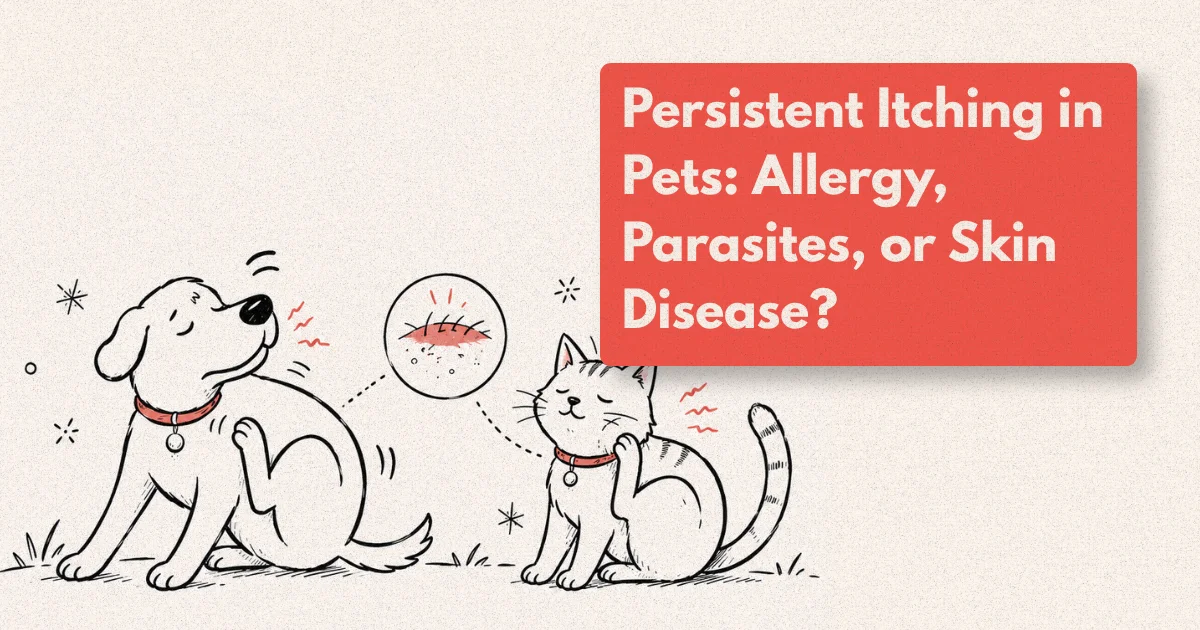
An itchy dog or cat is one of the most common presentations in veterinary practice, and one of the most mismanaged. The instinct to reach for an antihistamine, change the food, or try a new shampoo is understandable. It’s also frequently wrong, or at best, incomplete. Persistent pruritus (the clinical term for itch) is a symptom, not a diagnosis, and the range of conditions that can produce it is wide enough that guessing at the cause costs time, money, and the pet’s comfort.
Pruritus is the most common clinical sign in veterinary dermatology and accounts for approximately 20 to 25% of all small animal presentations globally (Veterinary Dermatology Journal, 2025). In dogs specifically, itching is second only to gastrointestinal complaints as a reason for unscheduled veterinary visits. The challenge is that canine atopic dermatitis, flea allergy, food hypersensitivity, sarcoptic mange, and Malassezia dermatitis can all look remarkably similar on first examination. Getting to the right answer requires a structured approach, not a series of empirical treatments.
What to Know
Persistent itching lasting more than four weeks almost always has an identifiable cause. Canine atopic dermatitis affects approximately 10 to 15% of dogs globally and is the most common cause of chronic itch after parasite exclusion. Intradermal skin testing and serological allergy panels, when interpreted correctly, identify causative allergens in 70 to 80% of atopic dogs (WCVD, 2025). The starting point for any persistent itch workup is parasite exclusion, not allergy testing.
Why Is My Dog Itching Persistently? Understanding the Itch-Scratch Cycle
Itch isn’t just discomfort. In dogs with chronic pruritic skin disease, the scratch response itself damages the skin barrier, introduces secondary bacterial and yeast infections, and generates inflammation that intensifies the itch signal. This itch-scratch cycle is self-perpetuating: the scratching that provides momentary relief makes the underlying condition harder to control and the skin progressively more vulnerable.
Canine atopic dermatitis is driven by a defective skin barrier that allows environmental allergens (pollens, dust mites, mould spores, and storage mites) to penetrate and trigger an aberrant immune response. The genetic predisposition is well-established: West Highland White Terriers, Labrador Retrievers, French Bulldogs, Boxers, Golden Retrievers, German Shepherds, and Cocker Spaniels carry significantly elevated lifetime risk compared with mixed-breed dogs (International Committee on Allergic Diseases of Animals, 2025). If your dog is one of these breeds and is itching persistently, atopic dermatitis belongs near the top of the differential list from the first consultation.
The itch signal itself is mediated primarily by interleukin-31 (IL-31), a cytokine released by activated T-helper cells in atopic skin. IL-31 binds to receptors on peripheral sensory neurons and triggers the scratch reflex. This mechanistic understanding has produced a new generation of targeted treatments that block either the IL-31 receptor (lokivetmab) or the Janus kinase pathway that amplifies the inflammatory cascade (oclacitinib, apoquel). These treatments work in hours to days rather than weeks, which is clinically significant when a dog has been scratching for months and the skin is already compromised.
Pruritus in cats takes a different form. Cats respond to itch through overgrooming rather than vigorous scratching, producing symmetrical alopecia, military dermatitis (tiny crusted papules across the back and neck), and eosinophilic granuloma complex lesions. The bilateral symmetry of feline overgrooming alopecia often leads owners to attribute it to a behavioural problem rather than skin disease. This is one of the most common diagnostic delays in feline dermatology.
What Are the Main Causes of Persistent Itching in Dogs and Cats?
Getting to the cause of persistent itch requires working through a differential list systematically, not jumping to the most obvious or least expensive explanation.
Ectoparasites belong at the top of every differential, regardless of how confident an owner is that their pet doesn’t have fleas. Flea allergy dermatitis (FAD) is the most common skin disease in dogs and cats in countries with temperate climates, yet it’s frequently missed because the fleas themselves are often not found at the time of examination. A hypersensitive animal reacts so intensely to flea saliva that a single bite triggers weeks of itch, and the flea may have been removed by grooming long before the appointment. The absence of visible fleas does not rule out FAD.
Sarcoptic mange (Sarcoptes scabiei) is intensely pruritic, often affecting the ear margins, elbows, hocks, and ventral abdomen, and is highly contagious to both other animals and humans. It’s frequently misdiagnosed as atopic dermatitis, a mistake that delays effective treatment by months. Cheyletiellosis (“walking dandruff”), otodectes (ear mites), and Demodex infestations complete the parasitic differential. Demodex in particular presents with patchy alopecia and comedones rather than intense itch in most cases, which distinguishes it from the others.
Environmental allergy (atopic dermatitis) affects approximately 10 to 15% of dogs globally and is the leading cause of chronic itch after parasites are excluded (ICADA, 2025). Clinical signs typically begin between one and three years of age, involve facial rubbing, paw licking, ear inflammation, and ventral body pruritus, and show a seasonal pattern initially that often becomes year-round as the allergen profile expands. Diagnosis is clinical, supported by exclusion of other causes and confirmed (allergen-specifically) by skin or serology testing.
Food hypersensitivity accounts for approximately 10 to 20% of allergic skin disease in dogs and 10 to 15% in cats (Journal of Veterinary Dermatology, 2024). It is frequently confused with atopic dermatitis because the clinical signs overlap almost completely. The critical distinguishing features are: food hypersensitivity often lacks seasonality and frequently involves recurrent ear infections alongside skin lesions. Diagnosing it requires a strict elimination diet trial with a novel or hydrolysed protein source for 8 to 12 weeks, not a blood test or skin test. Commercial “allergy” blood panels for food ingredients have poor predictive value and should not be used to diagnose or exclude food hypersensitivity.
Bacterial pyoderma and Malassezia (yeast) dermatitis are almost never primary diagnoses in isolation. They develop secondary to an underlying cause that disrupts the skin’s microbiome and barrier function: allergy, hormonal disease, keratinisation defects, or anatomical fold problems. Treating the infection without addressing the underlying cause leads to recurrence, which is the most common pattern seen in dogs presenting with “recurring skin infections.”
Keratinisation disorders, sebaceous adenitis, zinc-responsive dermatosis, and dermatomyositis make up a smaller but clinically important portion of persistent itch presentations, particularly in breeds with known predispositions (Standard Poodles for sebaceous adenitis, Northern breeds for zinc-responsive dermatosis, Collies and Shetland Sheepdogs for dermatomyositis).
Atopic dermatitis and flea allergy dermatitis together account for roughly two-thirds of persistent itch cases in dogs. This is important context for treatment decisions: in a dog with chronic itch, the probability that year-round comprehensive ectoparasite prevention alone will produce meaningful improvement is substantial. Across all age groups, the single most cost-effective intervention before any specialist workup is ensuring strict, consistent flea and mite prevention is in place.
Which Signs Tell You the Itch Needs Veterinary Attention?
Not all itching warrants urgent care, but persistent pruritus almost always does. These patterns should prompt veterinary assessment rather than continued home management:
- Itch lasting more than two weeks with no obvious cause (a visible wound, known burr exposure, or other identifiable irritant)
- Skin lesions accompanying the itch: redness, papules, pustules, crusts, thickened or lichenified (elephant skin) patches, or visible hair loss
- Odour from the skin or ears: a yeasty, musty, or sour smell indicates active secondary infection
- Recurrent ear infections: more than two episodes in a 12-month period in any dog is a red flag for underlying allergy
- Paw licking and face rubbing alongside body itch: the typical distribution pattern of atopic dermatitis
- Sudden intense itch with skin flaking and dandruff, particularly if human contacts have also developed mild, transient itching (suggests Cheyletiella or sarcoptic mange)
- Head shaking, ear scratching, and dark waxy debris in the ear canal: ear mites, yeast otitis, or both
A pruritus visual analogue scale (PVAS) is used in dermatology practice to quantify itch severity before and during treatment. Scores above 5 out of 10 (where the pet shows spontaneous scratching during rest and wakes from sleep to scratch) consistently correlate with significantly impaired quality of life in both pets and owners, and with a substantially elevated risk of complications from secondary infection (Veterinary Dermatology Journal, 2025).
Cats warrant particular mention here. Because feline itch manifests as overgrooming, owners often don’t identify it as a medical problem. A cat grooming so frequently that bald patches appear on the abdomen, flanks, or inner thighs, or a cat with a coat that looks thin and moth-eaten without obvious external cause, should be evaluated for skin disease rather than attributed to “stress grooming” by default.
What Does a Veterinary Dermatology Workup Involve?
A structured approach to persistent itch is not optional. Jumping to allergy testing before ruling out parasites is one of the most common and costly errors in dermatology management, because treating an allergy that is actually FAD will produce partial, intermittent improvement that looks enough like treatment response to delay the correct diagnosis by months.
Step 1: Ectoparasite exclusion. Before any allergy investigation begins, every pet with persistent itch receives four to eight weeks of appropriate, consistently applied ectoparasiticide treatment covering fleas, mites, and (in dogs with typical sarcoptic mange distribution) a scabicidal agent. This isn’t a throwaway step. In practices that consistently apply this protocol, 30 to 40% of “suspected allergic” referrals turn out to be flea allergy dermatitis that responds fully to adequate parasite control. Running allergy panels on a flea-allergic dog produces misleading positive results that lead to unnecessary, expensive immunotherapy.
Step 2: Skin cytology. Tape strips, impression smears, or swabs from lesion sites are examined microscopically for bacteria (cocci, rods) and Malassezia yeasts. This takes ten minutes and tells the clinician whether secondary infection is contributing to current itch severity, whether the infection needs treating before allergen investigation is meaningful, and sometimes points toward the cause (pure yeast overgrowth in a dog with normal immune function suggests an underlying hormonal or allergic driver).
Step 3: Skin scrapes. Superficial and deep scrapes are examined for Demodex mites, Sarcoptes mites, and Cheyletiella. Deep scrapes are taken at the periphery of lesions for Demodex; the characteristic lesion sites (ear margins, elbows) are targeted for Sarcoptes, although a negative scrape does not rule out sarcoptic mange because mite burden in hypersensitive animals is often very low. A trial scabicide treatment is diagnostic and therapeutic simultaneously.
Step 4: Elimination diet trial. If ectoparasites are excluded and the itch pattern is non-seasonal or involves recurrent otitis, an 8 to 12-week hydrolysed or novel protein elimination diet is conducted. This is the only validated method for diagnosing food hypersensitivity. The diet must be strict: no treats, flavoured supplements, chews, or table scraps outside the test diet. Approximately 60 to 70% of dogs with food hypersensitivity show meaningful improvement within 6 weeks of a correct elimination diet, with full resolution typically by week 10 to 12 (ICADA Clinical Guidelines, 2025).
Step 5: Skin testing for atopic dermatitis. Once parasites and food hypersensitivity are excluded and atopic dermatitis is confirmed clinically, allergen identification for immunotherapy planning uses either intradermal skin testing (IDST) or a serological allergy panel (serum IgE testing).
Intradermal Skin Testing vs. Serological Allergy Panels
Intradermal skin testing (IDST) has been the gold standard in veterinary dermatology for decades. Small amounts of individual allergens are injected into clipped skin, and reactions (wheals) are measured and scored at 15 and 30 minutes. It requires the animal to be free of antipruritic drugs (steroids, oclacitinib) for a washout period before testing, and it must be performed by or under direct supervision of a veterinary dermatologist because reading the reactions accurately requires expertise. When performed correctly, IDST identifies relevant allergens for immunotherapy formulation with a sensitivity of approximately 70 to 80% (WCVD, 2025).
Serological allergy panels (serum IgE) are more accessible because they don’t require drug washout or specialist involvement. They test IgE concentrations against a standardised allergen panel from a blood sample. Sensitivity is broadly comparable to IDST for house dust mites and storage mites (the allergens with the strongest IgE signal), but less reliable for pollens and moulds, which tend to produce lower and more variable IgE titres. Serological panels are the practical choice when a dermatologist is not available, when drug washout is clinically impractical, or when the dog is young and the allergen profile is expected to evolve.
Both tests inform allergen-specific immunotherapy (ASIT) formulation. ASIT, administered as subcutaneous injections or oral sublingual drops, desensitises the immune system to identified allergens over 12 to 24 months. It doesn’t work for every dog, but in patients where the allergen load can be meaningfully addressed, it offers the possibility of long-term reduced dependence on pharmacological itch control. Response rates of 50 to 80% (moderate to excellent improvement) are reported across species and allergen types, with better outcomes in dogs who begin ASIT before the allergen profile becomes extensively poly-sensitised (WCVD, 2025).
The stepwise protocol isn’t bureaucracy. Each step genuinely resolves a subset of cases that would otherwise be misattributed to atopic dermatitis and receive allergy-targeted treatment that doesn’t address the real problem. By the time a dog reaches formal skin testing, most competing differentials have been excluded, making the test result vastly more interpretable.
How Is Persistent Itch Treated?
Treatment depends on what the workup reveals, but some management approaches apply broadly across allergic skin disease.
Parasite control. For any pet with persistent itch, comprehensive ectoparasiticide treatment is both therapeutic and diagnostic. Products combining flea adulticide with systemic mite coverage (isoxazolines, for example) are now the standard recommendation for itchy pets rather than topical-only products with more limited spectrum. Treatment of all animals in the household is necessary; treating one pet while another harbours a flea burden achieves little.
Targeted pharmacological control. For atopic dermatitis specifically, oclacitinib (Apoquel) and lokivetmab (Cytopoint) have largely replaced corticosteroids as first-line management for acute flares. Oclacitinib inhibits JAK1-mediated cytokine signalling and produces itch relief within 24 hours. Lokivetmab is a caninised monoclonal antibody that directly neutralises IL-31; a single injection typically provides four to eight weeks of itch control with a favourable safety profile for long-term use. Both are significantly safer for extended use than long-term corticosteroids, which carry risks of iatrogenic Cushing’s syndrome, diabetes mellitus, and immunosuppression.
Allergen-specific immunotherapy (ASIT). Where skin or serology testing identifies the responsible allergens, ASIT addresses the underlying immune sensitisation rather than just suppressing the itch signal. It is the only disease-modifying treatment available for atopic dermatitis. Subcutaneous injection protocols and sublingual drop regimens are both effective, with the choice depending on owner preference, dog temperament, and allergen load. Response develops over months; the target is reducing pruritus severity by 50% or more from baseline with reduced dependence on pharmacological control.
Food trial management. A confirmed food hypersensitivity is managed by strict, lifelong avoidance of the offending antigen. Once the rechallenge confirms the causative protein(s), switching to a hydrolysed or novel protein diet long-term is both effective and sufficient. There is no role for steroids or Apoquel in food-allergic dogs whose diet is correctly managed, though they may be used temporarily during the diagnostic phase before the diagnosis is confirmed.
Secondary infection treatment. Bacterial pyoderma responds well to appropriate topical antiseptics (chlorhexidine shampoos, wipes, and sprays) and systemic antibiotics selected on the basis of culture and sensitivity when deep or recurrent infections are involved. Malassezia overgrowth responds to antifungal shampoos and miconazole or ketoconazole. Both must be treated concurrently with the underlying cause, not instead of it.
Oclacitinib achieves clinically significant itch reduction in approximately 66% of dogs within the first 14 days of treatment and maintains that response in approximately 80% of dogs at six months, based on controlled study data from the pivotal trials and post-market surveillance (Journal of Veterinary Pharmacology and Therapeutics, 2024). Its rapid onset has changed how pruritic flares are managed in practice: a dog in significant distress from itch doesn’t need to wait two to three weeks for immunotherapy to take effect.
The Role of Grooming and Skin Barrier Support in Managing Itch
Grooming is not just cosmetic. In dogs with skin disease, it’s a therapeutic tool. An itchy dog benefits from regular, targeted grooming and topical skin barrier support in ways that genuinely complement pharmacological treatment rather than replacing it.
The skin barrier in atopic dogs is structurally compromised compared with healthy dogs. Reduced ceramide levels in the stratum corneum allow allergens, irritants, and microorganisms to penetrate more easily, perpetuating both sensitisation and secondary infection. Restoring and supporting the barrier with appropriate topical products measurably reduces allergen penetration, itch severity, and secondary infection frequency.
Medicated shampoos. Chlorhexidine-based shampoos (2 to 4% concentration) reduce bacterial and yeast populations on the skin surface and are the most evidence-supported topical antiseptic intervention available. A twice-weekly bathing protocol with a 10-minute contact time before rinsing has been shown to reduce surface microbial load by over 90% and significantly reduces pruritus scores in dogs with concurrent surface infections (Veterinary Dermatology Journal, 2025). Bathing also mechanically removes environmental allergens from the coat, reducing the allergen exposure that drives ongoing sensitisation.
Skin barrier creams and emollients. Ceramide-containing topical formulations designed for veterinary use reduce transepidermal water loss and partially restore barrier function between bathing sessions. They’re particularly useful in dogs with facial fold involvement, paw dermatitis, and ventral body pruritus where medicated shampoos are difficult to apply effectively. Applied after bathing, they extend the benefit of the cleansing step.
Omega-3 fatty acid supplementation. Dietary supplementation with EPA and DHA (eicosapentaenoic and docosahexaenoic acid) from marine oil sources improves skin barrier lipid composition and has an established anti-inflammatory effect at the tissue level. The clinical evidence supports a reduction in pharmacological dose requirements for allergic dogs receiving adequate omega-3 supplementation, though the effect is modest and supplements are an adjunct, not a substitute, for primary treatment (ICADA, 2025).
Professional grooming considerations. For dogs with persistent skin disease, selecting a groomer familiar with veterinary dermatological conditions matters. Aggressive dematting, overuse of harsh detergent shampoos, and hot-air drying at high temperatures all damage already-compromised skin barriers. Groomers who use gentle handling, appropriate product selection, and cool or ambient-temperature drying make a measurable difference to the post-grooming itch trajectory in sensitive dogs. A brief written summary of the dog’s dermatological status, current topicals, and bathing instructions from the veterinary team to the groomer is a simple intervention that significantly reduces treatment disruption.
Dietary omega-3 supplementation at clinically relevant doses (approximately 100 to 200 mg EPA+DHA per kilogram of body weight daily) reduces inflammatory eicosanoid production in atopic skin and has a documented corticosteroid-sparing effect of approximately 20% in controlled studies, allowing lower effective doses of pharmacological control in some atopic dogs (JVST, 2024). This modest but real benefit makes high-quality omega-3 supplementation a standard recommendation in every atopic dog management plan.
Ready to Get to the Bottom of Your Pet’s Itch?
Persistent pruritus has an answer in almost every case. The path to it is structured, methodical, and considerably less expensive when it starts at the beginning of the differential list rather than in the middle. Our veterinary dermatology service offers full skin workups, in-house cytology and scrapes, elimination diet consultation, intradermal and serological allergy testing, and immunotherapy formulation.
The sooner a diagnosis is confirmed, the sooner the scratch cycle ends.
Frequently Asked Questions
Is it normal for dogs to scratch occasionally?
Yes. Occasional self-grooming and brief scratch responses to external irritation are normal. The clinical threshold for investigation is itch persisting more than two weeks, causing visible skin changes such as redness or hair loss, disrupting sleep, or scoring above 3 out of 10 on a pruritus scale. Intermittent mild itch in a dog with no lesions and good skin condition does not typically warrant workup.
Can I diagnose my dog's allergy with a home test kit?
Home blood spot or saliva allergy kits for pets are not validated and produce high rates of false positives. They should not guide treatment decisions. Veterinary serology panels using validated allergen extracts in accredited laboratories are a different, clinically meaningful category. If you want allergy testing, have it ordered and interpreted by a veterinarian (WCVD, 2025).
My dog has been on Apoquel for a year. Is that safe?
Oclacitinib (Apoquel) has an established long-term safety profile from clinical trials and post-market surveillance. It does not cause Cushing’s syndrome or elevate blood glucose like corticosteroids. The main monitored risks are modestly elevated susceptibility to skin infections and a theoretical immune surveillance concern at high doses. Annual bloodwork monitoring is standard practice for dogs on long-term Apoquel (JVPT, 2024).
Why does my cat groom so much, and could it be allergies?
Symmetrical alopecia from overgrooming on a cat’s abdomen, flanks, or inner thighs is a classic presentation of feline pruritus. The most common causes are flea allergy dermatitis, environmental allergy, and food hypersensitivity. Any cat with bilaterally symmetrical hair loss should be evaluated by a vet before a behavioural explanation is accepted, as skin disease is far more common than psychogenic alopecia.
How long does allergy immunotherapy take to work?
Most dogs show some improvement within three to six months of beginning allergen-specific immunotherapy (ASIT), with meaningful response (50%+ itch reduction) typically apparent by 9 to 12 months. A full two-year course is recommended before assessing final efficacy. Approximately 50 to 80% of atopic dogs achieve moderate to excellent responses (WCVD, 2025).