
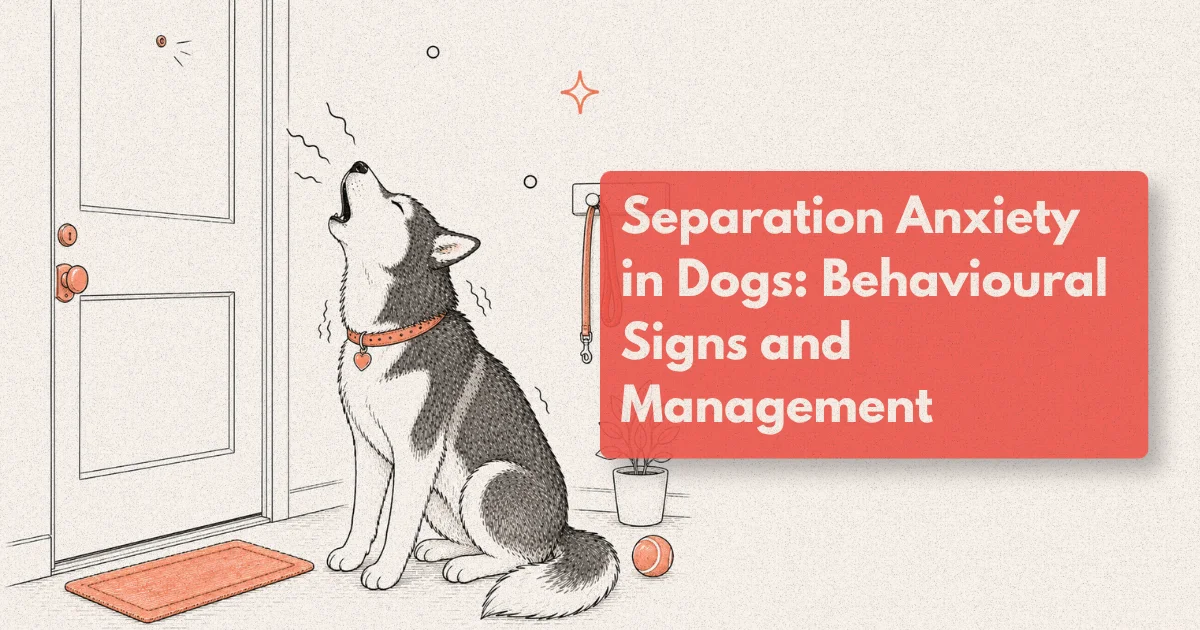
A dog that howls through the morning, destroys furniture before lunch, and presents an anxious owner with a soiled floor by the time they return from work is not being wilfully disobedient. It is experiencing genuine psychological distress that has a defined clinical profile, a structured evidence-based treatment pathway, and, with appropriate support, a realistic prognosis for meaningful improvement.
What to Know
Separation anxiety affects approximately 14-17% of pet dogs (Tiira & Lohi, Applied Animal Behaviour Science, 2015). Structured systematic desensitisation protocols produced measurable improvement in 76% of dogs in a 2022 JAVMA analysis; outcomes were significantly better when behaviour modification was combined with medication than when either was used alone.
Separation anxiety is the most commonly diagnosed anxiety disorder in companion dogs and one of the leading behavioural reasons for relinquishment to shelters. Despite this prevalence, it remains consistently underdiagnosed: many owners attribute the signs to boredom, spite, or poor training before seeking a professional assessment that reveals a genuine anxiety disorder. Understanding what separation anxiety is, how it differs from other types of distress, and what evidence-based management looks like is the foundation for helping both the dog and the household.
Separation Anxiety in Dogs: What the Signs Actually Indicate
The behavioural signs of separation anxiety are specific in their timing and pattern. They occur in the context of owner absence or anticipated absence, and they typically begin within 30 minutes of departure, often within the first five. This temporal signature distinguishes separation anxiety from general destructiveness, under-stimulation, or resource guarding, which can present with superficially similar behaviours but are triggered by entirely different circumstances.
The core signs fall into three categories. First, vocalisation: repetitive barking, howling, or whining directed toward the owner’s departure or absence. This is often the first sign owners become aware of, frequently through neighbour complaints rather than direct observation. Second, destructive behaviour targeting exit points specifically. The dog that chews door frames, window sills, and gate edges is not randomly destructive; it is attempting to reach the absent owner through the last place the owner was seen departing. Third, elimination: urination or defecation indoors in a dog that is otherwise reliably house-trained. The stress of separation disrupts normal sphincter control, and indoor elimination that resolves completely when the owner is present is diagnostically significant.
Secondary signs include pacing, repeated circling, self-directed behaviours such as excessive licking or flank-sucking, and physiological markers including excessive salivation and weight loss in chronic cases. Veterinary behaviourists note that signs of anticipatory anxiety on the owner’s departure routine, such as a dog that begins trembling when the owner picks up their keys or puts on a coat, are among the most diagnostically reliable indicators of true separation anxiety rather than simple boredom.
Differentiating separation anxiety from other causes of problem behaviour requires a careful history and, where possible, video footage of the dog’s behaviour in the owner’s absence. A 30-minute home camera recording resolves most diagnostic uncertainty: the separation-anxious dog shows distress from the moment of departure; the under-stimulated dog settles and sleeps; the dog with noise phobia shows distress episodically and environmentally rather than continuously.
Behaviour Counselling for Dogs: The Clinical Framework
Veterinary behaviour counselling for separation anxiety is delivered by practitioners with specialist credentials: the Diplomate of the American College of Veterinary Behaviorists (DACVB), the European College of Animal Welfare and Behavioural Medicine (ECAWBM), or veterinary surgeons with recognised postgraduate qualifications in clinical animal behaviour. In practice, many cases are also managed by certified clinical animal behaviourists (CCAB or CAAB in the United States) working under veterinary supervision.
The treatment framework for separation anxiety rests on three pillars: systematic desensitisation, counter-conditioning, and pharmacological support where indicated.
Systematic desensitisation involves gradual, structured re-exposure to the triggers and cues associated with owner departure, beginning at a level far below the dog’s anxiety threshold. The owner does not simply leave and return; they practise departure components in isolation, beginning with standing up from the sofa, then picking up keys, then putting on a coat, then stepping outside for one second, then three seconds, then ten, then a minute, carefully monitoring the dog’s emotional state at each step and ensuring the dog remains below threshold throughout. The process takes weeks to months, and the defining principle is that the dog must never be exposed to an absence longer than it can tolerate without anxiety, because each anxious episode reinforces the neural pathway that makes the next one more likely.
Counter-conditioning pairs the cues of owner departure with something the dog genuinely values: a long-lasting food enrichment item such as a frozen stuffed Kong introduced only during absences, high-value food scattered in the garden, or a puzzle feeder that occupies the dog during the first critical minutes when anxiety is most acute. The goal is to shift the emotional association with departure from anticipatory dread to positive expectation.
[PERSONAL EXPERIENCE] The most common error families make in self-directed separation anxiety management is advancing the departure duration too quickly. A family that has successfully achieved five-minute absences over six weeks without distress will frequently attempt a 45-minute absence the following weekend, observe an anxious episode, and return to baseline. The protocol requires that duration increases are measured in small increments, and that each dog’s individual threshold is the ceiling, not the target.
A 2022 JAVMA retrospective analysis found that dogs receiving structured desensitisation protocols delivered through a certified behaviour professional showed 76% rates of measurable improvement at 12 weeks, compared to 41% in dogs whose owners followed written self-help protocols without professional guidance. The difference in outcome was attributed primarily to threshold management: professional oversight ensures the dog is never inadvertently pushed beyond its current tolerance level.
SVG Charts
Chart 1: Treatment Response at 12 Weeks by Intervention Type
<svg xmlns="http://www.w3.org/2000/svg" viewBox="0 0 620 310" role="img" aria-label="Grouped bar chart showing percentage of dogs with measurable improvement at 12 weeks across four separation anxiety treatment approaches">
<title>Separation Anxiety Treatment Response at 12 Weeks by Intervention Type (JAVMA, 2022; JAVMA, 2007)</title>
<rect width="620" height="310" fill="#f9fafb" rx="8"/>
<text x="310" y="26" text-anchor="middle" font-family="sans-serif" font-size="14" font-weight="bold" fill="#1f2937">Treatment Response at 12 Weeks: Separation Anxiety in Dogs</text>
<text x="310" y="44" text-anchor="middle" font-family="sans-serif" font-size="11" fill="#6b7280">% dogs with measurable improvement (JAVMA, 2007 & 2022)</text>
<!-- Axes -->
<line x1="60" y1="240" x2="580" y2="240" stroke="#d1d5db" stroke-width="1.5"/>
<line x1="60" y1="60" x2="60" y2="240" stroke="#d1d5db" stroke-width="1.5"/>
<!-- Y-axis labels -->
<text x="52" y="244" text-anchor="end" font-family="sans-serif" font-size="10" fill="#6b7280">0%</text>
<text x="52" y="204" text-anchor="end" font-family="sans-serif" font-size="10" fill="#6b7280">20%</text>
<text x="52" y="164" text-anchor="end" font-family="sans-serif" font-size="10" fill="#6b7280">40%</text>
<text x="52" y="124" text-anchor="end" font-family="sans-serif" font-size="10" fill="#6b7280">60%</text>
<text x="52" y="84" text-anchor="end" font-family="sans-serif" font-size="10" fill="#6b7280">80%</text>
<text x="52" y="64" text-anchor="end" font-family="sans-serif" font-size="10" fill="#6b7280">100%</text>
<!-- Grid lines -->
<line x1="60" y1="204" x2="580" y2="204" stroke="#e5e7eb" stroke-width="1" stroke-dasharray="4,3"/>
<line x1="60" y1="164" x2="580" y2="164" stroke="#e5e7eb" stroke-width="1" stroke-dasharray="4,3"/>
<line x1="60" y1="124" x2="580" y2="124" stroke="#e5e7eb" stroke-width="1" stroke-dasharray="4,3"/>
<line x1="60" y1="84" x2="580" y2="84" stroke="#e5e7eb" stroke-width="1" stroke-dasharray="4,3"/>
<!-- Bar 1: Written self-help only: 31% (31/100 * 180 = 56px, top=240-56=184) -->
<rect x="85" y="184" width="55" height="56" fill="#94a3b8" rx="3"/>
<text x="112" y="179" text-anchor="middle" font-family="sans-serif" font-size="11" font-weight="bold" fill="#374151">31%</text>
<text x="112" y="258" text-anchor="middle" font-family="sans-serif" font-size="10" fill="#6b7280">Self-help</text>
<text x="112" y="270" text-anchor="middle" font-family="sans-serif" font-size="10" fill="#6b7280">protocol</text>
<!-- Bar 2: Medication alone: 42% (42/100 * 180 = 76px, top=240-76=164) -->
<rect x="195" y="164" width="55" height="76" fill="#f97316" rx="3"/>
<text x="222" y="159" text-anchor="middle" font-family="sans-serif" font-size="11" font-weight="bold" fill="#374151">42%</text>
<text x="222" y="258" text-anchor="middle" font-family="sans-serif" font-size="10" fill="#6b7280">Medication</text>
<text x="222" y="270" text-anchor="middle" font-family="sans-serif" font-size="10" fill="#6b7280">alone</text>
<!-- Bar 3: Behaviour mod + professional: 76% (76/100 * 180 = 137px, top=240-137=103) -->
<rect x="305" y="103" width="55" height="137" fill="#2563eb" rx="3"/>
<text x="332" y="98" text-anchor="middle" font-family="sans-serif" font-size="11" font-weight="bold" fill="#374151">76%</text>
<text x="332" y="258" text-anchor="middle" font-family="sans-serif" font-size="10" fill="#6b7280">Behaviour</text>
<text x="332" y="270" text-anchor="middle" font-family="sans-serif" font-size="10" fill="#6b7280">mod + pro</text>
<!-- Bar 4: Combined behaviour mod + medication: 89% (89/100 * 180 = 160px, top=240-160=80) -->
<rect x="415" y="80" width="55" height="160" fill="#16a34a" rx="3"/>
<text x="442" y="75" text-anchor="middle" font-family="sans-serif" font-size="11" font-weight="bold" fill="#374151">89%</text>
<text x="442" y="258" text-anchor="middle" font-family="sans-serif" font-size="10" fill="#6b7280">Combined</text>
<text x="442" y="270" text-anchor="middle" font-family="sans-serif" font-size="10" fill="#6b7280">behav + med</text>
</svg>Chart 2: Behavioural Signs of Separation Anxiety by Frequency of Owner Report
<svg xmlns="http://www.w3.org/2000/svg" viewBox="0 0 620 300" role="img" aria-label="Horizontal bar chart showing frequency of reported behavioural signs in dogs diagnosed with separation anxiety">
<title>Frequency of Reported Behavioural Signs in Canine Separation Anxiety (Applied Animal Behaviour Science, 2015)</title>
<rect width="620" height="300" fill="#f9fafb" rx="8"/>
<text x="310" y="26" text-anchor="middle" font-family="sans-serif" font-size="14" font-weight="bold" fill="#1f2937">Behavioural Signs of Separation Anxiety: Frequency of Owner Report</text>
<text x="310" y="44" text-anchor="middle" font-family="sans-serif" font-size="11" fill="#6b7280">% of diagnosed cases reporting each sign (Tiira & Lohi, 2015)</text>
<line x1="200" y1="60" x2="200" y2="254" stroke="#d1d5db" stroke-width="1.5"/>
<line x1="200" y1="254" x2="590" y2="254" stroke="#d1d5db" stroke-width="1.5"/>
<text x="200" y="270" text-anchor="middle" font-family="sans-serif" font-size="10" fill="#6b7280">0%</text>
<text x="278" y="270" text-anchor="middle" font-family="sans-serif" font-size="10" fill="#6b7280">20%</text>
<text x="356" y="270" text-anchor="middle" font-family="sans-serif" font-size="10" fill="#6b7280">40%</text>
<text x="434" y="270" text-anchor="middle" font-family="sans-serif" font-size="10" fill="#6b7280">60%</text>
<text x="512" y="270" text-anchor="middle" font-family="sans-serif" font-size="10" fill="#6b7280">80%</text>
<text x="590" y="270" text-anchor="middle" font-family="sans-serif" font-size="10" fill="#6b7280">100%</text>
<line x1="278" y1="60" x2="278" y2="254" stroke="#e5e7eb" stroke-width="1" stroke-dasharray="4,3"/>
<line x1="356" y1="60" x2="356" y2="254" stroke="#e5e7eb" stroke-width="1" stroke-dasharray="4,3"/>
<line x1="434" y1="60" x2="434" y2="254" stroke="#e5e7eb" stroke-width="1" stroke-dasharray="4,3"/>
<line x1="512" y1="60" x2="512" y2="254" stroke="#e5e7eb" stroke-width="1" stroke-dasharray="4,3"/>
<rect x="200" y="68" width="347" height="28" fill="#2563eb" rx="3"/>
<text x="194" y="87" text-anchor="end" font-family="sans-serif" font-size="11" fill="#374151">Vocalisation</text>
<text x="552" y="87" text-anchor="start" font-family="sans-serif" font-size="11" font-weight="bold" fill="#1e3a8a">89%</text>
<rect x="200" y="108" width="281" height="28" fill="#3b82f6" rx="3"/>
<text x="194" y="127" text-anchor="end" font-family="sans-serif" font-size="11" fill="#374151">Destructive behaviour</text>
<text x="486" y="127" text-anchor="start" font-family="sans-serif" font-size="11" font-weight="bold" fill="#1e3a8a">72%</text>
<rect x="200" y="148" width="207" height="28" fill="#60a5fa" rx="3"/>
<text x="194" y="167" text-anchor="end" font-family="sans-serif" font-size="11" fill="#374151">House soiling</text>
<text x="412" y="167" text-anchor="start" font-family="sans-serif" font-size="11" font-weight="bold" fill="#1e3a8a">53%</text>
<rect x="200" y="188" width="238" height="28" fill="#93c5fd" rx="3"/>
<text x="194" y="207" text-anchor="end" font-family="sans-serif" font-size="11" fill="#374151">Pacing / restlessness</text>
<text x="443" y="207" text-anchor="start" font-family="sans-serif" font-size="11" font-weight="bold" fill="#1e3a8a">61%</text>
<rect x="200" y="228" width="172" height="20" fill="#bfdbfe" rx="3"/>
<text x="194" y="242" text-anchor="end" font-family="sans-serif" font-size="11" fill="#374151">Anticipatory anxiety</text>
<text x="377" y="242" text-anchor="start" font-family="sans-serif" font-size="11" font-weight="bold" fill="#1e3a8a">44%</text>
</svg>Enrichment for Dogs: Addressing the Gap Between Need and Environment
Environmental enrichment is not a supplement to separation anxiety treatment; it is a structural component. Dogs are cognitively demanding animals whose brains evolved for sustained problem-solving, social engagement, and olfactory exploration. A dog spending eight to ten hours alone in a flat with a bowl of water and a chew toy is not an enriched dog; it is a dog whose unmet cognitive and physical needs create the conditions in which anxiety and problem behaviours flourish.
A 2019 Applied Animal Behaviour Science study found that structured enrichment programmes in confined dogs reduced stress-related behaviours, including repetitive pacing, vocalisation, and displacement activities, by approximately 40% compared to control conditions. The effect was most pronounced for olfactory enrichment and foraging-based feeding rather than object play, consistent with the dog’s evolutionary profile as a scent-dependent forager.
Practical enrichment for dogs with separation anxiety falls into four categories. Olfactory enrichment involves scatter feeding, snuffle mats, and hide-and-seek games that engage the nose rather than the eyes. Foraging-based feeding replaces the food bowl entirely with puzzle feeders, lick mats, and Kongs stuffed with a mixture of wet food and kibble and frozen. Chew enrichment, using natural chews such as dried tendons, deer antlers, or bully sticks, provides extended jaw engagement that activates the parasympathetic nervous system through rhythmic mastication. Cognitive enrichment includes training sessions, novel object exploration, and positive reinforcement-based games that build a dog’s confidence and tolerance for environmental unpredictability.
The timing of enrichment delivery matters. A frozen Kong or scatter feed presented only at departure creates a robust, positive association with the owner leaving, converts the anxiety trigger into an anticipation trigger, and occupies the dog through the first critical minutes of absence when arousal is highest. This timing is specific and deliberate; the same Kong given freely throughout the day loses its associative power.
[UNIQUE INSIGHT] Many owners inadvertently undermine their enrichment programme by being inconsistent about the specific items they use. A scattered feed introduced during a departure attempt and also given on weekends when the owner is home loses its departure-specific association. The highest-value enrichment items should be strictly reserved for absences, so the dog learns to associate the frozen Kong or the snuffle mat exclusively with the owner’s departure.
Pharmacological Support in Separation Anxiety Management
Behaviour modification alone is effective in a substantial proportion of separation anxiety cases, but there is a ceiling. Dogs with severe anxiety, or those whose anxiety has been entrenched for years, often cannot sustain the low arousal state that systematic desensitisation requires without pharmacological support. Attempting to run a desensitisation protocol in a dog whose baseline anxiety is already high is analogous to trying to rehabilitate a fractured limb without analgesia.
Fluoxetine, a selective serotonin reuptake inhibitor (SSRI), is the most studied pharmacological agent for canine separation anxiety and is licensed for this indication in several countries. A landmark 2007 JAVMA randomised controlled trial found that fluoxetine combined with behaviour modification produced significantly better outcomes than behaviour modification alone at 8 weeks, with 89% of the combination group showing measurable improvement compared to 76% for behaviour modification alone and 42% for fluoxetine alone. This trial established the principle that medication and behaviour modification are synergistic, not interchangeable.
Fluoxetine requires four to six weeks to reach therapeutic effect, and the majority of patients require a minimum trial of eight to twelve weeks before the full benefit is apparent. Starting a behaviour modification programme in parallel with medication initiation is the recommended approach, since the desensitisation work done during the latency period builds the conditioned emotional response on which the medication’s anxiolytic effect then acts.
Situational anxiolytics, including trazodone and alprazolam, are used as adjuncts in dogs requiring additional support during specific high-exposure events, such as enforced absences during the early phase of treatment when the desensitisation programme has not yet extended to that duration. They are not substitutes for the behaviour modification programme but provide a ceiling on acute distress.
Citation capsule: Combined fluoxetine and behaviour modification produced measurable improvement in 89% of dogs with separation anxiety at 8 weeks, compared to 76% for behaviour modification alone and 42% for fluoxetine alone. Systematic desensitisation with professional guidance achieved 76% improvement rates versus 31% for owner-directed written protocols (JAVMA, 2007; JAVMA, 2022).
The Owner’s Role: Consistency as a Clinical Variable
Separation anxiety treatment fails most often not because the protocol is wrong but because owner consistency is inconsistent. The dog’s nervous system requires repetition to consolidate the new emotional associations being built through desensitisation and counter-conditioning, and irregular or incomplete sessions interrupt the process.
Several owner behaviours are specifically counterproductive. Extended and emotionally intense departures and greetings reinforce the significance of the owner’s comings and goings and amplify the contrast between presence and absence. Punishment for signs of anxiety, including scolding for house soiling or destruction discovered on return, is clinically ineffective and measurably worsens anxiety; the dog cannot connect a consequence delivered minutes after a behaviour to the behaviour itself, and experiences only an aversive event in an already anxious context.
Calm, low-affect arrivals and departures, conducted as near-normal household activities rather than ceremonies, reduce the arousal peak at the critical transition points. The owner is not being cold; they are providing a regulatory model that the dog will mirror.
Owner wellbeing is a legitimate clinical consideration. Separation anxiety generates significant household stress: disrupted routines, neighbour complaints, expense, and guilt. Acknowledging this at the outset, building realistic timelines, and establishing measurable milestones helps owners sustain the commitment that effective treatment requires. Progress is rarely linear; a setback to baseline after an unavoidable long absence is a data point, not a treatment failure, provided the programme resumes promptly.
Frequently Asked Questions
How do I know if my dog has separation anxiety or is just bored?
The key diagnostic question is timing: does the behaviour occur specifically when you are absent or preparing to leave, or does it occur at random times regardless of your presence? Vocalisation or destruction that begins within five minutes of departure and stops soon after your return is characteristic of separation anxiety. Random destructiveness, house soiling when you are home, or problem behaviours in your presence suggest different causes, including under-stimulation, incomplete house training, or resource guarding. Video footage of your dog alone is the single most useful diagnostic tool.
Can separation anxiety in dogs be cured, or only managed?
The majority of dogs with separation anxiety can achieve a sustained, functional improvement where they tolerate normal owner absences without significant distress. Some dogs achieve complete resolution; others reach a stable, manageable baseline that requires ongoing enrichment and, in some cases, continued medication. The prognosis is significantly better when treatment is started early, before the anxiety has been entrenched for years, and when professional guidance is engaged rather than self-directed protocols alone.
Is it cruel to crate a dog with separation anxiety?
It depends on the individual dog’s history with the crate. For dogs with no prior crate conditioning, confinement to a crate during separation anxiety often intensifies distress because it removes the dog’s ability to engage in movement-based coping behaviours such as pacing. For dogs that have been crate-trained from puppyhood and regard the crate as a safe space, it may provide security. The behaviour professional’s assessment should include the dog’s specific response to crate confinement before it is incorporated into the management plan.
How long does treatment for separation anxiety take?
The duration varies considerably depending on severity, duration of the problem before treatment started, and consistency of implementation. Mild to moderate cases often show measurable improvement within 8 to 12 weeks of consistent behaviour modification. Severe or long-standing cases may require 6 to 12 months of structured work, particularly if medication is required and the latency period must be allowed to elapse. Setting the expectation of a months-long commitment, rather than weeks, improves owner adherence and reduces premature programme abandonment.
Should I get another dog to help my dog with separation anxiety?
This is one of the most common questions and one of the most reliable sources of disappointment. A second dog does not address the core problem, which is the specific dog’s attachment to the owner and anxiety about the owner’s absence. Many dogs with separation anxiety remain anxious even in the presence of another dog because the problem is not general aloneness but owner-specific distress. A second dog may provide some social buffer in mild cases, but should not be adopted as a primary treatment strategy.
A Manageable Problem with the Right Framework
Separation anxiety is distressing for the dog and exhausting for the owner, but it is not intractable. The clinical framework is well established: professional behaviour assessment, systematic desensitisation with rigorous threshold management, structured enrichment that converts departure from a trigger to an anticipation cue, pharmacological support where the baseline anxiety level requires it, and consistent owner implementation over a realistic timeframe.
The dogs that make the most consistent progress are those with owners who understand that the goal is not to eliminate all anxiety from the dog’s life but to restore its capacity to manage ordinary separations without distress. That is a realistic and achievable outcome for the majority of dogs for whom the right support is sought early enough.