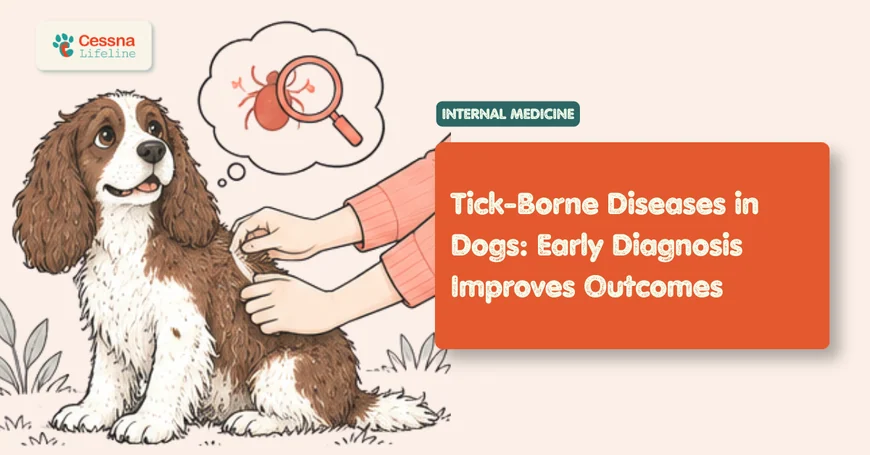
Tick-Borne Diseases in Dogs: Early Diagnosis Improves Outcomes
Tick-borne diseases in dogs kill up to 10% even with treatment. Spot symptoms of tick fever, ehrlichiosis, and babesiosis early to save your dog's life.
One tick bite can alter a dog's life permanently. Tick-borne diseases in dogs range from mild, self-resolving infections to conditions that cause organ failure, severe anemia, and death within days. Up to 10% of dogs infected with Rocky Mountain spotted fever die even with treatment (MSD Veterinary Manual, 2024), and survival rates decline sharply when diagnosis comes late. The difference between a dog that walks out of the clinic in two days and one that doesn't is usually measured in hours, not weeks.
What makes these diseases particularly dangerous is how ordinary the early signs look. Lethargy, reduced appetite, a slight fever: these are symptoms any owner could reasonably attribute to a long walk in the heat or a minor stomach upset. By the time the more alarming signals appear, some dogs are already in critical condition.
This guide covers the four most clinically significant tick-borne diseases affecting dogs in the United States, with particular attention to the focus areas that matter most for early recognition: tick fever, ehrlichiosis, babesiosis, and the overlapping symptom picture that makes diagnosis genuinely difficult.
The Short Version Tick-borne diseases in dogs, including ehrlichiosis, babesiosis, and Rocky Mountain spotted fever, are expanding geographically and now pose a year-round risk across much of the United States, according to the Companion Animal Parasite Council's 2026 forecast. Dogs diagnosed and treated in the first four to five days of illness have dramatically better outcomes than those treated in the chronic phase, where mortality rises significantly. The CAPC processes over 10 million diagnostic test results per vector-borne disease annually and projects continued northward expansion of tick risk zones (CAPC, 2026).
What Is Tick Fever in Dogs?
"Tick fever" isn't a single disease. It's a term pet owners and many veterinarians use to describe several distinct infections that ticks transmit to dogs, all of which share fever as a prominent early symptom. The four most clinically significant ones are Rocky Mountain spotted fever (RMSF), ehrlichiosis, babesiosis, and anaplasmosis, each caused by a different pathogen, transmitted by different tick species, and requiring somewhat different management.
What these conditions share is timing. Symptoms typically appear between two and fourteen days after an infected tick bite, a period called the incubation window (UC Davis School of Veterinary Medicine, 2024). A dog may have been bitten during a routine walk and show no signs at all until nearly two weeks later, making it genuinely difficult for owners to connect the dots when symptoms finally appear.
The Companion Animal Parasite Council's 2026 forecast projects continued geographic expansion of ehrlichiosis and Lyme disease risk, with particular spread into the Upper Midwest, New England, and parts of the Southwest where these diseases were historically rare (CAPC, 2026). That expansion matters clinically. Veterinarians in historically low-risk areas may not immediately suspect tick-borne illness when a dog presents with vague symptoms, and that's exactly how treatment windows get missed.
tick species identification guide
Symptoms of Tick Fever in Dogs
The earliest symptoms of tick fever in dogs are frustratingly nonspecific. Fever is the hallmark sign, often running as high as 105°F (40.6°C), but it arrives packaged with lethargy, reduced appetite, and a general reluctance to move that could describe dozens of conditions. Most owners don't notice the fever directly because they don't take their dog's temperature; they notice that something seems off.
As tick-borne diseases progress beyond the acute phase, symptoms become more distinctive and more severe. Recognizing these secondary signs is often what prompts pet owners to seek veterinary care, but by this stage the treatment window may already be narrowing.
Signs that should prompt same-day veterinary evaluation include:
- Petechiae: pinpoint red or purple hemorrhages on the gums, inner eyelids, or belly skin, caused by low platelet counts
- Pale or yellowish gums: indicating anemia or jaundice from red blood cell destruction
- Nosebleeds or unusual bleeding from minor cuts or injection sites
- Swollen lymph nodes or joints, particularly around the neck and limbs
- Neurological signs including head tilt, tremors, or incoordination
- Dark rust-colored or blood-tinged urine
- Facial or limb swelling
- Difficulty breathing and persistent coughing
Petechiae on the inner ear flap or gum line, combined with fever, is treated as a presumptive tick disease presentation at most emergency veterinary clinics. Thrombocytopenia (low platelets) was identified as the strongest laboratory predictor of tick-borne disease in a 2024 study of dogs presenting with clinical abnormalities in Central Thailand (Frontiers in Veterinary Science, 2024), a finding consistent with clinical experience across all four major tick-borne pathogens.
The critical point: this progression from vague to severe doesn't always take weeks. In RMSF, a dog can move from mild fever to multi-organ involvement in 24 to 48 hours. Waiting to see if symptoms resolve on their own is a gamble with poor odds.
<figcaption>Relative frequency of clinical signs across tick-borne diseases in dogs. Petechiae and bleeding signs are late-stage indicators requiring same-day care.</figcaption> </figure>
what to do if you find a tick on your dog
Ehrlichiosis in Dogs
Ehrlichiosis is caused by obligate intracellular bacteria in the genus Ehrlichia, most commonly E. canis (transmitted by the brown dog tick), E. chaffeensis, and E. ewingii (both transmitted by the lone star tick). It's one of the most studied tick-borne diseases in dogs and one of the clearest demonstrations of why the timing of diagnosis determines the outcome.
The Three Phases
The disease moves through three distinct phases, and prognosis shifts dramatically between them.
In the acute phase, one to four weeks post-infection, clinical signs include fever, lethargy, swollen lymph nodes, reduced platelet count, and mild bleeding tendencies. Doxycycline, the standard treatment, works best here. Most dogs in the acute phase show clinical improvement within 24 to 48 hours of starting antibiotics (AMC of Cumming, 2024). The overall survival rate for dogs treated at this stage is estimated at approximately 95%.
The sub-clinical phase is deceptive. The dog appears to recover; symptoms resolve. But the bacteria persist within monocytes, a type of white blood cell, continuing to replicate without producing obvious clinical signs. An owner who saw their dog improve in the acute phase might reasonably assume the illness passed. It didn't.
The chronic phase is where outcomes deteriorate sharply. Dogs reaching this stage develop severe bone marrow suppression, profound anemia, bleeding episodes, weight loss, and sometimes kidney failure. Treatment in the chronic phase requires longer antibiotic courses, frequent supportive care, and often blood transfusions. The mortality rate climbs significantly compared to acute-phase cases, and some dogs don't recover even with aggressive intervention (Whole Dog Journal, 2024).
A 2025 study on seroprevalence of E. canis in northern Peru found infection rates as high as 38.6% in dogs presenting with clinical signs consistent with ehrlichiosis (PMC, 2025). The frequency of infection in endemic regions, combined with the narrow window for effective treatment, makes early testing a genuine clinical priority, not just a precaution.
tick prevention products for dogs
Babesiosis in Dogs
Babesiosis operates through a different mechanism. Where ehrlichiosis attacks white blood cells, Babesia parasites invade red blood cells directly, rupturing them as they replicate. The result is hemolytic anemia that can escalate to hemoglobinuria (blood-tinged urine), jaundice, and circulatory shock if parasite load climbs quickly enough.
The global pooled prevalence of canine babesiosis is 12%, with European dogs showing a notably higher rate of 20.7%. Among Babesia species, Babesia canis shows the highest individual prevalence at 21.6% in affected regions (PMC/NCBI, 2024). In the United States, Babesia gibsoni is the species of most clinical concern, particularly in American Pit Bull Terriers and dogs imported from endemic countries.
Clinical signs of babesiosis in dogs include fever and lethargy in most cases, pale or white gums from anemia, yellowish tinge to skin and eyes, dark rust-colored urine, exercise intolerance, vomiting, and spleen enlargement. The variance between individual cases is wide: one dog may present with mild lethargy and a marginally low red cell count, while another presents in shock with a packed cell volume (PCV) of 8%. A PCV below 20% signals serious danger; below 10% indicates a transfusion-level emergency.
Treatment depends on species identification. Babesia canis infections respond to imidocarb dipropionate injections. B. gibsoni is treatment-resistant and requires the combination of atovaquone and azithromycin (AskAVet, 2025). This is precisely why PCR-based species identification matters before committing to a drug protocol: the wrong treatment for the wrong Babesia species wastes time the dog doesn't have.
Co-infection complicates the picture further. A 2024 study in Central Thailand found that 34% of dogs with babesiosis were simultaneously infected with another tick-borne pathogen (Frontiers in Veterinary Science, 2024). A negative rapid test for ehrlichiosis doesn't clear the slate when a dog has babesiosis; both infections can coexist in the same animal from the same tick bite.
<figcaption>Co-infection rates highlight the importance of broad-panel testing when babesiosis is confirmed. A positive result for one pathogen does not exclude others.</figcaption> </figure>
anemia in dogs
Rocky Mountain Spotted Fever
Despite the name, Rocky Mountain spotted fever is most prevalent in the southeastern United States, Oklahoma, and North Carolina, with expanding risk zones documented by CAPC. The disease is caused by Rickettsia rickettsii, transmitted primarily by the American dog tick and the Rocky Mountain wood tick, and it's the most acutely dangerous tick-borne infection dogs can contract.
R. rickettsii infects endothelial cells, the cells lining blood vessels throughout the body. This makes RMSF a vasculotropic disease: as the bacteria replicate and the immune system responds, blood vessels become inflamed and leaky, creating hemorrhages in skin, eyes, kidneys, lungs, and the nervous system simultaneously. It's not one organ at a time. It's everything at once.
The diagnostic marker most owners associate with the name, the "spotted" rash or petechiae, may not appear until the disease is already severe. Fever, lethargy, joint pain, and facial swelling often come first. Waiting for a visible rash to appear before seeking veterinary care is one of the most common reasons treatment begins too late.
Here's the number that matters most: treatment with doxycycline is most effective when started before day five of symptom onset (UC Davis School of Veterinary Medicine, 2024). If the antibiotic begins within that window, fever typically resolves within 24 to 72 hours. Without prompt treatment, RMSF carries a mortality rate of up to 10% in dogs (Pet Health Network, 2024), and surviving dogs can suffer lasting damage to kidneys, lungs, and the nervous system.
How Vets Diagnose Tick-Borne Diseases
When a dog presents with fever, lethargy, and tick-exposure history, most veterinarians run a combination of tests rather than relying on any single result. Each diagnostic tool has strengths and specific blind spots.
Complete blood count (CBC) is usually the first step. Thrombocytopenia is present in most tick-borne diseases and functions as the initial signal. Anemia, abnormal white cell counts, and elevated total protein all add to the clinical picture, though none of them point specifically to one disease over another.
4Dx Plus SNAP test is the in-clinic rapid screen used in most U.S. practices. It screens simultaneously for Lyme disease, ehrlichiosis, anaplasmosis, and heartworm in about eight minutes. It detects antibodies rather than the pathogen itself, which means a dog in the earliest days of infection may test negative while actively infected. A negative 4Dx in a dog with strong clinical signs doesn't close the case.
PCR testing is the gold standard for active infections. It detects pathogen DNA directly and, critically for babesiosis, can distinguish between Babesia species, which determines which drug protocol to use. PCR is sent to a reference laboratory, with results in 24 to 48 hours. Treatment often starts in parallel rather than waiting.
Blood smear examination can visually confirm Babesia parasites within red blood cells when parasite density is high enough. It's fast and requires no external lab, but sensitivity drops when parasite load is low. PCR will catch what a smear misses.
Serology (antibody titers) via indirect immunofluorescence assay is useful for confirming past or current exposure, but the retrospective nature limits its use during acute illness. A four-fold titer rise between acute and convalescent samples taken two to four weeks apart is considered diagnostic confirmation, a timeline rarely useful when a dog is acutely ill.
how to read your dog's bloodwork
Why Early Diagnosis Changes the Outcome
The case for early diagnosis is mechanistic, not rhetorical. Tick-borne diseases in dogs don't become dangerous gradually and uniformly. They follow biological timelines that create narrow windows of high treatment efficacy.
Take ehrlichiosis. A dog treated with doxycycline in the acute phase typically improves within 48 hours. That same dog, if it progresses to the chronic phase through delayed diagnosis, may need weeks of intensive treatment, blood transfusions, and extended monitoring, and still may not survive. The antibiotic hasn't changed. The disease has advanced past the point where antibiotics alone can reverse the damage.
RMSF tells an equally direct story. Initiating doxycycline before day five correlates with fever resolution within 24 to 72 hours (UC Davis, 2024). Dogs treated after that window are more likely to develop complications including kidney injury, neurological damage, and respiratory distress that require specialized support beyond antibiotics.
Babesiosis follows a different but equally clear trajectory. The severity of illness at presentation is largely a function of how much red blood cell destruction has already occurred. A dog caught in early hemolysis might respond to a single imidocarb injection. A dog in crisis with a PCV of 8% needs transfusion support, oxygen, and extended hospitalization. The parasite load determines how much ground there is to recover.
The practical implication is simple. If a dog has been in tick habitat and develops fever, lethargy, or any of the bleeding signs described above, same-day veterinary evaluation gives a dramatically better shot at full recovery than waiting until symptoms become unmistakable.
Prevention and Year-Round Protection
Given how sharply outcomes deteriorate without early intervention, prevention carries a higher return on investment than even the best available treatments. The CAPC's 2026 forecast argues that year-round tick prevention is no longer an over-precaution in most of the United States: geographic expansion of lone star ticks into the Upper Midwest and New England, and brown dog tick activity in the Southwest and Mountain West, has pushed tick exposure into seasons and regions where it was historically absent (CAPC, 2026).
Veterinarian-prescribed tick preventatives are the most reliable foundation. Oral isoxazolines (afoxolaner, fluralaner, sarolaner) work systemically, affecting tick nervous systems within hours of attachment, often before the transmission window for most pathogens opens. Most tick-borne pathogens require 12 to 24 hours of tick attachment before transmission occurs; preventatives that kill ticks within that window substantially reduce infection risk. Topical permethrin-based products work similarly for dogs, with the added benefit of repellent activity.
Tick checks after every outing in wooded or grassy areas remain important even with preventatives. The groin, armpits, between the toes, inside the ears, and around the collar are the spots ticks prefer and the spots owners routinely miss. A tick found within a few hours of attachment and removed promptly before transmission occurs adds a meaningful layer of protection.
Yard management reduces exposure closer to home. Ticks quest rather than jump: they climb grass blades and wait for a passing host. Keeping grass short, removing leaf litter, and creating a gravel or mulch barrier between lawn and wooded edges reduces tick habitat more than most owners expect.
Prompt, correct tick removal matters for the ticks that get through. Grasp the tick close to the skin with fine-tipped tweezers and pull straight out with steady, even pressure. Twisting, burning, or applying petroleum jelly increases the risk of the tick regurgitating infectious material into the bite site. After removal, note the date and monitor the dog for symptoms for two weeks.
best tick prevention for dogs in 2026
Frequently Asked Questions
How quickly do symptoms of tick fever in dogs appear after a bite?
Symptoms of tick fever in dogs typically appear between two and fourteen days after an infected tick bite, depending on the pathogen. Rocky Mountain spotted fever often produces signs within two to four days; ehrlichiosis may take one to two weeks. Because the incubation period varies considerably, always mention recent tick exposure to your vet even if the bite occurred nearly two weeks before symptoms started (UC Davis Veterinary Medicine, 2024).
Can a dog with ehrlichiosis fully recover?
Yes, the majority of dogs with ehrlichiosis make a full recovery when treated in the acute phase, with a survival rate of approximately 95% (AMC of Cumming, 2024). Treatment is typically four weeks of doxycycline, with most dogs showing measurable improvement within 48 hours of starting the antibiotic. Dogs that progress to the chronic phase before diagnosis face significantly worse odds and frequently require blood transfusions alongside extended antibiotic therapy. doxycycline for dogs
Is babesiosis curable in dogs?
Babesiosis can be treated successfully, though some dogs become long-term low-level carriers after infection. Treatment depends on species: Babesia canis responds to imidocarb dipropionate injections, while B. gibsoni requires the combination of atovaquone and azithromycin due to treatment resistance (AskAVet, 2025). Dogs diagnosed before severe anemia develops have the best chance of recovery without blood transfusion support, making early detection the most important factor in outcome.
What is the most dangerous tick-borne disease in dogs?
Rocky Mountain spotted fever carries the highest acute mortality risk, with up to 10% of infected dogs dying even with treatment (MSD Veterinary Manual, 2024). However, chronic ehrlichiosis and severe babesiosis with profound anemia are also life-threatening. The speed of progression, not the pathogen alone, determines how dangerous any individual case becomes, which is why same-day evaluation of suspected tick disease is clinically important regardless of which specific infection is suspected.
Do tick-borne diseases in dogs pose any risk to people?
Some tick-borne pathogens are zoonotic. Rickettsia rickettsii, which causes RMSF, infects people through the same tick species that bite dogs, meaning a dog with RMSF signals high tick activity in the shared environment. Dogs with ehrlichiosis or babesiosis cannot directly transmit these infections to people; the risk is the shared tick habitat rather than dog-to-human transmission. In households where a dog tests positive for any tick-borne disease, all household members should check themselves carefully for recent tick bites. zoonotic risks from pets
The Window That Matters
Tick-borne diseases in dogs are one of the few veterinary conditions where "early diagnosis improves outcomes" is measurably, mechanistically true rather than a general-purpose precaution. The biology of Ehrlichia, Babesia, and Rickettsia infections creates real, time-limited windows where treatment is most effective, and those windows close on biological timelines that don't wait for symptoms to become obvious.
The good news is that most of these diseases respond quickly when caught in time. A dog in the acute phase of ehrlichiosis or RMSF can be dramatically improved within 48 hours of the right antibiotic. That's a tight window, and the best way to hit it is knowing the signs, tracking tick exposure, and making same-day calls to your veterinarian when something seems off rather than waiting to see if it resolves.
Prevention remains the more efficient path. The CAPC's 2026 data shows that tick risk has expanded well beyond its historical seasonal and regional boundaries (CAPC, 2026). Year-round preventatives have shifted from being a cautious recommendation to a baseline standard of care for dogs across most of the country.
If your dog has been in tick habitat and develops any combination of fever, lethargy, pale gums, or unusual bleeding, don't wait. That's the one sentence this entire article reduces to.