Loss of Appetite in Pets: When to Investigate Further
Chronic loss of appetite in pets can signal serious disease. Learn when a dog not eating but acting normal warrants investigation, diagnosis, and treatment.
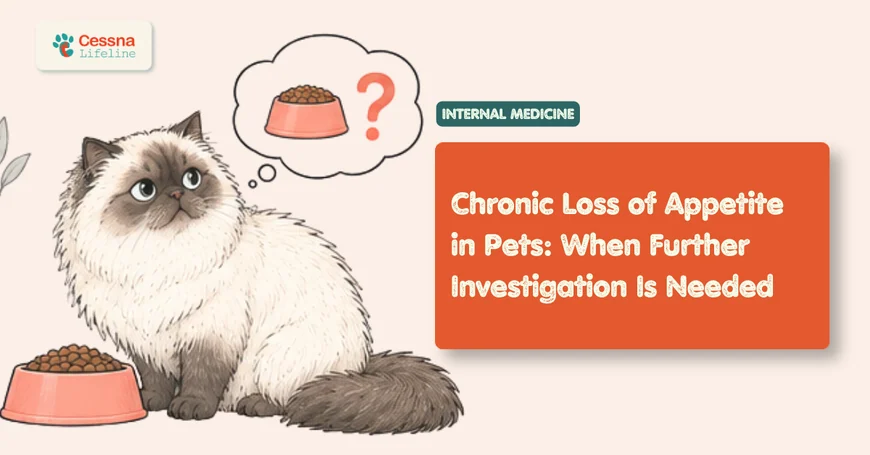
A pet who skips a meal is easy to dismiss. Stress, a bout of nausea, dislike of a new food, or simply a warm afternoon can explain a single skipped bowl. But when a dog or cat refuses food for more than a day, or eats inconsistently over several weeks, the calculation changes. The question is no longer "what upset their stomach?" It becomes "what is wrong, and how serious is it?"
Loss of appetite in pets is one of the most common reasons owners contact their veterinarian, and also one of the most diagnostically loaded. Appetite is regulated by a complex interplay of hormones, brain signals, and organ function, so when it fails, the list of possible causes runs from dental pain and anxiety all the way to kidney failure, liver disease, and cancer. Knowing where your pet sits on that spectrum, and how quickly you need answers, is what this guide addresses.
The goal here is practical: help you understand the difference between appetite loss that resolves on its own and appetite loss that demands a workup, recognize the specific red flags that change the urgency, and understand what a proper diagnostic investigation looks like when it's warranted.
The Short Version Loss of appetite lasting more than 24 to 48 hours in cats or 72 hours in healthy adult dogs warrants veterinary contact, even if the animal appears otherwise normal. Cats who don't eat for 2 to 3 days risk hepatic lipidosis (fatty liver disease), a life-threatening secondary condition requiring intensive care (Vetlens, 2026). Dental disease alone accounts for a significant share of unexplained appetite loss, affecting an estimated 80% of dogs over age 3 (GoodRx Pet Health, 2024), but chronic or recurring inappetance always warrants investigation for systemic disease.
What Counts as Chronic Appetite Loss in Pets
The word "chronic" does real clinical work here, and it's worth defining before going further. Acute appetite loss means a pet hasn't eaten for one to two days, often with an identifiable trigger. Chronic appetite loss means a pet is eating less than normal for more than a week, cycling through periods of refusal, or gradually reducing intake over weeks without an obvious cause.
Veterinary professionals use several terms to describe different degrees of appetite change:
- Anorexia (complete refusal to eat)
- Hyporexia or dysrexia (partial appetite loss; the animal eats, but less than normal)
- Inappetance (reduced food interest without complete refusal)
These distinctions matter because chronic, partial appetite loss is often more concerning than a single day of complete refusal. A dog that eats 40% of its normal food every day for three weeks is frequently sicker than one that refuses food entirely for 36 hours after a stressful car ride. The gradual nature of chronic inappetance lets owners rationalize it ("she's just picky") while serious disease progresses.
A 2020 paper in the Journal of the American Veterinary Medical Association highlighted that the terminology around reduced food intake in dogs and cats is inconsistently applied in both clinical practice and published research, making it genuinely harder to compare study findings or create standardized clinical guidelines (JAVMA, 2020). That inconsistency at the research level mirrors what owners face at home: without clear reference points, it's hard to know when "eating a bit less" crosses into a clinical problem.
A useful working rule is this: if your pet has eaten less than half of their normal food intake on more than three days in a single week, that pattern warrants a phone call to your vet, regardless of how otherwise normal your pet appears.
tracking your pet's weight at home
When a Dog Won't Eat But Acts Normal
This is the scenario that generates the most confusion for pet owners: the dog skips meals, maybe for a full day or two, but shows no other signs of illness. No vomiting. No diarrhea. No obvious lethargy. Still wants to play, still greets you at the door, still interested in treats.
There's a name for this in veterinary medicine: pseudo-anorexia or selective inappetance. It describes a dog that physically could eat but is choosing not to for reasons that range from behavioral to mildly physical. The causes most commonly include:
Behavioral and environmental causes:
- Stress from changes in routine, household, or schedule
- A recently introduced companion animal
- A change in food brand, flavor, or texture
- Social eating (the dog eats better when people are present)
- Previous illness-related food aversion (eating a specific food while sick creates a learned negative association)
Mild physical causes:
- Dental pain, especially from a fractured tooth or gum inflammation
- Mild nausea from a new medication
- Recent vaccination (minor immune response suppresses appetite temporarily)
- Gastroesophageal reflux causing early morning nausea
Dental disease is the most commonly missed cause in this category. An estimated 80% of dogs over age 3 have some degree of periodontal disease (GoodRx Pet Health, 2024). Dogs don't stop eating entirely with moderate dental pain; they eat reluctantly, slowly, drop food from their mouth, or show preference for softer foods. To an owner, this looks like a picky eater, not a dog in pain.
The practical threshold: if a healthy adult dog skips more than 24 hours of eating with no obvious trigger, contact your vet. If two days pass without food, don't wait for other symptoms to appear.
Loss of Appetite in Pets: The Underlying Causes
When appetite loss persists, recurs, or is accompanied by any other change in the pet's baseline, the list of potential underlying causes becomes the central clinical question. Veterinarians approach this as a differential diagnosis, working from the most common to the less common, and using the pet's signalment (age, species, breed, sex), history, and physical exam findings to narrow the field.
The underlying causes of chronic appetite loss in pets fall into several major categories:
Gastrointestinal disease is among the most common. Inflammatory bowel disease (IBD), intestinal parasites, pancreatitis, foreign body obstruction, and gastric ulcers all reduce appetite either through nausea, pain, or malabsorption. Pancreatitis specifically presents with inappetance, vomiting, abdominal pain, and lethargy, and is one of the most frequently encountered GI emergencies in dogs.
Organ system failure is the category where appetite loss becomes a serious indicator. Kidney disease is particularly notable: uremic toxin accumulation in the bloodstream causes nausea and oral ulceration that makes eating painful. In cats with chronic kidney disease (CKD), one survey of 1,079 CKD cat owners found that 43% reported "abnormal appetite" as a clinical sign (VIN/WSAVA, 2013). Separate studies show that 42% to 82% of cats with CKD experience weight loss, with a median weight loss of 8.9% of body weight in the year prior to diagnosis (PMC, 2016).
Endocrine disorders including Addison's disease (hypoadrenocorticism), hypothyroidism, and diabetes mellitus all affect appetite through hormonal pathways. Addison's disease, which is underdiagnosed in dogs, classically presents with waxing and waning GI signs including appetite loss, vomiting, and lethargy, often for months before diagnosis.
Cancer represents the most serious end of the differential. Cancer-associated anorexia is driven by cytokines including interleukin-1, interleukin-6, and tumor necrosis factor-alpha, which act centrally to suppress appetite independent of tumor location (Frontiers in Veterinary Science, 2024). Lymphoma, intestinal tumors, liver tumors, and mast cell tumors are the most common cancer types associated with significant appetite loss in dogs and cats.
When Lethargy Joins the Picture
A dog or cat that won't eat is a concern. A dog or cat that won't eat and seems unusually tired, slow to respond, or disinterested in things that normally excite them is a different and more urgent situation.
Lethargy combined with appetite loss is one of the most consistent clinical pairings in veterinary medicine, and the combination shortens the acceptable watchful-waiting period considerably. While a dog that's food-avoidant but energetic can reasonably wait 24 hours before a vet call, a dog that's food-avoidant and noticeably lethargic warrants same-day or next-morning contact.
The conditions most likely to produce both signs simultaneously include:
- Kidney disease: uremic toxins cause both nausea (appetite loss) and fatigue (lethargy)
- Liver disease: impaired energy metabolism and toxin accumulation produce both
- Addison's disease: cortisol and aldosterone deficiency affect energy, digestion, and appetite simultaneously
- Anemia: reduced oxygen delivery to tissues produces fatigue; concurrent GI bleeding or disease reduces appetite
- Systemic infection: fever, immune activation, and pain suppress both appetite and energy
- Pain: chronic pain from orthopedic disease, abdominal masses, or dental infection reduces activity and food interest together
The significance of this combination isn't just that it suggests something more serious. It's that lethargy provides additional data about the pet's internal state that appetite loss alone doesn't. A lethargic pet is telling you that the problem is affecting multiple systems, not just the gut.
<figcaption>When lethargy accompanies appetite loss, urgency escalates. Kidney failure with both signs warrants emergency evaluation rather than a scheduled appointment.</figcaption> </figure>
Anorexia in Cats: The Fatty Liver Factor
Cats occupy a separate clinical category when it comes to appetite loss, and it's important enough to address directly. Feline hepatic lipidosis, commonly called fatty liver disease, is a condition that develops when a cat stops eating and the body mobilizes fat stores faster than the liver can process them. Fat accumulates in liver cells, impairing function and creating a cascade of metabolic disruption.
The concerning part is how quickly this develops. Cats who go without adequate food for two to three days are at risk of developing hepatic lipidosis, and overweight cats are at higher risk because they have more fat to mobilize (Vetlens, 2026). A cat that was completely healthy last week can be in liver failure within five days of stopping eating due to an unrelated stress event.
This means the "watchful waiting" approach acceptable in dogs does not apply to cats. A cat who has not eaten for 24 to 48 hours needs veterinary contact. A cat who hasn't eaten in 72 hours needs veterinary evaluation, regardless of whether any other symptoms are present.
The underlying triggers for feline anorexia are similar to those in dogs, but cats are notably more sensitive to several specific causes: food texture and temperature changes (warmer food is more aromatic and more likely to be accepted), environmental stress (cats stop eating when they feel unsafe or their routine is disrupted), and upper respiratory infection (cats rely heavily on smell to identify food; nasal congestion can make previously acceptable food seem unpalatable).
In the context of systemic disease, CKD is the most common chronic condition in older cats and a leading cause of persistent appetite loss. From a survey of 1,079 owners of cats with CKD, 43% reported abnormal appetite as a significant ongoing problem (VIN/WSAVA, 2013), making it one of the primary quality-of-life challenges in managing long-term kidney disease in cats.
hepatic lipidosis in cats
What Diagnostic Investigation Looks Like
When appetite loss has persisted beyond the watchful-waiting threshold, veterinarians begin a systematic investigation. The sequence depends on clinical findings, but most investigations follow a recognizable arc.
Physical examination comes first and often yields more information than owners expect. A thorough oral exam can identify fractured teeth, gum disease, or oral masses. Palpation of the abdomen may reveal organ enlargement, pain responses, or masses. Lymph node assessment, coat condition, mucous membrane color, and body condition scoring all contribute to narrowing the differential.
Basic bloodwork (CBC and chemistry panel) is almost always the next step. The complete blood count reveals anemia, signs of infection, and platelet abnormalities. The chemistry panel evaluates liver enzymes, kidney values (creatinine, BUN, SDMA), blood glucose, protein levels, and electrolytes. Together, these two panels can detect kidney disease, liver disease, diabetes, Addison's disease, and several other systemic conditions within hours.
Urinalysis adds critical data about kidney concentration and function that bloodwork alone doesn't capture. A dog or cat with elevated kidney values on chemistry but concentrated urine has a different prognosis than one with dilute urine alongside the same bloodwork changes.
Imaging becomes necessary when bloodwork is abnormal or when the physical exam suggests structural changes. Abdominal radiographs can identify masses, organ enlargement, gas patterns, and foreign bodies. Ultrasound is more sensitive for soft tissue detail, lymph node assessment, and guiding needle aspirates of suspicious masses.
Additional testing may include thyroid function tests (especially in cats over 7, where hyperthyroidism is common), cortisol stimulation testing for suspected Addison's disease, bile acid testing for liver function, or cytological evaluation of lymph nodes and organ aspirates.
what to expect at a veterinary wellness visit
Appetite Stimulants and Treatment Options
When appetite loss is secondary to an underlying condition, treating the underlying cause is the primary goal. But when the underlying cause requires time to treat, or when appetite loss itself is causing rapid weight loss or nutritional deficiency, appetite stimulants become part of the management plan.
Capromorelin (sold as Entyce for dogs and Elura for cats) is the only FDA-approved appetite stimulant for small animals. It works as a ghrelin receptor agonist, mimicking the hunger hormone ghrelin to trigger appetite signals. In a prospective, randomized, placebo-controlled study of 244 dogs with reduced appetite, capromorelin produced significant increases in owner-assessed appetite scores within four days of starting treatment compared to placebo (PMC, 2025). It's available as a once-daily liquid, which makes administration relatively practical for most owners.
Mirtazapine is a human antidepressant that also functions as an antiemetic and appetite stimulant in dogs and cats. A 2025 retrospective study and placebo-controlled trial found that dogs treated with mirtazapine were significantly more likely to resume voluntary food intake compared to controls, with an odds ratio of 3.06 (PMC, 2025). In cats, mirtazapine is widely used for CKD-associated anorexia, where its combined antiemetic and appetite-stimulating properties address the nausea-driven component of appetite suppression.
Neither drug is a substitute for diagnosis. Using an appetite stimulant in a pet with unidentified disease can mask progression and delay necessary treatment. The appropriate use is concurrent with, not instead of, diagnostic investigation.
Dietary modifications sometimes bridge the gap. Warming food to body temperature increases aroma and palatability, particularly for cats. Switching to higher-protein, lower-carbohydrate foods can improve palatability in some cases. Hand-feeding, syringe feeding, and offering small, frequent meals can encourage intake in pets who've lost interest in food but retain the ability to eat.
Assisted feeding through an esophageal or nasogastric feeding tube becomes necessary when a pet cannot or will not eat enough to maintain weight and when underlying disease makes rapid recovery unlikely. Tube feeding is standard of care for cats with hepatic lipidosis, where adequate caloric intake is the primary treatment.
<figcaption>Both capromorelin and mirtazapine significantly outperform placebo for appetite stimulation in dogs. Neither replaces diagnosis of the underlying cause.</figcaption> </figure>
feeding tubes for pets
When to Push for Further Investigation
Sometimes a first visit produces normal bloodwork and a recommendation to monitor. That's a legitimate clinical outcome when the examination was thorough and initial findings were genuinely unremarkable. But if appetite loss continues or recurs after a "wait and see" period, returning with this specific ask is appropriate: "I'd like to investigate further."
Situations that warrant pushing for deeper investigation include:
Normal initial bloodwork but persistent symptoms. Basic CBC and chemistry panels can miss early-stage kidney disease (where SDMA testing is more sensitive than creatinine), early cancer, early Addison's disease, and gastrointestinal disease. If symptoms persist after a normal panel, ask specifically about SDMA, a bile acids test, cortisol stimulation testing, or abdominal ultrasound.
Weight loss accompanying the appetite change. A pet eating less but maintaining weight suggests early or mild disease. A pet eating less and losing weight simultaneously suggests the caloric deficit is significant and disease is progressing. Monthly weight checks at home using a bathroom scale (weigh yourself, then weigh yourself holding the pet, subtract the difference) are practical and informative.
Age and breed considerations. Cats over 7 should have thyroid function included in any bloodwork for appetite loss; hyperthyroidism in cats is extremely common and produces weight loss despite normal or increased food intake in some cases, but appetite suppression in others. Large-breed dogs have higher cancer rates; small-breed dogs have higher dental disease burden and cardiac disease rates. These factors change which differentials should be prioritized.
Returning symptoms after treatment. If a pet was treated for a presumed cause (dental extraction, GI medication, deworming) and symptoms return within weeks, that's evidence the first diagnosis was incomplete.
Frequently Asked Questions
How long can a dog go without eating before it becomes a medical concern?
A healthy adult dog can physically go without food for three to five days without immediate danger, but a dog not eating for more than 24 to 48 hours warrants veterinary contact, particularly if no clear behavioral trigger exists (PetMD, 2024). Puppies, diabetic dogs, and dogs with known medical conditions cannot wait this long. how to know when your dog is sick
Why is my cat not eating but acting normal?
Cats who stop eating but appear otherwise normal may have dental pain, a recent stress event, food aversion from a previous illness, or upper respiratory congestion reducing their ability to smell food (GoodRx Pet Health, 2024). The more important question is duration: cats who haven't eaten for 24 to 48 hours need veterinary contact because of the risk of hepatic lipidosis (fatty liver disease), which can develop within two to three days of caloric restriction.
What is the most common cause of appetite loss in older dogs?
Dental disease is the most frequently underdiagnosed cause of appetite loss across all ages, affecting an estimated 80% of dogs over age 3 (GoodRx Pet Health, 2024). In older dogs (8 years and above), systemic causes become increasingly common, including chronic kidney disease, liver disease, cancer, and Addison's disease. Any appetite loss in a senior dog lasting more than 24 hours warrants bloodwork rather than watchful waiting.
Can anxiety or stress cause a dog to stop eating?
Yes. Stress-related inappetance is a genuine and common cause of appetite loss in dogs, often triggered by changes in routine, new household members or pets, relocation, or prolonged separation. Stress-related appetite loss typically resolves within a day or two once the trigger is removed or the animal adapts. If appetite doesn't return within 48 hours of a known stressor, or if the stress cause isn't identifiable, veterinary evaluation is warranted to rule out concurrent illness that stress may be unmasking. anxiety in dogs
What does it mean if my pet loses appetite but is drinking more water?
Increased thirst (polydipsia) combined with decreased appetite is a significant pairing that points toward several serious conditions: diabetes mellitus, chronic kidney disease, Cushing's disease (hyperadrenocorticism), liver disease, or pyometra in intact females (WebMD Pets, 2024). This combination warrants same-day or next-day veterinary contact, not a wait-and-see approach. The bloodwork and urinalysis ordered will almost always reveal the cause.
Reading What Your Pet Can't Say
Chronic loss of appetite in pets is one of those symptoms that sits at the intersection of easy-to-dismiss and clinically significant. A dog that skips breakfast after a loud night of fireworks is not the same as a dog that has eaten 60% of its food for three weeks running. A cat that turned down a new brand of food is not the same as a cat who's lost half a pound over a month and barely finishes meals.
The difference between those scenarios is pattern, duration, and accompanying signs. Owners who track what their pet eats, notice behavioral changes early, and don't wait for dramatic symptoms before calling the vet give their animals the same advantage that early detection offers in any disease context: more options, less damage, and better outcomes.
The diagnostic tools veterinarians have access to, from basic bloodwork to abdominal ultrasound, are genuinely good at identifying the causes of chronic appetite loss when they're applied systematically. The limiting factor is usually time, specifically how long the owner waited before seeking care and how many watchful-waiting cycles passed before investigation began in earnest.
If your pet is eating less than normal and has been for more than a week, that's enough reason to call.