How Do I Know If My Dog Is in Pain?
Dogs conceal pain, so the signals that matter are posture, sleep position, stair reluctance and panting at rest. Here is how to read each one and when to worry.
The most reliable signs your dog is in pain are changes in what he does. A dog in pain usually goes quiet. He sleeps in a new position, hesitates before jumping onto the sofa, eats more slowly, licks one spot repeatedly, or simply stops doing something he used to enjoy. Crying out is real, but it is late and uncommon. If you are waiting for a yelp to confirm your suspicion, you will miss weeks or months of discomfort.
The common misconception is that a dog in pain will tell you. The instinct runs the other way. An animal that advertises weakness becomes a target, and domestication has not removed that wiring. A dog with a painful hip will still get up to greet you at the door, because greeting you matters more to him than protecting the joint.
This article covers the early behavioural signs, the specific postures and movements that point to particular problems, how to separate pain from ordinary ageing, which signs mean you should go to a vet today, and what we do to confirm and treat pain in a patient who cannot describe it.
What to Know Dogs conceal pain. Behaviour shifts long before anything is visible: reluctance on stairs, a new sleeping position, slower eating, licking one area, irritability when handled. Panting at rest, with no heat and no exercise to explain it, is one of the most commonly missed pain signs in dogs. Never give human painkillers. Ibuprofen, aspirin and diclofenac cause stomach ulceration and kidney injury in dogs; paracetamol damages the liver and has a very narrow margin. In a small dog a single tablet can do serious harm. A dog who cries when lifted, has a tense hard abdomen, cannot settle, or retches without producing anything needs veterinary attention the same day.
Why Do Dogs Hide Pain So Well?
Concealing pain is a survival behaviour and it is older than domestication. An animal that limps conspicuously or lies groaning in the open is the one a predator selects. Dogs descend from animals for whom looking well was a form of defence, and several thousand years in our houses has not undone that.
This produces a predictable pattern in the consulting room. An owner arrives saying the problem started last week. The radiographs show a joint that has been deteriorating for a year. Nobody was careless. The dog was doing what dogs do, which is to compensate quietly until compensation stops working, and then to look, from the outside, as though something sudden has happened.
Stoicism varies between individuals and to some extent between types. Working breeds and the Indian street-descended dogs we see a great deal of in Bengaluru are often remarkably uncomplaining. Many were shaped, formally or informally, by a simple requirement to carry on. Small companion breeds tend to be more expressive, which cuts both ways. A Pomeranian who yelps when lifted may have a genuine spinal problem, or may dislike being lifted, and only an examination separates the two.
The speed of onset matters more than almost anything else. Chronic pain that arrives slowly is the hardest kind to see, because there is no before and after to compare. A dog who loses a little mobility every month gives you no single day on which something changed, and the new normal replaces the old one too gradually to notice. Acute pain is far easier. A dog who was sound at breakfast and is holding a leg up by lunch has handed you a clear signal.
There is one more reason pain goes unrecognised, and it is ours. We expect pain to look like suffering. In practice it looks like a slightly duller dog. Owners who are told their dog has been in pain for months often feel they should have seen it. Very few people see it, which is why a structured look at the specific signs is more useful than being more observant in general.
What Are the Earliest Signs Your Dog Is in Pain?
The earliest signs are nearly always behavioural, and nearly always a subtraction. Less interest, less movement, less tolerance. Owners describe them as changes in personality, and that description is accurate. Pain alters personality before it alters posture.
Watch for subtraction. The dog who used to bring a toy and now does not. The dog who met you at the gate and now lifts his head from the floor instead. The dog who slept curled against the sofa and now stretches flat on the cool tiles, or the reverse. None of these is dramatic on its own. Together they are information.
Irritability deserves particular attention, because it is the sign most often misread as a training problem. A gentle dog who begins growling when a child leans on him, who snaps when the collar goes on, or who has turned unpredictable near his bed is frequently a dog who hurts. Pain lowers the threshold for everything. Correcting the growl makes matters worse and teaches the dog that signalling discomfort brings trouble, which removes the only warning you had.
| Early change | What it often reflects |
|---|---|
| Slower to stand after lying down | Joint or spinal pain, usually chronic |
| Hesitating at stairs, cars or the sofa | Hip, stifle, elbow or back pain |
| Licking or chewing one spot persistently | Pain referred from the joint or tissue beneath |
| Eating more slowly, dropping food, chewing on one side | Dental pain or facial pain |
| New growling or snapping when touched | Pain anywhere; often neck, back or ears |
| Sleeping in an unfamiliar position or place | Attempt to unload a painful area |
| Withdrawing from the family, hiding, facing the wall | Generalised discomfort or visceral pain |
| Restlessness and pacing at night | Pain that is worse at rest, or abdominal pain |
Two of those entries confuse owners regularly. The first is dental pain, which almost never presents as a dog refusing to eat. Hunger beats toothache in most dogs, so they keep eating and simply do it differently: slower, tilted to one side, with kibble dropped and picked up again. The second is hiding. A dog who takes himself behind the sofa is often assumed to be sulking. Dogs do not sulk in the way we mean it. A dog who removes himself from the household is usually telling you that being approached has become unwelcome, and pain is the commonest reason for that.
In what order do the signs usually appear?
For a slowly progressing problem such as arthritis or degenerative joint disease, the signs tend to emerge in a rough sequence. Knowing the sequence helps, because the signs at the top of the list are the ones that give you months of warning, and the ones at the bottom are the ones most owners are waiting for.
The useful lesson from that pattern is that the signs most owners treat as confirmation are the ones that arrive last. By the time a dog is flinching or vocalising, the problem has usually been present for a long time. The signs at the top of the chart are vaguer and easier to dismiss, and they are also the ones that let you act early, when there is more that can be done.
How Does Pain Change the Way a Dog Moves?
Movement and posture are the most objective evidence available to you at home, and they are often clearer on video than in person. Film your dog walking away from you and towards you on a hard floor, then film him standing still and getting up from lying down. Owners who bring that footage to a consultation give us more information in thirty seconds than ten minutes of description.
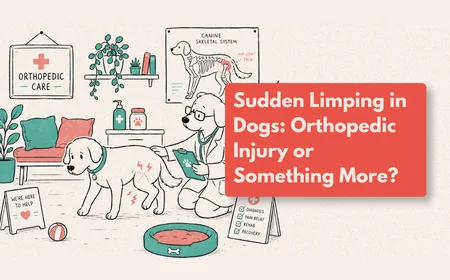
A limp is the obvious sign and the least common one. Dogs in chronic pain usually redistribute weight instead of lifting a leg, and redistribution reads as a general stiffness. Look at where the weight sits when the dog stands square. A dog quietly keeping load off a painful hind limb will stand with that foot slightly forward and the opposite hip dropped, and over months the muscle on the sore side becomes visibly thinner than the other.
| What you see | What it often points to |
|---|---|
| Chest down, forelegs out, hindquarters raised | Abdominal pain, sometimes severe |
| Hunched back, tucked belly, short tight steps | Abdominal or spinal pain |
| Standing with weight shifted off one hind leg | Hip, stifle or cruciate problem |
| Sitting with one hind leg out to the side | Stifle pain, commonly cruciate disease |
| Head carried low, reluctant to look up or turn | Neck pain or cervical disc disease |
| Both hind legs moving together in a bunny hop | Pain in both hips |
| Lying down slowly, in stages, with a drop at the end | Joint pain, often elbows or hips |
| Pacing, circling, unable to settle anywhere | Visceral pain or severe discomfort |
The chest-down posture in the first row has a specific name in practice, the praying position, and it matters because dogs adopt it to relieve pressure on a painful abdomen. A dog holding that position, especially one who is also retching unproductively or whose belly looks distended, is an emergency. In deep-chested breeds it can indicate gastric dilatation and volvulus, where the stomach twists, and that is measured in hours.
Stairs and slick floors are a useful everyday test, and in Bengaluru flats the polished granite and vitrified tiles that most homes have are genuinely informative. A dog with hip or stifle pain loses confidence on a smooth surface long before he loses the ability to walk on grass, because he cannot trust his footing if the joint will not take a correction. Owners often read the hesitation as fear of the floor. Put a few rubber-backed mats along his usual route and watch whether the hesitation disappears. If it does, the floor was only revealing a problem that was already there.
Do Panting, Sleep and Appetite Changes Mean Pain?
They can, and panting is one of the most under-recognised pain signs in dogs. Panting at rest, in a cool room, with no exercise in the previous half hour, is abnormal. It is a stress response, and pain is one of the commonest causes.
In Bengaluru this takes some care to interpret, because heat and humidity confound it. A dog panting at two in the afternoon in April is probably hot. A dog panting at two in the morning in a fan-cooled room, who then settles when he is given something for pain, was in pain. Judge panting by context: temperature, time, recent activity, and whether it has changed from the dog's own baseline.
Night-time restlessness points the same way. Many painful conditions are worse at rest, partly because there is nothing to distract from them and partly because joints stiffen when they are still. A dog who circles, shifts position repeatedly, gets up to drink, or whines quietly at three in the morning and then sleeps through the afternoon is describing a pain pattern. Owners frequently bring this in as a behavioural complaint about sleep, and in older dogs it is often one of the first things to improve on appropriate analgesia.
Appetite is a less reliable indicator than people expect. A dog who stops eating entirely is clearly unwell, but the reverse does not hold. Plenty of painful dogs eat normally, and dental pain in particular rarely stops a dog eating. The amount often stays the same while the manner changes: slower, more selective, dropping pieces, preferring soft food, turning away from a bone or a hard chew he used to take.
Track water intake and toilet habits too. A dog who suddenly strains, cries or adopts the posture repeatedly without producing urine may have a blocked urethra or cystitis, both painful and both urgent. A dog who has started having accidents indoors may be in too much pain to get up and go outside, which is a mobility problem presenting as a house-training problem.
How Do I Tell Pain From Normal Ageing?
This is the most important distinction on the page, and the honest answer is that most of what owners attribute to old age is pain. Ageing slows a dog down. It does not make him stiff for twenty minutes after a nap, reluctant on stairs, irritable when handled, or unwilling to jump into a car he managed last year. Those are mechanical and inflammatory problems, and most of them respond to treatment.
The reframe that helps is to stop asking whether the behaviour is normal for the age and start asking what is physically stopping the dog. Old age is not a mechanism. Something specific is limiting him, and in older dogs it is usually osteoarthritis, dental disease, or both at once.
| What owners say | What is usually happening |
|---|---|
| "He is just slowing down." | Joint pain limiting activity, often hips, elbows or spine |
| "He has become grumpy in old age." | Pain lowering his tolerance for handling and contact |
| "He sleeps all day now." | Reduced activity because movement hurts, plus poor night sleep |
| "He does not play any more." | Pain on the turns, stops and jumps that play involves |
| "He is fussy about food now." | Dental pain or nausea, not fussiness |
| "He cannot manage the stairs at his age." | Specific hind limb or spinal pain, often treatable |
Monsoon brings a seasonal version of the same question. Owners notice their dog is stiffer through June and July and put it down to the weather. Damp and cooler mornings do make arthritic dogs less comfortable, and reduced walking in the rain means less maintained muscle, which makes joints feel worse. The weather is a trigger, not the diagnosis. If your dog is noticeably worse every monsoon, he has an underlying joint problem for the rest of the year, and it should be treated properly.
There is a diagnostic shortcut we use for exactly this question, and it is more reliable than any single examination finding. A short, controlled course of a prescription pain relief appropriate to the dog, given for a week or two, and an honest assessment of what changed. If the dog starts greeting you at the door again, climbs the stairs without pausing, or sleeps through the night, the problem was pain. That trial has to be prescribed and monitored, because the medicines involved require a weight-based dose and some assessment of kidney and liver function first.
Which Signs of Pain Need a Vet Today?
Most pain is chronic and can be assessed at a routine appointment within a few days. A smaller group of signs indicates pain severe enough, or a cause urgent enough, that waiting is not safe. Treat the following as reasons to see a vet the same day.
- Crying out when touched, lifted or moved, or a dog who screams on standing
- A tense, hard or distended abdomen, or the chest-down praying posture
- Repeated retching or attempts to vomit that produce nothing
- Straining to urinate without producing urine, particularly in male dogs
- Any inability to stand, bear weight on a limb, or use the hind legs
- A dog who cannot settle at all, pacing continuously for hours
- Pale or very red gums, rapid breathing, or collapse alongside signs of pain
- A known trauma such as a road accident or a fall, even if the dog seems bright
- Sudden onset of severe neck or back pain, especially with wobbliness behind
- A bite wound, a puncture, or a swelling that is hot and painful
Road traffic injuries deserve a specific note here. A dog hit by a vehicle can look remarkably well for several hours and still have a ruptured bladder, a diaphragmatic tear, internal bleeding or a fractured pelvis. The adrenaline of the event masks a great deal. Any dog involved in a collision should be examined regardless of how he appears.
One further caution applies locally. Rabies remains present in India, and sudden unexplained changes in temperament, swallowing or vocalisation in a dog who is unvaccinated or has a possible bite history should be taken seriously and discussed with a vet by telephone before handling the dog closely. This is rare in comparison with ordinary pain, and the great majority of grumpy dogs are simply sore, but the consequences of missing it are severe enough that it belongs on the list. Keep your dog's rabies vaccination current.
Can I Score My Dog's Pain at Home?
You can, and doing it in writing is far more useful than doing it in your head. Pain scoring at home works because it forces a comparison against a recorded baseline instead of your memory of how your dog used to be, and memory adjusts quietly to decline.
Pick five things your dog does every day: getting up from lying, managing stairs or a jump, the first two minutes of a walk, greeting you, and settling at night. Score each out of two, where zero is normal for him, one is slower or more hesitant, and two is unwilling or unable. Record it once a day for a week at the same time of day. The total gives you a number you can repeat, and the trend matters more than any single figure.
| Overall picture | What you are seeing | What to do |
|---|---|---|
| Comfortable | Normal activity, sleep and temperament | Continue routine checks, note the baseline |
| Mild | Slower to rise, slight hesitation, otherwise himself | Keep a diary for a week, then book a review |
| Moderate | Clear reluctance, stiffness, reduced play, new irritability | Book an examination this week |
| Marked | Limping, panting at rest, poor sleep, avoiding handling | See a vet within twenty-four hours |
| Severe | Crying out, unable to stand, cannot settle, tense abdomen | Same-day emergency assessment |
Two practical rules improve the quality of what you record. Score at the same time each day, because many painful dogs are worst in the first hour after waking and look fine by evening. Film it and do not try to describe it, since a ten-second video of a dog rising from the floor tells a clinician more than a paragraph about it.
What a home score cannot do is identify the cause. A dog scoring moderately might have hip arthritis, a cruciate injury, a disc problem, a dental abscess or tick fever, and the management of those differs entirely. Ehrlichia and Babesia infections transmitted by ticks are common in Bengaluru and can present as a vague, achy, lethargic dog with shifting joint pain and no obvious lameness, which is one reason a blood test often forms part of the workup in a dog who seems sore without a clear mechanical reason.
What Should I Never Give My Dog for Pain?
Human painkillers are among the most frequent causes of serious drug poisoning we treat in dogs, and the intention behind them is almost always kind. The margin of safety in dogs is much narrower than in people, and for some of these drugs there is no dose an owner can safely guess at.
| Do not give | Why |
|---|---|
| Paracetamol (acetaminophen) | Very narrow margin in dogs and liver damage above it; rapidly fatal in cats at small amounts |
| Ibuprofen | Stomach ulceration and perforation, kidney injury; one tablet can harm a small dog |
| Aspirin | Gastric bleeding, clotting effects, and it complicates safe prescribing afterwards |
| Diclofenac and similar gels or tablets | Strongly ulcerogenic; also absorbed when licked off skin |
| Leftover medicines from another pet | Wrong drug, wrong dose, wrong weight, and often expired |
| Human balms, sprays and muscle rubs | Licked off and swallowed; several contain salicylates or camphor |
| Turmeric, oils or massage used alone | No reliable pain relief at the doses used, and they delay diagnosis |
Giving a human anti-inflammatory also narrows what we can do next. Veterinary anti-inflammatories cannot safely be started on top of a dog who has recently had ibuprofen or aspirin, so an owner trying to help often has to wait several days before effective treatment can begin, with the dog still in pain throughout. If your dog has already had a human painkiller, say so plainly when you arrive. Nobody will be annoyed, and it changes the plan.
If your dog has swallowed any of these, do not wait for symptoms. Bring the packet and go straight to a vet. With ibuprofen and paracetamol, treatment given early is markedly more effective than treatment given once vomiting or jaundice has begun.
Effective veterinary pain relief does exist and most of it is well tolerated in dogs when dosed by weight and monitored. There are licensed anti-inflammatories, drugs that target nerve pain specifically, and a range of options for dogs whose kidneys or livers restrict the usual choices. An injectable monoclonal antibody for osteoarthritis pain is also available in some markets, and we can tell you whether it is an option for your dog. The right choice depends on the diagnosis, the dog's age and his bloodwork, which is why prescribing follows the examination and not the other way round.
What Will a Vet Do to Find and Treat the Pain?
A pain consultation is mostly a physical examination, and a thorough one takes time. We watch the dog walk and turn before touching him, because handling changes how a dog moves. Then we work systematically through the spine, the limbs, the joints and the abdomen, comparing left with right, and watching the face and the ears closely throughout. Most dogs signal pain with a stillness, a muscle twitch, a turned head or a lick of the lips long before they make a sound.
From there the route depends on what the examination finds. Orthopaedic pain usually needs radiographs, often under sedation, because a tense dog cannot be positioned accurately and a painful joint cannot be properly stressed while he is awake. Spinal pain with any neurological deficit may need advanced imaging. A dog who is sore without a mechanical explanation gets blood work, including tick-borne disease testing, which is a high-yield test in this city. Dental pain needs a conscious look, then an examination under anaesthesia with dental radiographs, because most of the relevant disease sits below the gumline where it cannot be seen.
Treatment is rarely a single prescription. For a chronic joint problem, medication is one of four parts, and the other three carry most of the long-term benefit: weight control, which is the most effective single intervention for an overweight arthritic dog and the one owners underestimate most; controlled daily exercise that maintains muscle without flaring the joint; and changes at home such as mats on slick floors, a ramp into the car, a raised bowl and a supportive bed. Physiotherapy and hydrotherapy help selected patients considerably.
The part that matters most is the review. Pain management is adjusted, not prescribed once. We ask you to repeat the same home observations after two to four weeks so there is something objective to compare, and then we change the dose, the drug or the plan based on what actually improved. A dog who is greeting you at the door again has given you a clearer answer than any scan.
Frequently Asked Questions
How do I know if my dog is in pain?
Watch behaviour, not noise. Reluctance on stairs, slowness getting up, a new sleeping position, licking one spot, panting at rest, reduced play and new irritability when handled are the common signals. Crying out appears late and many painful dogs never do it. Film your dog rising and walking, keep a short daily diary, and book an examination.
What are the earliest signs your dog is in pain?
The earliest changes are usually subtractions: less enthusiasm for walks, less greeting at the door, less interest in toys, a shorter fuse when touched. A dog may also begin sleeping somewhere new or in a different shape to unload a sore area. These vague signs arrive months before any limp and are the ones to act on.
Why does my dog pant at night but seem fine in the day?
Many painful conditions, particularly joint and spinal problems, feel worse at rest. There is nothing to distract from the discomfort and joints stiffen when still. Panting in a cool room, with no recent exercise, is a stress response, not temperature control. In Bengaluru rule out heat first, then have the pattern assessed properly.
Can I give my dog paracetamol or ibuprofen for pain?
Never. Both cause serious harm in dogs. Ibuprofen produces stomach ulceration and kidney injury, and a single tablet can be dangerous in a small dog. Paracetamol has a very narrow margin in dogs, damages the liver above it, and is rapidly fatal to cats. Recent human painkillers also delay safe veterinary prescribing by several days, leaving your dog in pain for longer.
Is my dog just getting old, or is he hurting?
Age slows a dog down. Age does not make him stiff for twenty minutes after a nap, grumpy when handled, or unwilling to climb stairs he managed last year. Most of what owners attribute to ageing is osteoarthritis or dental disease, and both respond well to treatment. A short monitored trial of prescription pain relief usually settles the question.
Does a limp without crying still mean pain?
A limp almost always means pain. Dogs rarely change gait for any other reason, and neurological weakness is the main exception. Very few of them vocalise about it, so silence tells you about the dog's temperament, not the severity of the problem. A limp lasting more than a day or two, or one that returns after rest, needs an examination and usually radiographs.
How will a vet tell whether my dog is in pain?
Assessment begins with watching the dog move before anyone touches him, then a systematic examination of spine, limbs, joints and abdomen, comparing both sides while reading facial tension instead of waiting for a yelp. Radiographs under sedation, blood tests including tick-borne disease screening, and a monitored trial of analgesia follow depending on what the examination suggests.
Next Steps
If your dog is crying out, cannot stand, has a tense or swollen abdomen, is retching without producing anything, straining to urinate, or has been in a road accident, stop reading and go to a vet now. Those signs are urgent and some of them are measured in hours.
If the picture is quieter, which it usually is, start recording. Score the same five everyday activities once a day for a week, at the same time each day, and film your dog getting up from the floor and walking on a hard surface. Clear the slick floors with a few rubber-backed mats and see what changes. Do not give any human painkiller while you wait.
Then bring the diary and the videos in. Our team can examine your dog properly, work out what is physically limiting him, and tell you whether radiographs, blood tests or a monitored course of pain relief is the right next step. Book an examination with us and we will give you a plan you can measure, with a review date to check it is working.