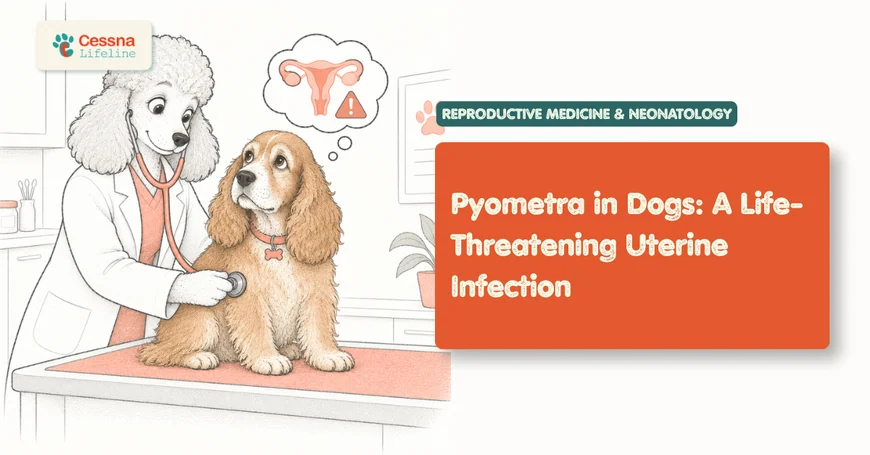
Pyometra in Dogs: A Life-Threatening Uterine Infection
Nearly 25% of intact female dogs develop pyometra before age 10. Recognize the symptoms, understand emergency surgery, and learn how to protect your dog.
Pyometra kills dogs that show no obvious symptoms until the infection has already taken hold. It's a bacterial infection of the uterus, but calling it that undersells the danger. By the time many owners recognize something is wrong, pus has filled the uterus, toxins have entered the bloodstream, and the kidneys may already be failing.
The numbers reflect how common this disease actually is. Nearly 25% of all intact female dogs develop pyometra before the age of 10, according to epidemiological data from Swedish veterinary research conducted in a population where routine spaying is uncommon. In certain breeds, lifetime risk exceeds 70%. The condition develops silently, often within four to eight weeks of a heat cycle, and it can move from subtle lethargy to septic shock within days.
Recognizing pyometra early isn't a nice-to-have. For many dogs, it's the difference between a straightforward surgery and an emergency that tests the limits of veterinary medicine. This article covers what pyometra is, why it's so dangerous, how to spot it, what emergency surgery looks like, and how spaying removes the risk entirely.
What to Know Pyometra is a life-threatening uterine infection affecting roughly 1 in 4 intact female dogs before age 10 (Hagman, Veterinary Integrative Sciences, 2021). Without emergency treatment, it carries a near-100% fatality rate. With timely ovariohysterectomy, survival reaches 97%. Spaying before or shortly after the first heat cycle eliminates the risk entirely.
What Is Pyometra and Why Does It Turn Deadly?
The name comes from the Greek for "pus uterus," and the condition lives up to that description. Pyometra occurs when bacteria colonize the uterus during or after a heat cycle, multiplying in an environment that progesterone has made uniquely hospitable to infection. The uterus fills with pus. In some dogs, that pus has nowhere to drain. In others, it exits through the cervix. In both forms, the systemic consequences can be severe.
What makes pyometra so dangerous isn't the local infection alone. It's the cascade that follows. Bacterial toxins leak into the bloodstream, triggering a whole-body inflammatory response. The kidneys, which must process the toxins produced by the bacteria, come under particular strain. Some dogs develop acute kidney injury, sepsis, and septic shock within 48 to 72 hours of the infection becoming established. Some collapse with no prior warning signs.
The bacterium most often responsible is Escherichia coli, the same microorganism that lives normally in the intestinal and vaginal flora of healthy dogs. Under ordinary circumstances, the uterus keeps it at bay. Under progesterone's influence, the uterine immune defense drops significantly.
Mortality rates, when treatment is delayed, range from 10% to 17% across published veterinary studies, and approach near-certain death if the uterus ruptures before surgical intervention occurs (Hagman, Veterinary Integrative Sciences, 2021). Dogs caught early and treated surgically land near the low end of that range. Dogs arriving in septic shock do not.
In clinical practice, the window between "seems a little off" and "critical emergency" can be as short as 48 hours. Veterinary teams who treat pyometra routinely note that owner-reported timelines often underestimate how long the dog has been symptomatic, because the earliest signs (mild lethargy, reduced appetite) are easy to attribute to something minor. The disease advances while owners wait.
How to recognize a dog emergency at home
How Does Progesterone Drive Pyometra Development?
The uterus doesn't become infected randomly. There's a predictable physiological sequence, and understanding it explains why intact older dogs face a compounding risk with every heat cycle they experience.
During estrus, progesterone levels rise sharply to prepare the uterine lining for potential pregnancy. After the cycle ends, progesterone doesn't drop immediately. It stays elevated for four to eight weeks, keeping the uterine lining thick and secretory. In a dog that doesn't conceive, that thickening serves no purpose. Over repeated cycles, the lining compounds. Vets call the resulting condition cystic endometrial hyperplasia (CEH).
Why does progesterone create this vulnerability? Because the hormone also suppresses the local immune response within the uterus. That suppression is intentional from a biological standpoint: the uterus must tolerate a developing embryo, which the immune system would otherwise reject. In a dog that doesn't become pregnant, that same suppression leaves the uterus defenseless. Bacteria from the vaginal flora, particularly E. coli, migrate upward through the cervix during estrus when it briefly opens, and find an environment that cannot fight them off.
A dog on her eighth heat cycle without pregnancy or spaying has a far more vulnerable uterine environment than one on her second. That's why pyometra predominantly affects middle-aged and older intact females, even though it can occur in younger dogs after a single cycle.
We've found that owners are often surprised to learn how tightly the timing maps to the heat cycle. Most pyometra cases present within four to eight weeks of a heat cycle ending. If your intact female dog shows any unusual symptoms in that specific window, that context matters. Mention it to your vet immediately, because it narrows the differential diagnosis considerably.
Understanding the canine heat cycle
Which Dogs Are Most at Risk?
Age and intact status are the two most reliable predictors, but breed matters more than many owners realize. Certain breeds carry a lifetime risk high enough that it should factor directly into decisions about spaying.
Breed-level prevalence data from Swedish epidemiological studies reveal a striking range across commonly kept breeds. Saint Bernards carry one of the highest documented lifetime risks, reaching 71.4% in insured populations studied. Tibetan Mastiffs follow at 54.5%. Dalmatians sit at 43.7%. Golden Retrievers, often discussed as a lower-risk breed in general contexts, show a lifetime prevalence of approximately 37% in the Swedish population studied by Hagman and colleagues. German Shepherds present at a much lower rate, around 3.4% (Hagman, breed risk studies, PubMed).
<figcaption>Lifetime prevalence of pyometra by breed in intact female dogs. Saint Bernards carry the highest documented risk at 71.4%. Source: Hagman et al., Swedish veterinary epidemiology data.</figcaption> </figure>
Dogs over six years of age account for the majority of cases, but pyometra isn't limited to older animals. In large and giant breeds, the condition has been documented in dogs as young as one to two years old after only one or two heat cycles. Hormonal medications, including synthetic progesterone used to suppress heat or treat false pregnancy, significantly raise risk regardless of age or breed. Intact dogs that have never been pregnant also show higher prevalence than those that have successfully carried a litter.
Every heat cycle without pregnancy or spaying adds another layer of risk. Recognizing which dogs are in high-risk categories is the first step toward catching the disease before it becomes a crisis.
Breed-specific health risks
What Are the Symptoms of Pyometra in Dogs?
The answer depends partly on which form of pyometra the dog has, and partly on how far the infection has progressed. The symptoms don't always announce themselves loudly. Many owners describe the early stage as indistinguishable from a mild illness: the dog seems tired, isn't finishing her meals, and drinks more water than usual.
General signs that appear across both types:
- Lethargy and depression (the most consistently reported early sign)
- Loss of appetite or complete refusal to eat
- Increased water intake (polydipsia) and unusually frequent urination (polyuria)
- Vomiting
- Abdominal distension as the swollen uterus presses on surrounding organs
- Fever, though not reliably present and sometimes absent even in severe infection
- Weakness or collapse in advanced cases
In open pyometra, the cervix remains at least partially dilated, and a visible vaginal discharge appears. It's typically cloudy, yellowish, or blood-tinged, with a foul odor. Owners who notice this and confuse it for a normal post-heat discharge face a particular risk, because the presence of drainage can create a false sense that the dog is managing the infection.
In closed pyometra, there is no visible discharge. This is what makes it more insidious. The uterus fills with nowhere to drain, pressure builds, and the risk of uterine rupture climbs steadily. A dog with closed pyometra looks ill but gives you nothing external to point to. She drinks more, seems off, may vomit, and her abdomen may gradually firm up as the uterus expands.
Polydipsia and polyuria appear in a significant proportion of pyometra cases because bacterial toxins interfere with the kidney's ability to concentrate urine properly. If your intact female dog has started drinking noticeably more water within a few weeks of her last heat cycle, that symptom alone is reason to call the vet that same day, not to monitor for another 48 hours.
Research published in BMC Veterinary Research confirmed that dogs with closed cervical pyometra presented with significantly more severe illness scores, higher rates of systemic inflammatory response syndrome, and longer post-operative hospitalizations compared to dogs with open cervical disease. The anatomical detail of whether the cervix can drain changes the entire clinical picture and urgency level (Fransson et al., BMC Vet Res, 2014).
Abnormal vaginal discharge in dogs
Open Pyometra vs. Closed Pyometra: How Does the Cervix Change Everything?
The cervix is the gatekeeper. Whether it stays open or closes after infection takes hold shapes how symptoms present, how fast the condition progresses, and how sick the dog is when she finally reaches veterinary care.
In open pyometra, the cervix remains at least partially dilated, allowing infected material to exit the uterus through the vagina. This is not a safe or self-resolving situation. The infection is still active, bacteria are still producing toxins, and the uterus is still vulnerable. But the visible discharge gives owners a cue that something is wrong, and the disease tends to progress somewhat more slowly because pressure inside the uterus has a partial outlet.
Closed pyometra is the faster-moving, harder-to-spot form. The cervix seals. The uterus fills with pus and fluid with nowhere to go. Pressure builds steadily. The dog looks sick, drinks excessively, may vomit, but shows nothing externally. On abdominal radiographs, the fluid-filled uterus sometimes appears as a large, sausage-shaped mass that displaces the intestines. An untrained eye can mistake it for a normal finding. A radiologist doesn't.
Why does a closed cervix make things so much worse? Because a sealed, pus-filled uterus is a pressure vessel. When pressure exceeds the tissue's tolerance, the uterus ruptures. Infected material spills into the peritoneal cavity. What was already a serious surgical case becomes an extreme one, adding peritonitis, septic shock, and a contaminated abdominal cavity to an already compromised patient.
Cost data reflects the difference in severity. Open pyometra surgery typically runs $1,400 to $4,000, depending on the dog's size, clinic type, and location. Closed pyometra, which often requires more intensive pre-surgical stabilization, runs $2,500 to $6,400 or more at emergency referral hospitals (VetReceipt.com, 2026 veterinary cost data). The cost gap reflects the clinical complexity, not just overhead.
Both forms are emergencies. The distinction matters because it affects the margin of time available. Open pyometra gives a slightly wider window. Closed pyometra does not.
A retrospective study reviewing 348 dogs with suspected pyometra identified uterine rupture as the primary mortality-contributing factor. Rupture occurred exclusively in advanced or closed pyometra cases and was strongly associated with delayed diagnosis and delayed owner presentation to veterinary care (Hagman, Veterinary Integrative Sciences, 2021).
When to go to an emergency vet vs. wait
How Vets Diagnose Pyometra
Veterinarians diagnosing pyometra work through a combination of patient history, physical examination, blood work, and imaging. No single test confirms it alone. The clinical picture assembles from multiple sources.
History is the starting point. A vet will ask about the dog's last heat cycle, any hormonal medications given, changes in water consumption or urination patterns, and how long symptoms have been present. A middle-aged intact female presenting with lethargy and polydipsia four to six weeks after her last heat raises immediate suspicion, even before a single test is run.
Physical examination often reveals an enlarged, tender abdomen. The uterus, not normally palpable in a healthy dog, becomes large enough to detect manually in moderate-to-severe cases. Any vaginal discharge is noted and assessed.
Blood work typically shows a markedly elevated white blood cell count, reflecting the immune response to systemic infection. Kidney values, specifically blood urea nitrogen (BUN) and creatinine, may be elevated in dogs whose kidneys have been stressed by bacterial toxins. A WBC count above 30,000 cells per microliter tends to correlate with more severe systemic disease and longer recovery (Fransson et al., BMC Vet Res, 2014).
Imaging confirms the diagnosis and guides surgical planning. Abdominal radiographs can reveal a fluid-filled uterus displacing surrounding organs. Ultrasound is more definitive, showing fluid-filled uterine horns, thickened uterine walls, and, in some cases, early peritoneal reaction if rupture is close.
In dogs arriving in severe condition, stabilization begins alongside diagnostics. Waiting for every test result before starting IV fluids and antibiotics isn't always appropriate.
Leukocytosis is one of the most consistent indicators of systemic involvement in canine pyometra. Dogs presenting with white blood cell counts above 30,000 cells/µL have been shown to require longer hospitalizations and carry greater post-operative complication rates compared to dogs with lower counts, making early bloodwork an important prognostic and triage tool (Fransson et al., BMC Vet Res, 2014).
What Happens During Emergency Surgery for Pyometra?
Surgery is the definitive treatment for pyometra in the vast majority of dogs, and the outcomes are genuinely encouraging when treatment occurs before the dog reaches septic shock.
The procedure is an ovariohysterectomy: the same operation as a routine spay, but performed in a dog whose uterus is infected, inflamed, and often dramatically enlarged. Surgeons handling a pyometra OHE work carefully, because a friable, pus-filled uterus requires gentle handling to prevent rupture during removal. The ovaries are taken at the same time, eliminating the hormonal environment that drove the infection in the first place.
Before the first incision, dogs in poor condition need stabilization. Intravenous fluids correct dehydration and support blood pressure. Broad-spectrum antibiotics begin pre-operatively. Analgesics and antiemetics are administered as needed. The goal is to bring the dog to the safest possible state for anesthesia without unnecessary delay.
What do the survival numbers actually look like? A 2022 study published in the Journal of the American Veterinary Medical Association found a 97% survival rate to hospital discharge in surgically treated dogs, with 394 of 405 cases surviving, even when surgery was performed in non-specialized private practice settings (JAVMA, 2022). That's a meaningful figure. It means that most dogs who make it to surgery while still stable survive.
<figcaption>Pyometra treatment outcomes. Surgical OHE delivers 97% survival to discharge. Medical management resolves 75–85% of open cases initially, but 50–75% recur at the next heat cycle. Sources: JAVMA (2022); VCA Animal Hospitals; Veterinary Integrative Sciences (2021).</figcaption> </figure>
After surgery, most dogs stay in hospital for 24 to 72 hours for IV fluid support, ongoing antibiotics, and pain management. The clinical turnaround can be remarkable: dogs that arrived hunched, lethargic, and unwilling to move often show interest in food within 24 hours of the infected uterus being removed.
Surgery costs range from $1,400 to over $6,000 depending on the dog's size, severity of illness, whether the surgery is performed at a general practice or emergency referral center, and geographic location. Pet insurance that covers illness can substantially offset these figures if the policy predates the diagnosis.
A 2022 JAVMA study of 405 surgically treated pyometra cases found 97% survival to hospital discharge, even in a non-specialized private practice environment. This outcome held across varying severity presentations, underscoring that the procedure itself is not the limiting factor: the timing of presentation is (JAVMA, 2022).
Pet insurance for emergency vet bills
Can Medical Management Replace Surgery for Pyometra?
Some owners, particularly those with breeding dogs, ask whether there's a non-surgical option. Who is the real candidate for medical management, and what does it actually involve?
The protocol typically involves prostaglandin injections, which cause the uterine musculature to contract and expel infected contents while simultaneously lowering progesterone levels. Antibiotic therapy runs alongside.
This approach is appropriate only for dogs with open pyometra (drainage must be possible), dogs without severe systemic illness, and dogs whose owners have a clear breeding purpose. It requires four to seven days of hospitalization for monitoring, because initial prostaglandin doses frequently cause temporary side effects including vomiting, defecation, salivation, and significant restlessness.
The initial success rate in appropriate candidates is 75 to 85%. The problem lies in what happens next. Research consistently documents a 50 to 75% recurrence rate at the subsequent heat cycle (VCA Animal Hospitals, Pyometra clinical reference). Most dogs treated medically develop pyometra again, often in a future heat cycle when they're older and carry higher surgical risk than they do today.
Veterinarians present medical management as a bridge option: treat the current episode, breed on the first eligible cycle following treatment, then spay. It's not a permanent solution, and it shouldn't be presented as one.
Medical management with prostaglandins achieves pyometra resolution in 75 to 85% of correctly selected cases (open cervix, no severe systemic disease), but published recurrence data shows 50 to 75% of medically managed dogs develop pyometra again at the next estrus. The standard clinical recommendation is to breed the dog on the first post-treatment cycle and then spay (VCA Animal Hospitals, Pyometra clinical reference).
Canine reproductive planning
What Does Recovery Look Like After Pyometra Surgery?
What does recovery actually look like? For most dogs who come through surgery without major complications, the course is predictable. The first 24 to 48 hours are spent in hospital, where the team monitors for post-operative bleeding, sustained fever, and fluid balance.
At home, the priorities are protecting the incision site, restricting activity, and watching for warning signs. Typical discharge instructions include:
- Keeping the incision dry and clean for 10 to 14 days
- Preventing licking or chewing at sutures (an Elizabethan collar is standard)
- No running, jumping, or rough play for two to three weeks
- Completing the full antibiotic course as prescribed
- Returning for a suture check at 10 to 14 days
Most dogs feel noticeably better within three to five days of surgery. The relief from having the infected uterus removed is often visible: dogs that were previously hunched, unwilling to move, and disinterested in food start showing energy and appetite within 24 to 48 hours post-operatively. Owners frequently describe the change as dramatic.
Blood work abnormalities, including elevated kidney values and white blood cell counts, typically normalize within seven to ten days in dogs without pre-existing kidney disease (Fransson et al., BMC Vet Res, 2014). Dogs that had significant kidney involvement may need extended monitoring and follow-up bloodwork.
Call your vet promptly if the dog develops new fever after going home, shows increasing redness or swelling at the incision, stops eating for more than 24 hours post-discharge, or seems to regress rather than improve day over day.
Clinical recovery after pyometra OHE is rapid when the dog's systemic condition is not severely compromised. Serum biochemistry values, including BUN and creatinine, return to normal ranges within approximately seven days post-surgery in dogs without pre-existing kidney disease, according to a BMC Veterinary Research outcomes study (Fransson et al., BMC Vet Res, 2014).
Home care after abdominal surgery in dogs
How Can You Prevent Pyometra in Dogs?
Pyometra cannot develop in a dog without a uterus. Spaying, specifically ovariohysterectomy, removes both the uterus and ovaries and eliminates the risk completely. That's as close to a guarantee as veterinary medicine offers.
The timing of spaying affects other health outcomes, but from a pyometra standpoint, any spay performed before the disease develops is protective. Dogs spayed before their first or second heat cycle also benefit from a substantially reduced lifetime risk of mammary tumors, a benefit that diminishes as more heat cycles pass without surgical intervention.
For breeds with high lifetime risk, including Saint Bernards, Tibetan Mastiffs, and Dalmatians, the case for early spaying is strong and specific. For owners managing a breeding dog, a defined reproductive plan with a clear endpoint and a committed timeline for spaying after the final litter is the responsible path forward. Leaving an aging intact female without a spay plan isn't a neutral choice. It's a choice to accept escalating risk.
Synthetic progestins should never be used to suppress or delay heat without close veterinary oversight, because these medications substantially increase pyometra risk and can accelerate the development of cystic endometrial hyperplasia even in younger dogs.
Spaying eliminates pyometra risk entirely by removing both the uterus and ovaries. Epidemiological data from Swedish veterinary populations, where intact females are common, found that nearly 25% of all intact female dogs develop pyometra by age 10. In high-risk breeds like Saint Bernards, that proportion exceeds 70% over a lifetime (Hagman et al., Swedish veterinary epidemiology research).
One underappreciated preventive window: dogs spayed within the first two heat cycles benefit from the lowest pyometra lifetime risk AND the strongest protective effect against mammary tumors. Owners who delay spaying past the second heat cycle are forfeiting both benefits simultaneously. The compounding nature of that trade-off is rarely communicated clearly during puppy wellness visits.
Spaying timing and long-term health benefits
Frequently Asked Questions
What are the first signs of pyometra in dogs?
The earliest signs include lethargy, reduced appetite, and noticeably increased water consumption with more frequent urination. Open pyometra adds a cloudy, foul-smelling vaginal discharge. Closed pyometra shows no discharge, making it harder to detect. Most cases develop four to eight weeks after a heat cycle, so intact females in that window need same-day veterinary evaluation if any of these signs appear.
Can pyometra go away on its own?
No. Pyometra does not resolve without veterinary treatment. Without surgical or medical intervention, the infection progresses to sepsis, organ failure, and death. No home remedy addresses the underlying uterine infection or the structural changes that allow bacteria to thrive. The 0–17% mortality range documented in veterinary studies reflects treated cases; untreated pyometra carries a near-100% fatality rate.
How quickly does pyometra progress?
Closed pyometra can move from early illness to life-threatening condition in 48 to 72 hours. Open pyometra progresses somewhat more slowly because the cervix allows partial drainage, though it remains an emergency. Research published in BMC Veterinary Research found that closed cervical cases consistently presented with more severe illness and required longer hospitalizations than open cases (Fransson et al., 2014).
Is pyometra surgery risky?
Risk is real but manageable with timely treatment. A 2022 JAVMA study found 97% of surgically treated dogs survived to discharge (394 of 405 cases). Risk increases significantly when dogs arrive in septic shock or with advanced kidney failure. The longer a dog goes without treatment, the higher anesthetic and surgical risk becomes. Prompt surgery is always safer than delayed surgery.
Can a dog get pyometra twice?
Not if she's spayed during or after treatment. Without spaying, recurrence is highly likely: medical management carries a 50 to 75% recurrence rate at the next heat cycle. This is the primary reason most veterinarians recommend surgical management over medical management. Medical treatment is appropriate only for breeding dogs with a defined plan to spay after the next successful litter.
The Window That Matters Most
A dog that survives pyometra and receives an ovariohysterectomy has an excellent quality of life ahead. The uterus is gone, the infection is cured, and the risk is permanently removed. Many dogs that come through pyometra surgery return to full health with energy levels that suggest they'd been quietly unwell for longer than anyone around them realized.
The harder lesson is about the window that preceded that surgery. Pyometra is predictable. It only affects intact females. Its risk compounds with every heat cycle. The disease has clear physiological precursors, a reliable timing pattern relative to heat cycles, and a known set of at-risk breeds. None of those facts are secret or difficult to act on.
For intact female dogs not in an active breeding program, the question isn't whether to spay but when. For dogs in breeding programs, the question is whether the breeding plan has a defined endpoint and a commitment to spaying afterward. And for every intact female dog in the four to eight weeks following any heat cycle, the question is a daily one: does she seem off in any way?
Pyometra caught early and treated promptly carries a 97% survival rate. That number belongs to dogs whose owners knew what to watch for and acted without delay. The 3% on the other side of that figure belongs to dogs whose owners didn't know, waited, or arrived too late.
Reviewed by a licensed veterinarian. This article is for informational purposes and does not replace professional veterinary advice. If you believe your dog may have pyometra, contact your veterinarian or emergency animal hospital immediately.