Feline Lower Urinary Tract Disease: Beyond the Litter Box
FLUTD affects 1-3% of cats annually and urethral obstruction is fatal within 48 hours. Recognize straining emergencies, FIC triggers, and recurrence prevention.
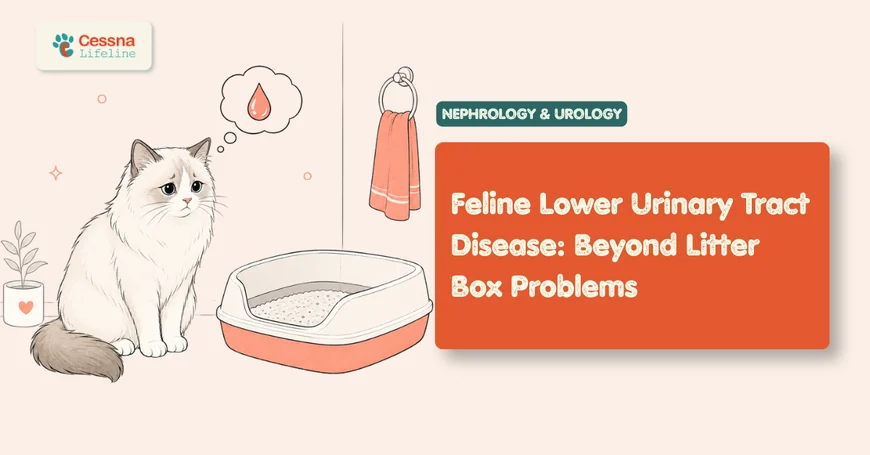
The owner assumes the cat is constipated. He's been squatting in the box more than usual, sometimes outside it, sometimes on the bathroom mat. He seems uncomfortable but is still eating, still coming to sit on the couch. She calls the vet the next morning and schedules an appointment for that afternoon.
By the time they arrive, the cat's bladder is a taut, painful mass the size of a golf ball. He hasn't produced urine in 18 hours. His potassium is climbing. The vet uses the word "emergency" and the owner doesn't understand yet what that means for a cat straining in a litter box.
This scenario plays out in veterinary clinics constantly, because feline lower urinary tract disease looks benign when it isn't. The signs — trips to the litter box, occasional drops of bloody urine, licking at the genitals — can seem like minor plumbing complaints. In many cases they are. In others, they're 12 hours from a cardiac event.
What to Know Feline lower urinary tract disease is an umbrella covering several distinct conditions, from stress-induced cystitis to life-threatening urethral obstruction. Feline idiopathic cystitis accounts for 55-65% of cases and recurs in approximately 50% of cats within a year without management (Westropp & Buffington, JAVMA 2004). A cat that strains for more than two hours without producing urine needs emergency care.
When "Bathroom Trouble" Is Something More
FLUTD is not a diagnosis. It's a collection of conditions that affect the bladder, urethra, or both in cats, grouped together because their presenting signs overlap. Straining to urinate, blood in the urine, frequent short visits to the litter box, and urinating outside the box are all features of FLUTD. They're also features of half a dozen different underlying conditions that require completely different treatments.
That ambiguity is what makes FLUTD both easy to underestimate and difficult to manage. An owner watching their cat squat repeatedly without producing much doesn't know whether they're seeing feline idiopathic cystitis, a bladder stone, a urethral plug, or the opening hours of a complete urethral blockage. From the outside, these can look identical.
What separates them, clinically and urgently, is whether urine is flowing at all.
when to take your cat to the emergency vet
The Causes Behind FLUTD: A Spectrum, Not a Diagnosis
Why do cats develop FLUTD? The answer depends entirely on which underlying condition is driving the signs, and in cats under 10 years old, the dominant cause is one that has nothing to do with infection.
Feline idiopathic cystitis — FIC — accounts for approximately 55-65% of FLUTD cases in younger and middle-aged cats (Westropp JL, Buffington CA, JAVMA 2004). "Idiopathic" means the cause isn't fully understood, but decades of research, particularly by Dr. C.A. Tony Buffington at Ohio State University, have established that FIC is a stress-mediated condition. The cats most commonly affected are indoor-only, sedentary, overweight, eating exclusively dry food, and living in households with multiple cats or environmental instability. Stress triggers neurogenic inflammation in the bladder wall, causing swelling, pain, and disruption of the protective glycosaminoglycan layer that normally keeps urine from irritating the tissue beneath it.
What, then, is driving the other 35-40% of cases?
Urolithiasis — bladder stones — accounts for roughly 15-23% of FLUTD cases (Minnesota Urolith Center, University of Minnesota). Two minerals dominate: struvite (magnesium ammonium phosphate) and calcium oxalate, together comprising more than 90% of feline uroliths. Struvite in cats is usually sterile and diet-responsive, dissolving predictably on prescription dissolution diets. Calcium oxalate stones require surgical or cystoscopic removal, since no dietary protocol reliably dissolves them. The relative prevalence has shifted over the past three decades: struvite dominated in the 1980s; calcium oxalate has increased steadily and now represents a large share of submissions to urolith analysis centers.
Urethral plugs — soft, matrix-mineral concretions that wedge into the urethra rather than sitting loose in the bladder — account for approximately 10-15% of cases. They're almost exclusively a problem of male cats and are particularly prone to causing complete obstruction. Bacterial UTI, by contrast, is rare in cats under 10, accounting for fewer than 5% of FLUTD cases in this age group and more than 20% in cats over 10, where declining immune function and kidney disease change the environment in which bacteria can establish.
Feline idiopathic cystitis is the most common cause of FLUTD in cats under 10 years, accounting for approximately 55-65% of cases, followed by urolithiasis (~15-23%) and urethral plugs (~10-15%). Bacterial UTI accounts for fewer than 5% of FLUTD cases in younger cats (Westropp JL, Buffington CA, JAVMA 2004; Minnesota Urolith Center). This distribution flips considerably in cats over 10, where UTI becomes significantly more common.
<figcaption>FLUTD cause distribution in cats under 10 years. FIC dominates, accounting for roughly 60% of cases. Bacterial UTI is rare in younger cats but becomes more common after age 10. Source: JAVMA 2004; Minnesota Urolith Center.</figcaption> </figure>
types of bladder stones in cats
Recognizing the Signs Before They Escalate
The symptoms of FLUTD exist on a spectrum from inconvenient to immediately life-threatening, and an owner's ability to read where on that spectrum their cat falls is the most important clinical skill they can develop.
The benign end looks like this: frequent short trips to the litter box, sometimes producing only a few drops of urine. Occasional spots of pink-tinged urine. Some licking at the genital area. A cat that's using the box in unusual locations, or occasionally missing. These signs indicate bladder inflammation and discomfort but not complete obstruction.
How does an owner distinguish uncomfortable from critical? The clearest signal isn't pain level or vocalization — it's output.
The dangerous end looks like this: a cat making repeated trips to the box and producing nothing. Crying or vocalizing while straining. Resting between straining attempts. Hiding, or unusual stillness. Abdomen that feels hard or sensitive when touched. Is the cat producing any urine at all? That is the question that separates wait-and-watch from drive-to-the-emergency-clinic-now.
Hematuria, blood in the urine, is almost always present in FIC episodes and frequently accompanies urolithiasis and obstruction. It's alarming to owners but is not in itself an indication of severity. What matters is the combination of blood with absence of urine production. A cat with bloody urine who is still passing urine, eating, and alert warrants a same-day or next-morning vet visit. A cat with bloody urine who is not passing urine needs emergency care immediately.
Male cats are significantly more vulnerable to urethral obstruction than females, owing to the anatomy of their urethra: longer, narrower, and more tortuous, with a particularly narrow penile segment where plugs and small stones can lodge. This difference is so pronounced that complete urethral obstruction is, for practical purposes, a male cat emergency.
Complete urethral obstruction is the most life-threatening presentation of FLUTD and occurs almost exclusively in male cats, owing to their longer, narrower urethra (Cornell Feline Health Center). Signs including straining with no urine output for more than two hours, crying while posturing, and a palpably distended, painful bladder are veterinary emergencies requiring immediate unblocking to prevent fatal hyperkalemia and acute renal failure.
Urethral Obstruction: The Emergency Hidden in Plain Sight
Why does a blocked bladder become fatal? The process is worth understanding because it explains why time matters more than in almost any other urinary condition.
As urine accumulates in a bladder the cat cannot empty, pressure builds. That pressure eventually inhibits the nephrons' ability to excrete urine into the collecting system at all, effectively shutting down kidney filtration. Urea, creatinine, and potassium, all normally excreted in urine, begin rising in the bloodstream. Potassium is the most immediately dangerous. As serum potassium climbs, the cardiac muscle becomes unstable. Arrhythmias develop. Without intervention, the cat goes into cardiac failure.
This cascade doesn't take days. In a complete obstruction, a cat can move from straining and distress to life-threatening hyperkalemia within 24 to 36 hours. By 48 hours, acute renal failure is established. By 72 hours, outcomes are significantly worse even with treatment.
<figcaption>Hour-by-hour progression of urethral obstruction in male cats. The window for low-risk intervention closes by 18 hours. By 30-48 hours, cardiac and renal complications substantially worsen outcomes.</figcaption> </figure>
The deceptive quiet period: A blocked cat that stops straining is not improving. At 24-30 hours, uremia-induced weakness means the cat may no longer have the energy to posture and cry. An owner interpreting that stillness as improvement can lose another 12 hours before bringing the cat in, by which point the blockage has been present for nearly two days.
Unblocking is performed under sedation or anesthesia. A urinary catheter is passed retrogradely to dislodge or flush the obstruction, the bladder is emptied and flushed, and the cat is hospitalized on IV fluids, typically for 24 to 48 hours, while kidney values, potassium, and urine output normalize. Most cats who are unblocked promptly and have had no lasting organ damage go home within two to three days and do well. The risk is recurrence: approximately 35-40% of male cats who obstruct once will obstruct again within two years (Gerber B et al., JVIM 2008). For those with multiple obstructions, perineal urethrostomy, a surgery that widens the urethral opening, drops the reobstruction rate to approximately 5%.
perineal urethrostomy in cats
What the Vet Is Looking For
The diagnostic workup for a cat presenting with FLUTD signs is designed to answer two questions in sequence: is this cat obstructed, and if not, what is causing the signs?
The first question is answered by palpation. An experienced veterinarian can usually determine in seconds whether the bladder is distended, firm, and painful, the cardinal signs of obstruction. In a non-obstructed cat, the bladder may be small, empty from recent urination attempts, or mildly thickened. Radiographs may follow: struvite stones are radiodense and easily visible on plain X-ray, while some calcium oxalate stones and urethral plugs require ultrasound or double-contrast cystography to visualize.
Urinalysis is the cornerstone of diagnosis in non-obstructed cats. A complete urinalysis includes dipstick evaluation (pH, protein, blood, glucose), specific gravity, and sediment microscopy. Sediment reveals red blood cells, white blood cells, crystals, and bacteria. High numbers of red cells and epithelial cells with normal or low white cell counts and no bacteria point toward FIC. A positive urine culture in a younger cat without systemic illness or anatomic abnormality should raise suspicion for sample contamination, since true UTI is uncommon.
Bloodwork matters in any cat with systemic signs. Why does the chemistry panel carry such urgency in a blocked cat? Because the kidneys are already failing. Elevated BUN and creatinine indicate renal involvement. Hyperkalemia, a high potassium level, is the most urgent finding in a blocked cat and drives the pace of treatment. A cat with a potassium above 7-8 mEq/L needs immediate cardiac monitoring alongside unblocking.
Urinalysis and sediment microscopy remain the primary diagnostic tool for differentiating FIC from urolithiasis and UTI in FLUTD presentations. FIC is characterized by hematuria, proteinuria, and sterile inflammation on culture; struvite urolithiasis shows crystalluria with elevated urine pH; calcium oxalate urolithiasis often has normal urine pH but oxalate crystals visible on sediment (ISFM Guidelines on Feline FLUTD, 2020).
how to read a cat urinalysis
Managing FIC: How Environment Becomes Treatment
Here is the part of FLUTD management that surprises most owners: for the most common form, FIC, there is no drug, no surgery, and no supplement that replaces addressing the environment the cat lives in. The inflammation driving FIC is neurogenic, downstream from a stress response, and the most effective intervention is reducing the stress.
What does that actually look like? Dr. Buffington's Indoor Cat Initiative at Ohio State University developed what's called Multimodal Environmental Modification, or MEMO, as a structured approach to FIC management. The concept is straightforward: FIC cats typically live in environments that don't meet their behavioral needs, and the gap between what the cat needs and what the environment provides generates chronic low-grade stress that eventually tips over into a bladder episode.
Why the risk profile makes sense: The classic FIC cat is indoor-only, sedentary, overweight, eating dry food exclusively, and living in a multi-cat household or a home where the cat lacks predictable control over its daily routine. Each of those factors layers stress on the feline neuroendocrine system. The bladder inflammation isn't random — it's the endpoint of a chronic activation pattern that the environment created.
MEMO addresses five domains: nutrition (transitioning to wet food, puzzle feeders), environment (perches, hiding places, scratching posts, multiple water sources), play (daily structured interactive play, rotating toys), social structure (reducing inter-cat conflict, separate feeding and litter stations for each cat), and healthcare (addressing pain and anxiety pharmacologically when enrichment isn't sufficient). Cats receiving comprehensive environmental enrichment had significantly lower recurrence rates in Buffington's published colony studies compared to cats in unenriched housing (Buffington CA et al., JAVMA 2006).
<figcaption>Estimated FIC recurrence at 12 months by management approach. Full multimodal management (MEMO, wet food, structured play, inter-cat conflict reduction) can reduce recurrence from ~50% to ~10%. Sources: Buffington et al. JAVMA 2006; ISFM 2020.</figcaption> </figure>
For cats with severe or refractory FIC, anti-anxiety medications provide additional support. Amitriptyline, a tricyclic antidepressant, has shown benefit in reducing the frequency of FIC episodes in some cats. Gabapentin addresses the neuropathic pain component. Neither replaces environmental work, but both can reduce the neurogenic signaling that drives bladder inflammation when the cat's stress baseline is too high for enrichment alone to control.
Cats receiving comprehensive environmental enrichment under the Multimodal Environmental Modification (MEMO) protocol had significantly reduced rates of FIC recurrence compared to unenriched controls in Buffington's colony studies. The enrichment addressed nutrition, vertical space, play, and inter-cat conflict. FIC recurrence without management approaches 50% within 12 months; structured MEMO reduces this substantially (Buffington CA et al., JAVMA 2006; Westropp JL, Buffington CA, JAVMA 2004).
indoor cat enrichment for urinary health
Diet, Water, and the Case for Dilution
Whatever the underlying cause of FLUTD, one dietary principle applies across nearly all of them: more dilute urine is better. Concentrated urine is a more favorable medium for crystal formation, a more irritating substance for an already-inflamed bladder wall, and a richer growth environment for bacteria in cats who do develop UTI.
The single most effective way to dilute feline urine is wet food. Cats eating canned or fresh-prepared diets consume two to three times as much water daily as cats eating dry food, primarily through the food itself, which has a moisture content of 70-80%. The result is a measurable drop in urine specific gravity: dry-fed cats typically produce urine with a specific gravity of 1.040 or higher; wet-fed cats often fall in the 1.025-1.035 range. For struvite prevention, reducing urine concentration is part of what keeps minerals from precipitating into crystals.
Would a water fountain help even for a dry-fed cat? Yes, but less than transitioning to wet food. Water fountains increase voluntary water intake compared to still-water bowls, likely because cats are attracted to moving water, but the increase in total water consumption doesn't fully compensate for the low moisture content of dry kibble. The most effective strategy is both: wet food as the primary diet and a fountain for additional hydration support.
Prescription urinary diets add another layer. Struvite-dissolution diets modify urine pH toward acidic and reduce magnesium, the mineral component of struvite. They work. Most struvite stones in cats will dissolve within four to eight weeks on an appropriate dissolution diet, avoiding the need for surgery. Calcium oxalate stones, by contrast, don't dissolve on any current diet, and prescription diets for calcium oxalate management focus on reducing urinary calcium and oxalate excretion to slow recurrence rather than dissolving existing stones.
From the exam room: The transition resistance is real. Many cats that have eaten dry food exclusively for years will refuse wet food initially. The most effective approach is a gradual transition over two to three weeks, starting with a small amount of wet food mixed into the dry and slowly increasing the ratio. Warming the wet food slightly and adding low-sodium broth can help. Owners who declare that "my cat just won't eat wet food" after a three-day trial are giving up too early.
Frequently Asked Questions
How do I know if my cat has a urethral blockage?
The clearest sign is straining to urinate with no urine produced. A cat making frequent trips to the litter box and posturing but passing little or nothing, especially if vocalizing or seeming in pain, may be obstructed. Additional signs include hiding, unusual stillness or lethargy, a painful and distended abdomen, and excessive licking at the genitals. Any cat suspected of being blocked should be taken to a veterinary emergency clinic immediately, not observed at home. The condition is fatal without treatment.
Can female cats get urethral blockages?
Very rarely. Female cats have a shorter, wider, straighter urethra that makes complete obstruction nearly impossible in practice. Females can develop all other forms of FLUTD, including FIC, urolithiasis, and UTI, but straining-related emergencies in females are usually FIC or severe constipation rather than obstruction. If a female cat is straining with no urine output, that still warrants veterinary evaluation, but the likelihood of a life-threatening obstruction is considerably lower than in males.
Is FLUTD the same as a urinary tract infection?
No. UTI accounts for fewer than 5% of FLUTD cases in cats under 10 years old. The most common form, FIC, involves sterile bladder inflammation with no bacteria present. Assuming FLUTD is a UTI and treating with antibiotics is one of the most common management errors in cat owners and, historically, in veterinary practice as well. Antibiotics do nothing for FIC and are only appropriate when a culture confirms bacterial growth in a properly collected urine sample.
What is a perineal urethrostomy and when is it needed?
Perineal urethrostomy (PU) is a surgery that creates a wider, permanent urethral opening by removing the narrow penile urethra and allowing the cat to urinate through a larger stoma. It's considered for male cats who have obstructed two or more times, or who obstruct with dense plugs that are difficult to clear. The surgery significantly reduces reobstruction risk, from approximately 35-40% with medical management to roughly 5% post-PU. It's a major intervention and not appropriate as a first response to a single blockage.
Does stress really cause bladder problems in cats?
Yes, in the specific form of FIC. The mechanism involves the hypothalamic-pituitary-adrenal and autonomic nervous systems, which in FIC cats appear to have an exaggerated stress response. This neurogenic activation triggers inflammatory changes in the bladder wall through substance P and other neuropeptides, causing the classical FIC signs without any infection, stones, or structural cause. The connection is well-documented in Buffington's longitudinal work and is the basis for why environmental modification, not antimicrobials, is the evidence-based treatment for FIC.
stress management for indoor cats
The Space Between Stress and the Litter Box
Every cat with FIC is having a conversation with its environment, and the litter box is the only venue available. The signs — the straining, the blood, the trips to the mat in the corner — are not random. They're the physiological outcome of a nervous system that wasn't built for the life the cat is living.
Indoor cats have removed nearly all the behavioral outlets that their nervous systems evolved around: hunting, territory patrol, choice of social contact, control over their own time and space. When those needs go unmet for long enough, the body finds another way to express the imbalance. For cats, that expression often lands in the bladder.
Understanding FLUTD in full means recognizing that the litter box problem is usually the last stage of a longer chain of events, not the first. The cat who started straining this week may have been accumulating stress for months. Treatment starts not with a prescription but with a question: what is this cat's environment missing, and what would it take to provide it?
That question, asked honestly, is where most FIC cases begin to turn around.