How Can I Tell If My Exotic Pet Is Sick?
Prey animals hide illness until it is advanced, so by the time an exotic pet looks unwell it is often an emergency. The signs that come earlier, and the one number to track.
The signs of illness in exotic pets arrive late, and that single fact should reshape how you look after one. A dog that feels unwell will often tell you about it. A rabbit, a guinea pig, a parrot or a bearded dragon will do the opposite: it will behave as normally as it can manage, for as long as it can manage, because in evolutionary terms the animal that looks weak is the animal that gets taken.
The consequence is uncomfortable but worth stating plainly. By the time an exotic pet looks obviously ill to its owner, it is frequently not early disease that has just started. It is advanced disease that has finally outrun the animal's ability to mask it. This is why vets who see exotics treat "quiet and not quite right" as urgent when the same description in a dog might reasonably wait until morning.
This article covers the signs that do appear earlier, the one measurement that beats observation, and which presentations are genuine emergencies by species.
What to Know Weight is the most sensitive early indicator in every exotic species, and weekly weighing on kitchen scales will detect problems weeks before they become visible. A rabbit or guinea pig that has not eaten for twelve hours is an emergency, not a wait-and-see — gut motility stops and the situation deteriorates quickly. A bird sitting fluffed up, quiet, and low in the cage is in serious trouble and needs same-day attention. In reptiles, most illness traces back to husbandry: temperature gradient, UVB provision and humidity. Never withhold food or water to "see if it improves", and never treat an exotic pet with a medication intended for a dog or cat.
Why Do Exotic Pets Hide Illness So Well?
Because concealment is the behaviour that kept their ancestors alive, and it is not something the animal chooses.
Rabbits, guinea pigs, chinchillas and most pet birds are prey species. A visibly unwell individual in a wild group attracts predators and is abandoned by the group, so the instinct is to keep eating, keep moving and keep looking ordinary. Reptiles conceal differently — their metabolism is slow enough that a sick reptile can look merely inactive for weeks, and "inactive" is also what a healthy reptile looks like much of the time.
What this means practically is that observation alone is a weak tool. You are watching an animal whose entire behavioural strategy is to defeat your observation. So the approach has to be different: measure rather than watch, and know in advance which signs have slipped past the animal's control.
What Is the Single Most Useful Thing I Can Do?
Weigh your pet weekly, write it down, and look at the trend.
This is more valuable than any amount of looking, and it costs nothing beyond a set of digital kitchen scales. Weight loss precedes visible illness in essentially every exotic species, often by weeks, because an animal that feels unwell reduces its intake slightly long before it stops eating altogether.
How to do it usefully:
- Same scales, same day of the week, same time of day relative to feeding
- Record the number rather than trusting memory
- For small species, use scales that read to the gram — a 1.2 kg rabbit losing 60 g matters, and you will not see that by eye
- Act on a trend, not a single reading. Two consecutive drops, or a loss of around 5% of body weight, is a reason to book an appointment
A rabbit that has lost 8% of its body weight over three weeks while still eating, still moving and still looking fine to its owner is a genuinely common presentation, and the weight record is the only reason it arrives early enough to treat easily.
Which Signs Are Emergencies in Rabbits and Guinea Pigs?
These species have the shortest fuse of any pet, and the threshold for seeking help is correspondingly lower.
| Sign | Why it is urgent |
|---|---|
| Not eating for 12 hours | Gut motility slows and stops; deteriorates rapidly |
| No droppings, or much smaller droppings | Direct evidence that the gut has slowed |
| Hunched, pressing the abdomen to the floor | Abdominal pain |
| Teeth grinding, or a reluctance to be touched | Pain |
| Laboured breathing, or breathing through an open mouth | Rabbits are obligate nose-breathers; this is critical |
| Head tilted to one side | Neurological or inner-ear disease |
| Any fly strike or maggots around the rear | Immediate emergency, life-threatening within hours |
| Soft caecotrophs stuck to the rear | Diet or dental problem; infection risk |
| Drooling or a wet chin | Dental disease, which is extremely common |
The first two deserve emphasis because owners routinely wait on them. A rabbit's digestive system depends on continuous movement of fibre. When intake stops, motility stops, gas accumulates, pain increases, and the animal becomes less inclined to eat — a loop that accelerates. Twelve hours without food in a rabbit is not fussiness. It is a presentation.
What Should I Watch For in Birds?
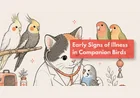
Birds conceal illness more effectively than almost anything else kept as a pet, and the classic presentation is unmistakable once you know it.
A bird that is fluffed up, quiet, sitting low on the perch or on the cage floor, with its eyes partly closed is seriously unwell and needs attention the same day. Fluffing conserves heat, and a bird doing it persistently has stopped being able to maintain itself.
Other signs worth knowing:
- Tail bobbing at rest, which indicates respiratory effort
- Any change in the droppings — colour, consistency, volume, or the ratio of the white to the dark portion
- Sitting on the floor of the cage, which healthy birds rarely do
- Reduced vocalising in a bird that normally calls
- Discharge from the nostrils, or sneezing
- Stopping preening, so the feathers look ragged
- Straining, particularly in a female, which may be egg binding and is an emergency
Birds also mask right up to collapse, so a bird showing signs at all should be treated as further along than it looks. Keep it warm and quiet in transit, and do not delay for a day to see whether it picks up.
What About Reptiles?
In reptiles the first question is almost always about the enclosure rather than the animal, because the large majority of illness in captive reptiles is created by husbandry.
| Check | Why it matters |
|---|---|
| Temperature gradient, measured with a probe | Reptiles cannot digest or mount an immune response without correct temperatures |
| UVB source, and its age | UVB output falls long before the bulb stops emitting light; most need replacing every 6–12 months |
| Humidity, measured | Wrong humidity causes shedding problems and respiratory disease |
| Enclosure size and hides | Chronic stress suppresses immunity and appetite |
| Diet and supplementation | Calcium and vitamin D3 deficiency causes metabolic bone disease |
Signs that something is wrong:
- Not eating, which in most species warrants review after a fortnight rather than days, but sooner in a juvenile
- Lethargy beyond the species' normal baseline, or failure to bask
- Open-mouth breathing, bubbling at the nostrils, or mucus — respiratory infection
- A soft jaw, bowed limbs, tremors or difficulty lifting the body — metabolic bone disease
- Retained shed, especially around the eyes and toes
- Swelling, discoloured patches, or discharge
- Sunken eyes and wrinkled skin, indicating dehydration
A reptile presented for "not eating" very often turns out to be a reptile kept five degrees too cool with a UVB bulb that expired eighteen months ago. Bring photographs of the setup and your actual measured temperatures to the appointment; it shortens the diagnostic process considerably.
How Should I Prepare for the Appointment?
Exotic consultations go considerably better when the owner brings information, because much of the diagnosis lies in the husbandry rather than in the animal.
Bring, if you can:
- The weight record. A trend is worth more than any single examination finding.
- Photographs of the enclosure, wide enough to show the whole setup rather than a close-up of the animal.
- Your measured temperatures for reptiles — the actual numbers from a probe thermometer at the warm end, the cool end and the basking spot. "It has a heat mat" is not a measurement.
- The age of the UVB bulb, which almost nobody knows and which matters enormously.
- A sample of the actual food, or a photograph of the packet. Owners and vets often mean different things by "rabbit food".
- A fresh dropping, in a sealed bag, for species where that is relevant.
Getting there safely
Transport is itself a risk for a compromised exotic patient, and a few choices make a real difference:
| Species | Transport note |
|---|---|
| Rabbit, guinea pig | Solid-sided carrier with familiar bedding and hay; keep companions together where possible |
| Bird | Small covered carrier rather than a large cage; a weak bird flapping in a big space injures itself |
| Reptile | Insulated box with a heat source in cool weather; reptiles cannot generate their own warmth |
| Any species | Warm, dark, quiet. Avoid the car's air conditioning blowing directly on a small animal |
Bringing a rabbit's companion along is worth the extra effort. Rabbits bond strongly, and separation during illness adds stress to an animal already struggling. It also prevents the bonded pair rejecting one another on return, which does happen.
One thing to avoid: do not feed a rabbit or guinea pig nothing on the way in, on the assumption that it should arrive with an empty stomach. These species are not fasted for procedures the way dogs and cats are, and continued fibre intake is part of the treatment rather than an obstacle to it.
What Should I Not Do?
| Do not | Why |
|---|---|
| Wait to see if it improves overnight | In rabbits, guinea pigs and birds, overnight is often the margin |
| Give a dog or cat medication | Doses and drug tolerances differ enormously; several are lethal |
| Give antibiotics left over from a previous illness | Some antibiotics cause fatal gut flora disruption in rabbits and guinea pigs |
| Withhold food to "rest the gut" | The opposite of what a rabbit needs; feeding support is part of treatment |
| Treat a reptile without reviewing the enclosure | You will treat the symptom and leave the cause |
| Assume a quiet exotic pet is simply resting | Quiet is the presentation, not the absence of one |
When Should I See a Vet?
Same-day, without waiting, for:
- A rabbit or guinea pig that has not eaten for 12 hours, or has stopped producing droppings
- A bird that is fluffed, quiet and sitting low
- Open-mouth or laboured breathing in any species
- Fly strike or maggots
- Straining, a head tilt, seizures, or collapse
- Any bleeding, or a wound from another animal
Within a few days, for:
- A downward weight trend over two or more weighings
- Reduced appetite that has not resolved
- Drooling, a wet chin, or dropping food
- Changes in droppings
- Lumps, swellings or skin changes
- A reptile that has stopped eating or basking
Exotic species also benefit from an annual examination even when nothing is obviously wrong, precisely because they are so good at hiding what is. Dental disease in rabbits and guinea pigs in particular is often found on routine examination well before an owner would have suspected it.
Frequently Asked Questions
What are the signs of illness in exotic pets?
Weight loss comes first and is detectable by weekly weighing before anything is visible. Then reduced appetite, less activity and more hiding. Visible signs — hunched posture, fluffed feathers, laboured breathing — arrive late and usually mean disease is already advanced rather than just beginning.
How quickly should I act if my rabbit stops eating?
Treat twelve hours without food as an emergency. A rabbit's gut depends on continuous fibre movement, so when intake stops, motility stops, gas builds and pain increases in a self-reinforcing loop. Absent or much smaller droppings confirms it. This is not something to sleep on.
Why should I weigh my exotic pet every week?
Because weight loss precedes visible illness by weeks in nearly every exotic species. Digital kitchen scales reading to the gram will show a trend you cannot possibly see by eye. Two consecutive drops, or losing about 5% of body weight, is a reason to book an appointment.
What does it mean when a bird sits fluffed up and quiet?
That the bird is seriously unwell and needs same-day veterinary attention. Fluffing conserves heat, and a bird doing it persistently while sitting low and quiet has stopped maintaining itself. Birds conceal illness until near collapse, so this sign is later-stage than it appears.
Why do reptiles get sick so often in captivity?
Because most captive reptile illness is created by husbandry rather than infection. An incorrect temperature gradient, an expired UVB bulb, wrong humidity or inadequate calcium will cause disease in a healthy animal. UVB output fades long before the bulb stops lighting, which catches many owners out.
Can I give my rabbit medicine meant for a dog?
No. Drug tolerances differ enormously between species, and some antibiotics that are routine in dogs cause fatal disruption of gut flora in rabbits and guinea pigs. Leftover medication from a previous illness is equally unsafe. Dosing for exotics needs to come from a vet.
Does my exotic pet need a check-up if it seems well?
Yes, annually. These species hide illness so effectively that routine examination is one of the few reliable ways to find problems early. Dental disease in rabbits and guinea pigs is frequently picked up on a routine visit long before the owner would have noticed anything.
Next Steps
Start weighing your pet this week and write the number down. That habit alone will give you earlier warning than anything else available to you, and it costs the price of a set of kitchen scales.
If your rabbit or guinea pig is not eating, your bird is fluffed and quiet, or any animal is breathing with effort, contact us today. For anything less urgent — a downward weight trend, reduced appetite, a change in droppings, or a reptile that has gone off food — book an examination and bring your weight record, and for reptiles, photographs of the enclosure and your measured temperatures. Our team sees exotic species regularly and knows how much of the picture is normally hidden.