Trauma in Pets: What to Do After an Accident
A dog hit by a car may have hidden internal injuries for hours with no visible signs. Learn the emergency steps and how to transport an injured pet safely.
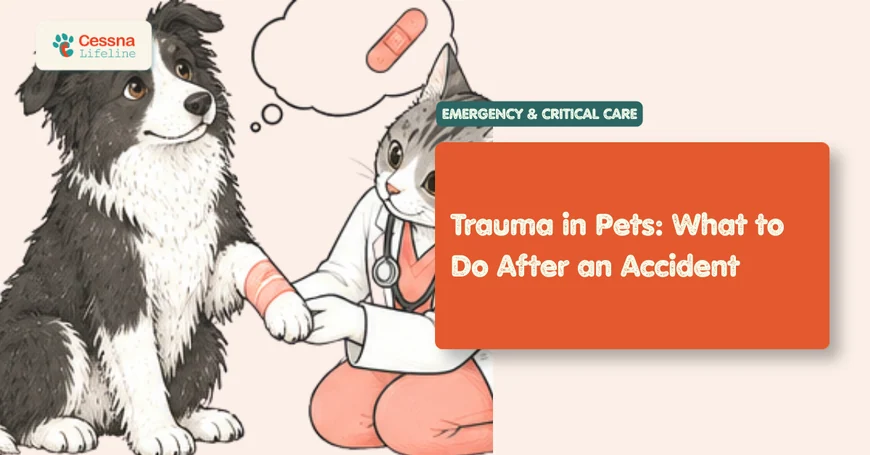
A dog that walks away from being hit by a car and appears uninjured is not necessarily a dog that is fine. Internal hemorrhage from a ruptured spleen or liver laceration can be silent for hours, progressing while the animal appears calm and the owner believes the worst has passed. The delayed signs, pale gums, sudden weakness, or a distended abdomen, can appear 12 to 36 hours after impact, by which point the volume of blood loss may already be critical (BluePearl Pet Hospital; Alpine Animal Hospital, 2024).
Trauma is one of the most common reasons pets require emergency veterinary care. The American College of Veterinary Emergency and Critical Care's Veterinary Committee on Trauma (VetCOT) registry analyzed 9,758 dog trauma cases and 11,734 cat trauma cases across 22 veterinary trauma centers in 2022 and 2023 (ACVECC VetCOT Registry Report, 2025). Vehicular strikes accounted for 17% of dog trauma cases. Bite wounds, falls, and blunt force trauma accounted for the rest. In all categories, the outcome is shaped not just by what happened but by what the owner does in the minutes between the accident and professional care.
The Short Version Any pet involved in a vehicular strike, fall, or significant blunt force trauma should be seen by a veterinarian immediately, regardless of visible injury. Internal injuries including hemoabdomen, pneumothorax, and pelvic fractures may not produce visible signs for hours. When moving an injured pet, use a firm board and minimize spinal movement. Call ahead to the clinic so the team is ready on arrival. Do not assume the pet is fine because it is walking — the absence of visible wounds is not an absence of injury.
What Trauma Does to a Pet's Body
The immediate threat after any significant traumatic injury isn't always the wound you can see. Shock is the physiological response to insufficient oxygen delivery to the body's tissues, and it is the leading cause of death in veterinary trauma patients within the first hour of injury. Hemorrhagic shock from internal bleeding, distributive shock from systemic inflammation, and obstructive shock from cardiac tamponade or tension pneumothorax all present similarly in the early stages: a pet that seems dazed or quiet, breathing somewhat faster than normal, with a heart rate that is elevated but perhaps not alarmingly so.
The veterinary community updated its trauma triage protocol to XABCDE: eXsanguination control first, then Airway, Breathing, Circulation, Disability (neurological), and Exposure (ACVECC VetCOT Registry, 2025; Merck Veterinary Manual, 2024). The change reflects accumulating evidence that stopping hemorrhage takes precedence over everything else, including airway management, in the majority of trauma cases. A pet that is losing blood fast enough to lose consciousness has minutes, not hours.
The injuries with the highest fatality risk are often the ones that don't announce themselves: diaphragmatic hernias that allow abdominal organs to enter the chest cavity, pneumothorax accumulations that compress the lung over 30 to 60 minutes, and splenic hemorrhage that fills the abdomen with blood while the animal remains ambulatory. These are the cases that make "watch and see at home" genuinely dangerous advice.
shock in dogs and cats
The Causes of Pet Trauma: What the Registry Data Shows
Understanding how trauma most commonly occurs helps owners recognize when a visit is necessary versus when they're actually dealing with an emergency. The 2022-2023 ACVECC VetCOT registry, the most comprehensive veterinary trauma dataset available, found clear differences between injury causes in dogs and cats (ACVECC VetCOT Registry Report, 2025).
In dogs, bite wounds from other animals were the leading cause of trauma, accounting for 35% of all cases. Bite wound injuries can be profoundly deceptive: the puncture visible on the surface of the skin often represents only a fraction of the tissue damage caused by the crushing and tearing force beneath. Vehicular strikes followed at 17%, and lacerations at 12%.
In cats, unknown blunt trauma led at 22% — reflecting both cats' outdoor exposure to vehicles, falls, and predator encounters, and the frequency with which owners don't witness the injury event. Bite wounds accounted for 20% and falls from heights 14%.
The "high-rise syndrome" in cats deserves specific mention: cats that fall from several stories frequently survive with manageable injuries because they adopt a flying squirrel posture and distribute impact across the body. However, injuries including thoracic trauma, pneumothorax, and jaw fractures are common, and internal injuries require veterinary assessment regardless of the cat's apparent stability after the fall.
<figcaption>Bite wound trauma leads in dogs and unknown blunt trauma leads in cats. In both species, the visible wound often underrepresents the extent of underlying injury.</figcaption> </figure>
bite wounds in dogs and cats
Signs of Trauma in Pets
The clinical presentation of a traumatized pet depends entirely on where the injury is and what systems are affected. Some signs appear within minutes; others develop over hours. The consistent mistake owners make is evaluating a pet's severity by whether it can walk, whether it's bleeding visibly, or whether it seems in pain. None of these are reliable indicators.
Signs requiring immediate emergency care:
- Labored, rapid, or shallow breathing — suggests pneumothorax, hemothorax, rib fractures, or diaphragmatic hernia
- Pale, white, or grayish gums — a reliable indicator of shock and significant blood loss
- Any degree of unconsciousness or unresponsiveness
- Active bleeding that does not slow with five minutes of direct pressure
- Obvious fracture with bone visible, severe limb deformity, or inability to bear weight
- Visible protrusion of abdominal contents through a wound
- Signs of spinal injury: paralysis or weakness in the hind limbs, abnormal bladder or bowel control, dragging limbs
Signs that appear deceptively mild but require urgent evaluation:
- Normal walking but rapid breathing — internal injuries often spare the ability to walk while damaging respiratory function
- Vomiting or retching after trauma — can signal abdominal organ involvement
- Swelling or bruising without a clear injury — suggests deeper tissue trauma
- A pet that settles quickly and wants to sleep after a traumatic event — this is often described by owners as "he seems okay, he just wants to rest," but lethargy following trauma is a reason to go, not to wait
Signs that may develop hours later:
- Progressive abdominal distension (abdomen visibly enlarging) — hemoabdomen from organ rupture
- Sudden worsening of breathing — delayed pneumothorax or pleural effusion
- Collapse or severe weakness after a period of apparent stability — delayed shock as compensatory mechanisms fail
- Blood in urine — bladder or kidney trauma
- Inability to defecate — pelvic fracture damaging the colon
pale gums in dogs and cats
Dog Hit by Car: What to Do in the First Five Minutes
A dog hit by a car represents the clearest example of a trauma emergency where owner actions in the first minutes directly affect outcome. The survivability of vehicular trauma is high when care begins promptly: a study of 239 dog vehicular trauma cases found the pelvis was the most commonly injured structure and the liver the most commonly injured abdominal organ, with many dogs surviving with appropriate surgical care (ResearchGate, Evaluation of Vehicular Trauma in Dogs). The clinical challenge is that the injury pattern is unpredictable from the outside.
Minute 0-1: Scene safety and initial approach
Check whether additional vehicles are present before moving onto the road. Approach the dog calmly and speak in a low voice. Even a gentle, familiar dog may bite when in severe pain; use a muzzle if available, or improvise with a strip of fabric or a leash looped twice around the snout. Do not muzzle if the dog is having difficulty breathing.
Minute 1-3: Assess and control visible bleeding
Apply direct, firm pressure to any wound that is actively bleeding. Use a cloth, gauze, or clothing. Do not remove the compress once it's in place; add material on top if blood soaks through. Do not tourniquet limbs unless you are a trained first responder and the limb is unsalvageable. Check breathing: if the chest is moving and the dog is making sound, the airway is open. Do not attempt to pull the tongue forward unless the dog is unconscious and you can clearly see an obstruction.
Minute 3-5: Call ahead and prepare transport
Call the emergency veterinary clinic before moving the dog. Tell them: the species, size estimate, nature of the accident, current visible injuries, and your estimated arrival time. This allows the team to prepare a treatment room, blood products if needed, and appropriate staffing. Don't lose this time — a 60-second call while a second person prepares transport is not wasted time.
<figcaption>Scene safety precedes everything. A 60-second call to the emergency clinic during preparation — not instead of preparation — ensures the team is ready on arrival and improves triage speed.</figcaption> </figure>
muzzling an injured dog safely
Safe Transport to the Veterinary Clinic
How a pet is moved after trauma can worsen a spinal or pelvic injury that might otherwise have been surgically repairable. The central principle is minimizing spinal movement. This is particularly relevant after vehicular trauma, falls from height, and any event where the animal shows hind limb weakness, paralysis, or loss of bladder or bowel control.
For large dogs: use a rigid board — a piece of plywood, a collapsed cardboard box, an ironing board, or any flat firm surface long enough to support the dog's full body length. Slide the dog onto the board using a blanket or jacket, grasping the skin at the back of the neck and the small of the back. Keep the head, neck, and spine in natural alignment. Secure loosely with strips of fabric, belts, or leashes if available. Two people lift the board together, keeping it level.
For small dogs and cats: use a carrier with the top removed so you don't have to push the animal through a small opening. A sturdy cardboard box lined with a soft towel works equally well. Lower the animal in from above rather than pushing from the side. Place a hot water bottle wrapped in a towel or a hand warmer under the towel if the animal is cold — maintaining body temperature is important in shock.
Head positioning: if the pet is unconscious, position the head in line with the spine — not flexed down toward the chest, not extended upward. Abnormal head positioning impedes venous drainage from the brain and worsens any traumatic brain injury.
What not to do: don't carry a large dog with arms under the body like a hammock, allowing the spine to sag; don't carry by grasping only the front limbs or rear limbs; don't attempt to "help" a dog with a pelvic fracture walk to the car.
how to restrain a frightened or injured cat
What Happens at the Emergency Clinic
A pet arriving with a history of vehicular trauma or significant blunt force injury enters triage immediately regardless of visible signs. The emergency team uses the XABCDE protocol: confirm hemorrhage control first, then evaluate airway patency, breathing quality, cardiovascular status, neurological function, and full body surface exposure for wounds not initially apparent (Merck Veterinary Manual, 2024).
Point-of-care ultrasound using TFAST (Thoracic Focused Assessment with Sonography for Trauma) is deployed in the first five to ten minutes at centers that have it. TFAST can detect pneumothorax, hemothorax, pericardial effusion, and diaphragmatic hernia before physical examination findings make these obvious, giving the team information to prioritize interventions while the patient is still stable enough to benefit (ACVECC VetCOT Registry Report, 2025).
Intravenous access is established rapidly. Blood pressure, heart rate, and oxygen saturation are monitored continuously. If shock is present, fluid resuscitation begins with careful titration — too much fluid in hemorrhagic shock can dislodge forming clots. Blood typing and cross-matching may be initiated if transfusion is anticipated.
Radiographs of the thorax, abdomen, spine, and pelvis are typically taken during the primary assessment period. Abdominal radiographs can show free fluid suggesting internal hemorrhage. Thoracic radiographs reveal pneumothorax, rib fractures, and pulmonary contusions. The pelvic films often reveal the most dramatic findings in vehicular trauma cases.
what to expect at an emergency veterinary clinic
Monitoring After Trauma: The 24-Hour Window
A pet discharged after trauma evaluation or a pet seen by a regular veterinarian and determined to be non-critical still requires active monitoring for 24 hours. The injuries most likely to become life-threatening in this window are those that were present but compensated at the time of examination.
Pulmonary contusions, bruising of the lung tissue from blunt force, often worsen over 24 to 48 hours as the inflammatory response peaks. A dog that breathes comfortably in the clinic on the day of the accident may develop significantly labored breathing the following morning as contusion-related fluid accumulates. This is not a failure of initial care; it is the natural progression of the injury.
Signs that require immediate return to emergency care after a trauma visit:
- Any increase in breathing effort or rate
- Gums becoming pale, white, or gray
- Abdomen becoming visibly larger or more tense
- Sudden worsening of weakness or inability to walk that was improving
- Blood in urine, significant blood in stool, or inability to urinate
- Worsening pain, especially abdominal pain
- Collapse or significant deterioration in consciousness
Restrict activity completely for the first 48 hours regardless of how the pet appears. Leash walks only for bathroom purposes. No jumping, running, stairs, or roughhousing.
pulmonary contusions in dogs
Frequently Asked Questions
What should I do immediately if my dog is hit by a car?
Secure the scene, approach calmly, and apply a fabric muzzle if the dog may bite from pain. Control visible bleeding with firm direct pressure. Call your nearest emergency veterinary clinic before moving the dog to let them prepare. Slide the dog onto a rigid board to minimize spinal movement and transport immediately, even if the dog appears uninjured. Internal injuries including hemorrhage, pneumothorax, and organ rupture may not produce visible signs for hours (VIN Veterinary Partner, 2024). emergency vet clinic near me
Can a dog seem fine after being hit by a car?
Yes, and this is one of the most dangerous situations in veterinary emergency medicine. Dogs have a strong instinct to mask pain and distress, and their compensatory physiological mechanisms can maintain near-normal vital signs even when significant internal bleeding is occurring. Hemoabdomen from a splenic or liver laceration can develop silently, and the volume of blood loss needed to cause collapse is large enough that a dog can walk and appear alert for hours before decompensating. Any dog hit by a car should be evaluated by a veterinarian the same day, regardless of appearance (Alpine Animal Hospital; BluePearl Pet Hospital, 2024).
How do I move an injured dog without causing more damage?
Use a rigid flat surface: a board, a stiff piece of cardboard, or any flat firm object long enough to support the full length of the dog's body. Slide the dog onto the surface using a blanket under the body to reduce friction, grasping skin at the back of the neck and the lower back rather than the limbs. Keep the head, neck, and spine in a straight, natural line. For small dogs and cats, lower them into a carrier or box from above without bending the spine. Two people are ideal for any dog over about 15 pounds (MSD Veterinary Manual, 2024). suspected spinal injury in dogs
What injuries are most common in dogs hit by cars?
A retrospective study of 239 vehicular trauma cases found skeletal injury in 87% of dogs with significant injuries, with pelvic fractures being the most common skeletal finding. Soft organ injury occurred in 27%, with the liver most frequently involved. Thoracic injuries including pulmonary contusions and pneumothorax are common even when the chest appears undamaged. Diaphragmatic hernia, in which the forceful impact drives abdominal organs into the thoracic cavity, is a less common but life-threatening complication that may not produce obvious signs for hours to days (ResearchGate, Evaluation of Vehicular Trauma in Dogs, 2001).
How long does recovery take after pet trauma?
Recovery varies enormously by injury type. A dog with superficial lacerations and no internal injuries may recover within days. A dog with pelvic fractures requiring surgery typically needs six to eight weeks of strict rest followed by gradual rehabilitation. Pulmonary contusions generally resolve within five to ten days if managed appropriately. Diaphragmatic hernia repair requires thoracic surgery with a recovery period of several weeks. Spinal injuries range from full recovery with cage rest over four to eight weeks to permanent deficits requiring long-term management. The first 48 hours are the most critical for identifying and managing life-threatening complications; the next four to six weeks are the most important for preventing complications from healing injuries. post-surgical care for dogs
The Thirty Seconds That Matter Most
The veterinary trauma teams that work these cases identify a consistent pattern in the cases with the best outcomes: owners who call ahead while preparing transport, who use a rigid board, and who arrive within the first hour of the accident. The cases with the worst outcomes share a different pattern: owners who waited several hours because the dog seemed okay, who carried the dog in a way that allowed the spine to sag, or who gave water or food before arrival.
None of these interventions require medical training. They require knowing that a dog that walks away from an accident is not a dog that is uninjured. They require knowing that the time spent waiting to see if symptoms develop is exactly the time internal hemorrhage needs to progress past the window where surgery can succeed.
Thirty seconds of preparation — a rigid surface, a phone call, a decision to leave now — represents the entire gap between the best outcome and the worst one for the majority of serious pet trauma cases.