Bloat in Dogs: GDV Signs, Emergency Action, and Prevention
GDV kills up to 45% of treated dogs without prompt surgery. Learn the signs of bloat in dogs and how to act in the critical 1-2 hour window to save your dog.
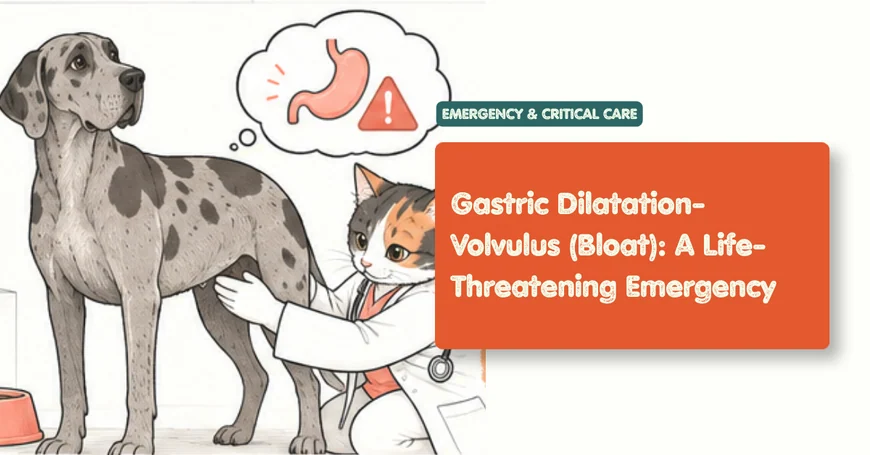
Most veterinary emergencies unfold gradually enough that a pet owner has hours or days to recognize them. GDV is not one of those. Gastric dilatation-volvulus, the condition dog owners commonly call bloat, can move a dog from apparently normal to near death in under two hours. It is one of the few veterinary emergencies where the difference between calling the clinic immediately and waiting until morning is frequently the difference between survival and death.
The condition is two things happening at once. The stomach dilates, filling with gas or fluid, and then rotates on its long axis, trapping everything inside. That rotation cuts off blood supply to the stomach wall itself, obstructs venous return to the heart, and compresses blood vessels serving the surrounding organs. The resulting shock is circulatory, not just gastrointestinal.
Understanding GDV is one of the most practical things an owner of a large or deep-chested breed can do. This article covers what's happening physiologically, what signs to look for, why the clock matters so acutely, which dogs are at highest risk, and what modern prevention can offer.
The Short Version Bloat in dogs (GDV) carries a mortality rate of 10-45% even with emergency surgical treatment, and untreated dogs die within hours (Merck Veterinary Manual, 2024). Great Danes face up to a 40% lifetime risk of developing the condition (Cornell University College of Veterinary Medicine). Prophylactic gastropexy reduces GDV recurrence from 55-85% to under 5% and can lower lifetime mortality from this condition to approximately 0.3% (VIN).
What GDV Actually Is
The stomach sits in a dog's abdomen with some freedom of movement, held loosely in place by ligaments and its connections to the esophagus and small intestine. In normal digestion, the stomach fills with food and gas, contracts, and empties. In GDV, that emptying fails.
The dilatation phase comes first. Gas and fluid accumulate in the stomach faster than they can be expelled, causing the stomach to expand dramatically. For some dogs, dilatation alone (without volvulus) is the end of the event. The stomach stretches, becomes uncomfortable, and can often be decompressed medically. But in dogs with the anatomical predisposition, especially deep-chested breeds with extra gastric mobility, that distended stomach begins to rotate.
The volvulus is the catastrophe. The stomach pivots 90 to 360 degrees along its axis. The cardia (esophageal entrance) and pylorus (exit to the small intestine) both become obstructed. The dog can't vomit, can't burp, and can't expel the accumulating gas. Blood vessels to the stomach wall are compressed or avulsed. The expanding organ pushes against the diaphragm and major blood vessels, reducing venous return to the heart and triggering distributive shock.
Necrosis of the stomach wall begins within hours. The spleen, which lies adjacent to the stomach, is often dragged along in the rotation and may itself lose blood supply. By the time visible shock signs appear, significant internal damage may already have occurred.
understanding gastrointestinal emergencies in dogs
Signs of Bloat in Dogs
Recognizing the signs of bloat in dogs is genuinely lifesaving knowledge, because the history every emergency veterinarian hates to hear is "we thought it would pass." The early signs are easy to dismiss. The later ones are unmistakable but may already indicate significant organ compromise.
Early Signs
The first signs of GDV typically appear within minutes to a few hours of the gastric distension beginning:
- Restlessness and inability to settle: the dog gets up, lies down, gets up again, can't find a comfortable position
- Unproductive retching: the dog makes the motion and sound of vomiting but produces nothing, or produces only white foam or saliva
- Hypersalivation: excessive drooling without an oral cause
- Abdominal distension: the belly, especially on the left side behind the ribcage, looks visibly swollen or feels taut when pressed
- Looking at or biting the flank: the dog focuses on its own abdomen, sometimes pawing at it
Late and Critical Signs
If the dog has progressed further, these signs indicate circulatory compromise and require immediate emergency care, not a call to schedule an appointment:
- Pale, white, or grayish-blue gums: indicating shock and poor peripheral perfusion
- Rapid, shallow breathing: the distended stomach is compressing the diaphragm
- Weak pulse or rapid heart rate
- Weakness or collapse: the dog cannot support its own weight
The unproductive retching is the sign most often cited by emergency veterinarians as the one to act on without hesitation. A dog that retches repeatedly without producing vomit, especially alongside a swollen abdomen or restlessness, should be in a car headed to an emergency clinic within minutes, not under observation at home.
<figcaption>The window between early and critical signs of GDV can be as short as 30 minutes. Call the emergency clinic while loading the dog into the car, not after waiting to see if early signs resolve.</figcaption> </figure>
when to go to the emergency vet
Why Time Is the Variable That Kills
GDV progresses on a physiological timeline that is largely indifferent to the owner's uncertainty or the distance to the nearest emergency clinic. The sequence from first gastric distension to irreversible organ damage follows hours, not days. This is not a condition where "wait until the clinic opens in the morning" is a safe option if symptoms appear at 11 pm.
Within the first one to two hours of volvulus, the stomach wall begins to lose blood supply. The cells lining the stomach are sensitive to ischemia; without circulation, they die. By hour two to four, patches of necrotic gastric tissue may already be present. During surgery, if the veterinarian finds necrotic tissue requiring partial gastrectomy, mortality rates rise substantially compared to dogs whose stomach wall remained viable.
Even with prompt surgery, GDV carries a mortality rate of 10% to 45% depending on the study and the severity of disease at presentation (Merck Veterinary Manual, 2024). A large retrospective of 736 GDV cases found that survival rates were 81.7% for dogs operated on by general surgeons and 88.7% for those treated at specialist centers (PubMed, 2020). What that data doesn't capture is the dogs who arrived too late for surgery to be viable, or whose owners couldn't reach an emergency facility in time.
The one factor owners can control is how quickly they get their dog to care. Presentation within the first hour or two of symptom onset gives the surgical team the best possible starting point.
Who Gets Bloat: Breed and Risk Factors
GDV is strongly associated with anatomy, specifically the deep-chested conformation that gives the stomach extra freedom of movement within the abdominal cavity. The stomach in a Great Dane or Irish Wolfhound has far more room to rotate than the stomach in a French Bulldog, and that anatomical latitude is the primary driver of breed risk.
The highest-risk breeds include Great Danes, St. Bernards, Weimaraners, Irish Setters, Gordon Setters, Standard Poodles, Doberman Pinschers, Basset Hounds, and Old English Sheepdogs. Great Danes carry the highest documented breed-specific risk: up to a 40% lifetime probability of developing GDV (Cornell University College of Veterinary Medicine). Purebred dogs overall are 1.5 to 4.8 times more likely to suffer GDV than mixed-breed dogs (AKC Canine Health Foundation).
Beyond breed, several modifiable and non-modifiable risk factors have been identified:
Non-modifiable:
- Age (risk increases with age, particularly over 7 years)
- Male sex (slightly higher risk than females)
- Having a first-degree relative who experienced GDV
- Lean body type with deep chest in large breeds
Modifiable:
- Eating one large meal per day rather than multiple smaller meals
- Eating very quickly (rapid ingestion)
- Eating from a raised food bowl (research on this is mixed; some studies suggest elevation increases risk in certain breeds)
- Drinking large volumes of water immediately before or after eating
- Exercising vigorously within an hour of meals
- High levels of chronic stress or fearful temperament
<figcaption>Great Danes face roughly a 1-in-2.5 lifetime chance of experiencing GDV. For these breeds, discussing prophylactic gastropexy with a veterinarian at the time of spay or neuter is a substantive medical conversation, not a precaution.</figcaption> </figure>
high-risk breeds for surgical emergencies
What Happens at the Emergency Clinic
When a suspected GDV case arrives at an emergency clinic, the team works in parallel rather than sequentially. Assessment and stabilization happen at the same time, because the dog's circulatory state at presentation often determines whether surgery is even an option.
Triage and stabilization begins immediately. Intravenous catheters are placed in both front legs (large-bore, bilateral access for rapid fluid resuscitation). Aggressive IV fluid therapy addresses the distributive shock and restores venous return to the heart. Analgesia is given. Blood pressure, heart rate, oxygenation, and ECG are monitored continuously.
Gastric decompression may occur before surgery if the stomach is confirmed dilated without complete volvulus, or if the dog needs stabilization before anesthesia is safe. A large-bore orogastric tube is passed through the mouth and into the stomach to release gas. In some cases, a trocar or large needle is passed through the abdominal wall to release pressure directly. This decompression is not treatment; it's preparation.
Imaging confirms the diagnosis. Abdominal radiographs show the characteristic double-bubble pattern of a rotated, gas-filled stomach. They also identify the degree of rotation and the condition of surrounding organs.
Surgery is the only definitive treatment when volvulus is confirmed. The stomach is rotated back to its correct position, blood supply is assessed, and any necrotic tissue is removed. The spleen is evaluated; if its blood supply was compromised by the rotation, it may be removed. A gastropexy is then performed at the same time, surgically attaching the stomach to the right body wall to prevent recurrence.
Post-operative monitoring addresses the complications most likely to cause delayed mortality: cardiac arrhythmias (reperfusion of ischemic tissue releases compounds that destabilize heart rhythm), infection from bacterial translocation through a damaged stomach wall, and disseminated intravascular coagulation (DIC) in severe cases.
what to expect during veterinary emergency surgery
Surgery and the Gastropexy Decision
The gastropexy performed at emergency surgery is not optional for a dog that has survived GDV. Without it, recurrence rates within the first year are reported at 55% to 85%, with most of those dogs dying from the recurrence (PMC, 2014). With gastropexy, recurrence drops to under 5%. That's a non-negotiable part of the emergency procedure.
The more interesting clinical question is whether high-risk dogs should have a prophylactic gastropexy before any episode of GDV occurs, typically at the time of spay or neuter.
A 2023 study examining outcomes of prophylactic incisional gastropexy in 766 dogs found that no dogs with long-term follow-up experienced GDV after the procedure, and direct complications from the gastropexy itself occurred in only 0.4% of cases (PMC, 2023). The procedure can be performed as an open incision, laparoscopically (minimally invasive), or combined with a routine spay or neuter under the same anesthetic episode to minimize cost and recovery time.
For a Great Dane owner, the math is straightforward. A 40% lifetime GDV risk against a 0.4% procedural complication rate, combined with the reduction of recurrence risk from 55-85% to under 5%, makes prophylactic gastropexy one of the highest-value preventive interventions in veterinary medicine for affected breeds.
Prophylactic gastropexy reduces the lifetime mortality risk from GDV to approximately 0.3% in dogs who receive it, compared to the 10-45% mortality of dogs presenting with acute GDV requiring emergency surgery (VIN).
prophylactic gastropexy explained
Preventing GDV Before It Happens
Prophylactic gastropexy addresses anatomical risk. The modifiable risk factors address behavioral and management-related triggers. Both matter, and they work on different timescales.
Feeding management is the most directly actionable prevention strategy for owners who haven't pursued gastropexy:
- Feed two or three smaller meals daily rather than one large meal. This reduces the volume of ingesta in the stomach at any one time and decreases post-meal gastric distension.
- Use a slow-feeder bowl or puzzle feeder to extend the eating time for fast eaters. Dogs that consume a large meal in under two minutes have significantly higher gastric air intake than those who eat over five to ten minutes.
- Avoid vigorous exercise for at least one hour before and two hours after meals.
- Do not allow excessive water consumption immediately before or after meals, particularly for deep-chested breeds.
Stress reduction is less discussed but relevant. Studies examining GDV risk factors have found that dogs described by owners as nervous, fearful, or unhappy have higher GDV incidence than dogs described as calm or happy. Whether stress is a direct physiological trigger or a marker for other risk factors isn't fully established, but the association is consistent enough to include in risk reduction discussions.
Raised feeders remain controversial. Earlier recommendations suggested elevated bowls reduced GDV risk; later studies found the opposite association in some breeds. The current consensus from veterinary nutritionists is that raised feeders should not be routinely recommended for deep-chested dogs.
feeding schedule for large breed dogs
Frequently Asked Questions
How do I know if my dog has bloat versus regular gas?
Regular gas produces mild discomfort, gurgling sounds, flatulence, and passes within minutes to an hour. Bloat (GDV) produces unproductive retching, visible abdominal distension especially on the left side behind the ribcage, restlessness that won't resolve, and hypersalivation. A dog with regular gas still wants to rest comfortably; a dog with developing GDV cannot settle. If you're genuinely unsure, call your emergency veterinary clinic and describe the symptoms. The clinical staff will tell you whether to come in. regular digestive upset vs GDV
Can bloat in dogs resolve on its own?
No. Gastric dilatation without volvulus can sometimes be managed medically with decompression and monitoring, but this requires veterinary assessment to confirm there is no volvulus. True GDV (stomach has rotated) is a surgical emergency that does not resolve spontaneously and progresses to death if untreated (ACVS). Waiting at home to see if symptoms pass is not a safe strategy for any dog showing signs of bloat, because there is no reliable way to determine externally whether volvulus has occurred.
What is the survival rate for GDV surgery?
Survival rates following GDV surgery range from approximately 55% to 90% depending on disease severity at presentation, timeliness of treatment, and whether gastric necrosis requiring partial gastrectomy is present. In a retrospective analysis of 736 GDV cases, overall survival was 81.7% to 88.7% (PubMed, 2020). Dogs presented within the first hour or two of symptom onset and without evidence of necrosis have the highest survival rates.
Should I get a gastropexy for my large-breed dog?
For high-risk breeds including Great Danes, St. Bernards, Weimaraners, Irish Setters, Dobermans, and Standard Poodles, prophylactic gastropexy is a serious conversation to have with your veterinarian, ideally at the time of spay or neuter. A 2023 study of 766 dogs found zero GDV recurrences in dogs after prophylactic gastropexy, with only a 0.4% complication rate (PMC, 2023). For a Great Dane facing a 40% lifetime GDV risk, the preventive case is compelling.
How long does it take for GDV to become fatal?
Without treatment, GDV can be fatal within six to twelve hours of symptom onset, and some dogs deteriorate to the point of irreversible shock within two to four hours (BluePearl Veterinary Partners). The timeline depends on the degree of rotation, the dog's baseline health, and how rapidly the cardiovascular system decompensates. There is no reliable way to predict where a specific dog sits on this timeline from symptoms alone, which is why emergency evaluation, not timed observation, is the only appropriate response.
The Thirty-Minute Decision
GDV is a disease that rewards preparation and punishes hesitation. Owners who know the signs, know their dog's risk level, and have already identified their nearest 24-hour emergency veterinary clinic make the right call in the first thirty minutes. Owners who are learning about bloat for the first time while their dog is pacing and retching at midnight are already behind.
The physiology doesn't change based on when a pet owner learns about it. What does change is the gap between first symptom and first treatment, and that gap, measured in minutes, is one of the strongest predictors of outcome for a disease where outcomes are already difficult.
For owners of Great Danes, St. Bernards, Weimaraners, and other high-risk breeds, the conversation to have is with your vet at your next appointment: what is our plan if this happens, and is prophylactic gastropexy an appropriate step for this dog? That conversation is far easier to have on a normal Tuesday afternoon than in an emergency parking lot at 1 am.
Keep your emergency clinic's number saved. Know what unproductive retching looks like. Know that a swollen belly in a large-breed dog at night is not a "wait until morning" situation. Those three pieces of preparation cost nothing and could be the reason your dog comes home.