IVDD in Dogs: How to Recognize Early Neurological Deficits
IVDD affects 1.2% of companion dogs (JAVMA, 2025), and Dachshunds face a 25% lifetime risk. Learn to recognize early signs and when surgery is time-critical.
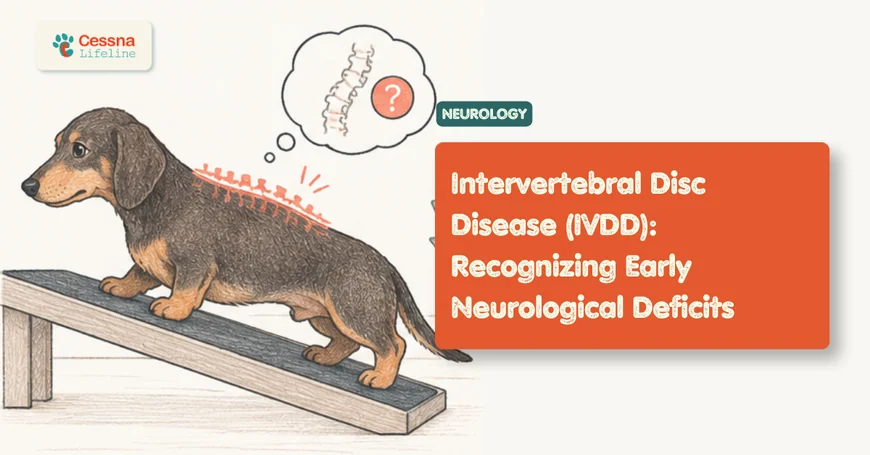
Intervertebral disc disease sends more dogs to veterinary neurologists than almost any other spinal condition, yet its earliest neurological signs are often mistaken for a pulled muscle or temporary soreness. A 2025 study of 43,517 companion dogs found a lifetime IVDD prevalence of 1.2% across the U.S. population (JAVMA, 2025), and Dachshunds face a 25% lifetime risk due to breed-specific genetics. The disease can progress from mild back pain to complete hind-limb paralysis in under 12 hours.
The challenge for pet owners is that early neurological changes look deceptively minor. A hunched back looks like stiffness. A wobbly gait looks like a sprain. By the time a dog is dragging its rear legs, the surgical window may already be narrowing. Catching IVDD at Grade 1 or 2 is the difference between a few weeks of crate rest and a $10,000 surgical emergency.
This guide covers what IVDD is, which dogs are at highest risk, how to read the five-grade neurological scale, what sudden paralysis looks like, and exactly when to act.
Key Takeaways
- IVDD (intervertebral disc disease) affects an estimated 1.2% of US companion dogs, with Dachshunds facing a 25% lifetime risk (JAVMA, 2025).
- Neurological severity is graded 1 to 5: Grade 1 is pain only; Grade 5 is full paralysis with no deep pain sensation and is a veterinary emergency.
- Dogs with intact sensation that receive surgery within 24 hours have roughly a 90% chance of walking again (VNIoC, 2024).
- Some dogs deteriorate from mild pain to complete paralysis in under 12 hours. Early recognition saves lives.
Table of Contents
- What Is IVDD (Slipped Disc) in Dogs?
- Which Dogs Are at Highest Risk for IVDD?
- What Are the Early Signs of IVDD in Dogs?
- Back Pain and Grade 1 Warning Signs
- Grade 2 Signs: When Neurological Changes Begin
- How Do Vets Grade IVDD? The 5-Point Neurological Scale Explained
- Grades 1-2: Pain and Mild Weakness
- Grades 3-4: Paralysis Without and With Bladder Loss
- Grade 5: Loss of Deep Pain Sensation
- What Does Sudden Paralysis in Dogs Look Like?
- When to Take Your Dog to the Emergency Vet
- Treatment Options: Conservative Care vs. Surgery
- Conservative Management for Grades 1-2
- Surgical Decompression for Grades 3-5
- Can IVDD in Dogs Be Prevented?
- Frequently Asked Questions
- Next Steps
What Is IVDD (Slipped Disc) in Dogs?
Intervertebral disc disease (IVDD) is the most common cause of spinal cord dysfunction requiring surgical decompression in dogs, affecting an estimated 2% of the general canine population globally (MDPI Veterinary Sciences, 2023). The condition occurs when the cushioning discs between vertebrae bulge, calcify, or rupture, forcing disc material into the spinal canal and compressing the cord. That compression produces inflammation, nerve damage, and the escalating neurological signs owners see as pain, weakness, or paralysis.
Two distinct disease types affect different breeds through different mechanisms.
Hansen Type I is the acute form. Chondrodystrophic (short-legged) breeds, Dachshunds above all others, carry a gene variant that causes disc material to harden abnormally early. These calcified discs can rupture suddenly under ordinary activity: a jump off a sofa, a run through the yard, sometimes nothing at all. Onset is fast, often dramatic, and frequently follows no predictable trigger.
Hansen Type II is the chronic form. Large breeds like Labrador Retrievers and German Shepherds experience gradual disc degeneration over years, producing slower-onset weakness rather than sudden collapse. Age is the primary driver, and the neurological decline tends to be more predictable and gradual.
The affected disc's location determines which body parts lose function. Thoracolumbar (mid-back) IVDD is far more common and affects hind-limb movement and bladder control. Cervical (neck) IVDD can cause weakness in all four limbs and is often more painful, because the neck carries more sensory nerve traffic than the lower back.
canine spinal anatomy overview
Which Dogs Are at Highest Risk for IVDD?
Breed and body shape are the strongest predictors of IVDD risk. The 2025 JAVMA study of 43,517 companion dogs found that toy and small breeds had 1.85 times the odds of IVDD compared to mixed-size breeds, overweight dogs had 1.67 times the odds, and male dogs were 1.36 times more likely to be affected (JAVMA, 2025). Purebred dogs overall had 1.66 times the odds of owner-reported IVDD compared with mixed-breed dogs.
Chondrodystrophy, the inherited gene variant responsible for the characteristic long-body, short-leg structure in Dachshunds and French Bulldogs, also causes disc degeneration to begin as early as one year of age (Canine Genetics and Epidemiology, 2024). That's not an old dog's disease. It's a structural problem that starts before your Dachshund finishes growing.
<figcaption>Sources: JAVMA 2025; Walkin' Pets breed risk data; Canine Genetics and Epidemiology (UK). Figures are lifetime risk estimates and vary by study and population.</figcaption> </figure>
Other high-risk breeds include Pekingese, Lhasa Apso, Shih Tzu, Pembroke Welsh Corgi, and Basset Hound. Among large breeds, German Shepherd Dogs are the most commonly affected by Type II disc disease.
According to a 2025 JAVMA study of over 43,000 companion dogs, dogs that were overweight carried 1.67 times the IVDD odds of healthy-weight dogs, while purebred dogs overall had 1.66 times the odds of mixed breeds (JAVMA, 2025). These two factors, breed and weight, are the most actionable risk variables an owner can influence.
breed-specific IVDD risk guide
What Are the Early Signs of IVDD in Dogs?
The earliest IVDD signs appear before any neurological deficit and are easy to miss. A dog at Grade 1 looks like it might have slept wrong. The signs are behavioral more than physical: something is off, but it's not obvious what. Because chondrodystrophic dogs can go from Grade 1 to Grade 3 in hours, these early signals demand prompt veterinary attention, not watchful waiting.
Back Pain and Grade 1 Warning Signs
Grade 1 IVDD produces pain without neurological deficit. The dog moves, walks, and stands normally, but something about its movement has changed. Watch for:
- Hunched or arched back, especially in the thoracolumbar (mid-back) region
- Yelping or crying when touched along the spine, when picked up, or when changing position
- Reluctance to jump, use stairs, lower the head to a food bowl, or climb onto furniture
- Neck stiffness: a dog that moves its whole body to look sideways rather than turning its head
- Shivering or trembling not explained by cold or fear
- Unusual stillness: the dog doesn't want to move, lies down more than usual
These signs reflect pain and spasm in the paraspinal muscles surrounding the affected disc. The dog is protecting itself. What makes it tricky is that anti-inflammatory medications often provide enough relief that owners assume the problem is resolved, when the underlying disc is still at risk of further herniation.
Grade 2 Signs: When Neurological Changes Begin
Grade 2 introduces the first measurable neurological changes while the dog still walks. The gait becomes weak, wobbly, or asymmetric. Look for:
- Ataxia in the hind limbs: a swaying, drunken walk that wasn't there before
- Paw knuckling: the dog places the top of the foot on the ground instead of the pad
- Stumbling or catching on low edges, curbs, or thresholds
- Weak hind-end pushoff when going up stairs or rising from lying down
- Asymmetric limb use: favoring one side, dragging one hind paw
At Grade 2, the dog's spinal cord is under increasing pressure. An owner might interpret knuckling as a sore paw, or wobbly walking as fatigue after exercise. Don't wait for a second episode to confirm the pattern. A veterinary neurologist can distinguish Grade 2 IVDD from musculoskeletal injury with a short neurological examination.
According to Gulf Shore Veterinary Specialists, some dogs progress from Grade 1 pain signs to complete hind-limb paralysis in under 12 hours with an acute disc extrusion (GSVS, 2024).
dog back pain vs. IVDD: how to tell the difference
How Do Vets Grade IVDD? The 5-Point Neurological Scale Explained
The five-grade IVDD scale is the clinical language veterinary neurologists use to assess severity, determine treatment, and predict outcomes. Knowing your dog's grade tells you what's at stake and how fast the situation can change. The 2025 JAVMA study of 43,517 companion dogs underscores that early-grade intervention is the strongest predictor of full recovery (JAVMA, 2025).
| Grade | Key Signs | Walks? | Deep Pain? | Recommended Path |
|---|---|---|---|---|
| 1 | Spinal pain, yelping, hunched posture | Yes | Yes | Conservative care (rest + meds) |
| 2 | Weak/wobbly gait, paw knuckling | Yes (weakly) | Yes | Conservative or surgical (imaging first) |
| 3 | Cannot walk, sensation intact | No | Yes | Surgery recommended |
| 4 | Cannot walk, bladder loss | No | Yes | Surgery urgent |
| 5 | No movement, no deep pain sensation | No | No | Surgical emergency within 12-24h |
Grades 1-2: Pain and Mild Weakness
Grade 1 is pain only, with no neurological deficits. The dog walks normally. This is the ideal intervention point because conservative care (strict crate rest and anti-inflammatory medication) resolves most Grade 1 cases without surgery.
Grade 2 produces mild-to-moderate neurological deficits with the dog still walking. Stumbling, paw knuckling, and rear-end weakness are the hallmarks. Conservative care is still an option at Grade 2, but many neurologists recommend advanced imaging first to assess how much cord compression is present before committing to a non-surgical approach.
Most Grade 1 and 2 dogs treated appropriately have an excellent prognosis for full recovery.
Grades 3-4: Paralysis Without and With Bladder Loss
Grade 3 is paralysis in the affected limbs without bladder dysfunction. The dog cannot walk or bear weight, but deep pain sensation (the nervous system's response to firm toe pressure) remains intact. This is typically the threshold at which surgical decompression becomes the recommended course, because Grade 3 dogs that don't receive surgery risk deteriorating further.
Grade 4 adds loss of voluntary bladder control to the paralysis. The dog cannot walk and cannot urinate without manual expression by the owner or veterinary team. Bladder complications, including urinary tract infections and urine scalding, become daily management challenges. The longer decompression is delayed, the higher the risk of permanent dysfunction.
<figcaption>Sources: PMC10305422 (cervical IVDD, 2023); PMC7756518 (thoracolumbar IVDD, 2020); VNIoC prognosis data (2024). Recovery = regaining ambulatory status.</figcaption> </figure>
Grade 5: Loss of Deep Pain Sensation
Grade 5 is the most severe classification and a genuine neurological emergency. The dog has no voluntary limb movement and has lost deep pain perception entirely. When a veterinarian firmly squeezes the toe or pinches the periosteum (bone surface), a dog with intact deep pain will vocalize or turn its head. A Grade 5 dog does not respond.
Deep pain loss is the single most important prognostic marker in IVDD. Dogs that lose deep pain and receive surgery within 24 hours of that loss have approximately a 50 to 64% chance of regaining ambulatory function (PMC, 2021; PMC, 2020). Dogs that don't receive decompression or receive it after 48 hours face a substantially worse outlook.
IVDD grading scale explained
What Does Sudden Paralysis in Dogs Look Like?
Sudden paralysis from IVDD doesn't always announce itself with a collapse. It builds in stages, sometimes over hours, and each stage is a narrowing of the intervention window. An estimated 2% of the general dog population will experience IVDD at some point, but in chondrodystrophic breeds this acute-onset presentation is the dominant pattern (MDPI Veterinary Sciences, 2023).
Here's the typical progression of a Type I acute disc extrusion:
- Unusual reluctance to rise from lying down, abnormal stillness
- Back or neck pain with yelping when touched, hunched posture
- Rear-limb weakness or wobbling that appears within minutes to hours of the pain
- Paw knuckling: the dog walks on the top of one or both hind paws
- Dragging one or both rear legs, unable to push off or bear weight
- Loss of bladder control: urinating without adopting a posture
- No response to deep toe pressure, indicating Grade 5 deep pain loss
The transition from step 1 to step 7 can occur in under four hours with a severe extrusion. It's not a worst-case scenario; it's the documented presentation pattern in breeds like Dachshunds, Corgis, and French Bulldogs.
A dog that walked normally at 7 a.m. can be dragging its hind legs by 11 a.m.
What confuses owners is that paralyzed dogs often appear calm or even comfortable once deep pain sensation is lost. They're not. Loss of sensation is not recovery. It's a sign the spinal cord injury has progressed to the level that the pain pathway itself is no longer functional.
emergency home care for a paralyzed dog
When to Take Your Dog to the Emergency Vet
Any neurological sign in a dog with a history of back pain warrants same-day veterinary evaluation. If your dog has moved to Grade 3 or beyond, treat it as an emergency and go immediately, not at the next available appointment.
Go to an emergency vet or veterinary neurologist right away if your dog:
- Cannot walk or cannot bear weight on hind legs
- Is dragging one or both rear limbs across the floor
- Cannot urinate or has suddenly lost bladder control
- Shows no response when you firmly squeeze a rear toe
- Is crying or screaming acutely with any attempt to move
The 12-to-24-hour surgical window for Grade 5 dogs is one of the most consequential time constraints in veterinary medicine. A retrospective study of 1,501 dogs with thoracolumbar IVDD found that timing of surgical decompression was among the strongest predictors of outcome (PMC, 2021). An MRI or CT scan to localize the herniated disc typically takes two to four hours at a specialty center.
If you can safely record a 20 to 30 second video of your dog walking before transport, do it. Neurological signs are sometimes suppressed when dogs are stressed or running on adrenaline at the clinic. Gait video captured at home is a valuable diagnostic aid that helps neurologists grade severity accurately.
Don't give human NSAIDs like ibuprofen or naproxen. They're toxic to dogs. If your veterinarian has previously prescribed canine anti-inflammatory medication, you can give the prescribed dose while arranging transport, but confirm first if possible.
finding a veterinary neurologist near you
Treatment Options: Conservative Care vs. Surgery
IVDD treatment in dogs divides into two tracks based on neurological grade. The grade at presentation, not the level of owner concern or the dog's pain level alone, determines which track is appropriate.
Conservative Management for Grades 1-2
Conservative care is the first-line treatment for Grade 1 and early Grade 2 IVDD. It consists of strict cage or crate rest for four to six weeks combined with anti-inflammatory medication (corticosteroids or NSAIDs, not both) and pain management. The "strict" qualifier is non-negotiable: even when medication brings visible pain relief within 48 hours, the disc remains herniated and the cord remains at risk. Premature return to normal activity is a leading cause of recurrence.
Physical rehabilitation, including gentle passive range-of-motion exercises, can begin once a neurologist confirms it's appropriate, and accelerates functional recovery. Cost for conservative management in 2026 typically runs $300 to $1,500, covering the initial exam, imaging if pursued, and medications (Vety, 2026).
Conservative care is not appropriate for Grade 3 and above. A dog that cannot walk needs decompression.
Surgical Decompression for Grades 3-5
Surgery removes the disc material pressing on the spinal cord. For thoracolumbar IVDD, the procedure is a hemilaminectomy, which involves removing a portion of the vertebral arch to access and clear the disc material. For cervical IVDD, a ventral slot decompression approaches the disc from below the neck.
A 2023 study of 60 Yorkshire Terriers with cervical IVDD treated with single ventral slot decompression found a 97.5% overall recovery rate with a median recovery time of just seven days (PMC, 2023). Dogs that retain deep pain sensation before surgery have approximately a 90% chance of regaining ambulatory function (VNIoC, 2024).
Post-surgical physical rehabilitation makes a measurable difference in outcomes. One study of Grade 5 dogs found that those receiving structured rehabilitation had ambulatory recovery rates of 91.4%, compared to 80.0% in those without rehabilitation (PMC, 2022). Spinal cord healing continues for six to nine months post-surgery; rehabilitation started early accelerates that process.
Surgical costs range from $4,000 to $12,000 in 2026 depending on the case complexity, procedure, facility, and whether structured rehabilitation is included (Vety, 2026). Pet insurance with pre-existing condition exclusions may not cover IVDD if the dog had prior signs. Coverage taken out before any symptoms appear generally offers the strongest financial protection.
<figcaption>Recovery timeline ranges based on published veterinary literature. Grade 5 recovery, when it occurs, may extend through 9 months of post-surgical spinal cord healing. Individual outcomes vary significantly.</figcaption> </figure>
IVDD surgery: what to expect
Can IVDD in Dogs Be Prevented?
IVDD can't be fully eliminated in genetically predisposed dogs, but the risk of disc herniation can be reduced with consistent lifestyle adjustments. The 2025 JAVMA study identified overweight body condition as one of the most significant modifiable risk factors (JAVMA, 2025). Every extra pound of body weight adds load to already-degenerating discs.
These are the highest-impact interventions for at-risk breeds:
Weight management. Keep your dog at a lean, healthy body condition score. Even modest weight loss in an overweight Dachshund reduces spinal compressive forces. Work with your veterinarian to establish an appropriate caloric target and monitor body condition regularly.
Ramps instead of jumping. Repetitive impact from jumping on and off furniture is a documented disc herniation trigger in chondrodystrophic breeds. Ramps to sofas, beds, and car seats are not excessive caution: they're a standard, evidence-supported preventive recommendation from veterinary neurologists.
Harnesses over collars. A neck collar concentrates leash tension at the cervical spine. A well-fitted chest harness distributes that force across the sternum and shoulders. This is especially relevant for dogs with a history of cervical IVDD or cervical pain episodes.
Genetic screening. The chondrodystrophy gene variant (FGF4 retrogene on chromosome 12) that predisposes dogs to Type I IVDD can now be identified through commercial DNA testing. Responsible breeders of Dachshunds and French Bulldogs increasingly screen breeding pairs to reduce the incidence of disc disease in offspring. If you're selecting a puppy from a high-risk breed, ask about parental genetic screening.
Regular veterinary spinal assessments. For dogs with a family history of IVDD or early behavioral signs of spinal discomfort, annual spinal palpation during wellness exams catches early changes before they become emergencies.
IVDD prevention guide for Dachshunds
Frequently Asked Questions
What are the first signs of IVDD in dogs?
The first signs of IVDD in dogs are typically pain-based rather than neurological: a hunched back, yelping when touched or picked up, reluctance to jump or use stairs, and unusual stillness. These Grade 1 signs reflect spinal pain without any limb weakness or gait abnormality. They're often misread as a muscle strain. Because chondrodystrophic breeds can deteriorate to paralysis within hours, Grade 1 signs warrant same-day veterinary contact, not watchful waiting.
How quickly can a dog go from back pain to paralysis with IVDD?
With an acute Type I disc extrusion in breeds like Dachshunds, the timeline can be under 12 hours from first pain signs to complete hind-limb paralysis (GSVS, 2024). Gradual Type II disc disease in large breeds progresses over weeks to months. The acute form is far more dangerous for timeline purposes: if your dog shows sudden back pain, treat it as a potential emergency regardless of whether it can still walk.
Can a dog recover from a slipped disc without surgery?
Yes, for Grade 1 and Grade 2 IVDD. Strict crate rest and anti-inflammatory medication resolves the majority of Grade 1 cases. Grade 2 outcomes are more variable, and many neurologists recommend imaging before committing to conservative care. Grade 3, 4, and 5 dogs that don't receive surgical decompression face a significantly lower probability of meaningful recovery and a much higher risk of permanent paralysis. "Trying rest first" for a Grade 3 or higher dog costs time the spinal cord doesn't have.
What does the deep pain test for IVDD actually measure?
Deep pain testing evaluates the integrity of the spinal cord's ascending pain pathways. A veterinarian applies firm pressure (usually a hemostat clamp) to the dog's toe or periosteum. An intact response means the dog vocalizes or turns its head, confirming that the brainstem received the signal. No response at Grade 5 indicates that compression has damaged the spinal cord severely enough to interrupt even deep pain transmission. This test takes seconds and provides the single most important prognostic data point in an IVDD evaluation.
How much does IVDD surgery cost in 2026?
IVDD surgery in the U.S. runs $4,000 to $12,000 in 2026, depending on the surgical procedure, facility, geographic location, severity of the case, and whether rehabilitation is included (Vety, 2026). Conservative management for Grade 1-2 dogs typically costs $300 to $1,500. Pet insurance that predates any IVDD diagnosis or signs may cover 70 to 90% of surgical costs, making pre-diagnosis coverage one of the highest-value financial decisions for owners of high-risk breeds.
Is IVDD more common in certain ages of dogs?
Type I IVDD in chondrodystrophic breeds typically presents between ages three and seven, though disc degeneration can begin in the first year of life (Canine Genetics and Epidemiology, 2024). Type II IVDD in large breeds tends to appear in older dogs, commonly eight years and above. The 2025 JAVMA study found no single dominant age group, reflecting the difference between these two disease types across the companion dog population (JAVMA, 2025).
Next Steps
Early recognition is the defining factor in IVDD outcomes. A Dachshund caught at Grade 1 with pain management and rest has a dramatically different prognosis than the same dog presenting at Grade 5 after two days of "it seemed to improve a little." The five-grade scale exists to give owners and clinicians a shared language for urgency.
If your dog is showing any back pain, neck stiffness, or gait changes right now, contact a veterinary neurologist or emergency practice today. Don't wait for a "good day" to see if the issue resolves.
For dogs already diagnosed or in recovery: