Pet Weight Management: Is Your Dog Overweight?
Pet weight management starts with body condition scoring, not the scales. How to tell if your dog is overweight, why diet food fails, and what actually works.
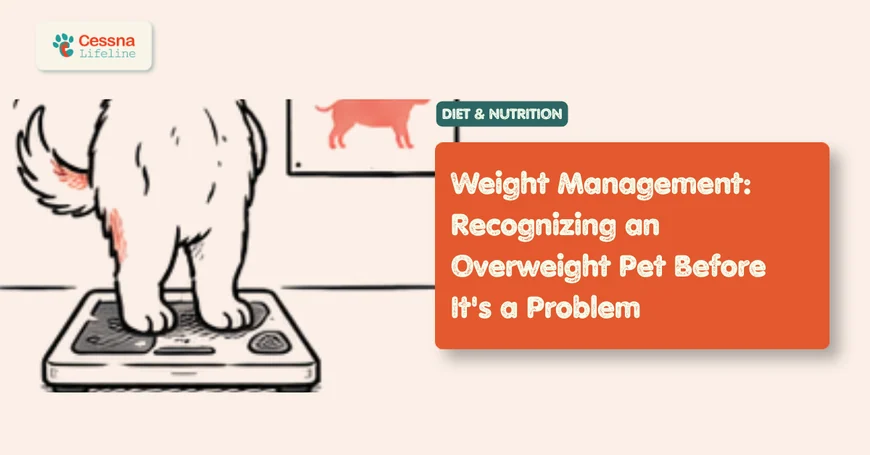
Pet weight management fails more often from measurement than from willpower. Owners are asked whether their pet is overweight and answer honestly from what they see, and what they see has drifted, because the average pet around them has got heavier too. A dog two or three kilos over its ideal weight looks entirely normal to the person who feeds it every day.
The fix is to stop judging by eye and start using your hands. Body condition scoring takes thirty seconds, needs no equipment, and is far more useful than the number on a scale, because it tells you whether a given weight is right for that individual animal.
What to Know Excess weight is not a cosmetic issue. It shortens life expectancy and is causally linked to osteoarthritis, diabetes mellitus in cats, respiratory compromise, reduced heat tolerance, higher anaesthetic risk, and reduced grooming ability. The encouraging part is that it is one of the most reversible problems in small animal practice, and modest loss produces disproportionate benefit: dogs with osteoarthritis frequently show measurable improvement in lameness from weight reduction alone, before any medication.
How Can I Tell if My Dog Is Overweight?
Overweight dogs are so common that the visual baseline has shifted. The practical answer to how to tell if my dog is overweight is to use your hands rather than the scales, and check three things.
Ribs. Run your flat palm along the side of the chest with light pressure. You should feel each rib distinctly, with a thin covering, much as you feel the bones on the back of your own hand. If you need to press to find ribs, there is excess fat. If ribs are visible and sharp with no covering at all, the pet is underweight.
Waist from above. Standing over your pet looking down, there should be a visible narrowing behind the ribcage. A straight line from ribs to hips, or a bulge outward, means excess weight.
Abdominal tuck from the side. Viewed from the side, the belly should rise from the bottom of the ribcage toward the hind legs. A belly that runs level, or hangs below the ribcage, indicates excess.
That is body condition scoring, usually recorded on a nine-point scale where four to five is ideal. The scale matters more than breed-average weight charts, because an individual's ideal weight depends on frame size. A chart saying Labradors should weigh thirty kilos is useless for a small-framed Labrador whose correct weight is twenty-six.
| Score (of 9) | What you feel and see | Action |
|---|---|---|
| 1 to 3 | Ribs, spine and pelvis prominent, no fat cover, obvious waist | Underweight. Needs veterinary assessment for an underlying cause |
| 4 to 5 | Ribs easily felt with thin cover, visible waist, clear abdominal tuck | Ideal. Maintain, and reweigh every few months |
| 6 | Ribs felt with slight pressure, waist beginning to disappear | Overweight. Act now, it is easiest at this stage |
| 7 | Ribs hard to feel, no waist, abdomen level | Clearly overweight. Needs a structured plan |
| 8 to 9 | Ribs not palpable, fat deposits over spine and tail base, abdomen distended | Obese. Needs veterinary-supervised reduction and screening |
Two cautions. A thick or long coat hides a great deal, so this is a hands assessment and not a visual one. And heavily muscled breeds feel different from fat ones: muscle is firm and follows the body contour, fat is softer and moves.
Why Does Excess Weight Matter So Much?
Because it changes the trajectory of several diseases rather than simply adding bulk.
Joints carry the most direct consequence. Extra weight increases load on every joint, and in a dog with existing osteoarthritis that load drives pain and progression. This is also where the best news sits: weight reduction alone frequently improves lameness measurably, which makes it the most cost-effective intervention in canine arthritis and one that works alongside medication rather than instead of it. arthritis in senior pets
In cats, the link with diabetes mellitus is the one to understand. Excess weight drives insulin resistance, and overweight cats are at substantially higher risk of developing diabetes than lean ones. Diabetes in cats can go into remission with weight and dietary management, particularly when caught early, so this is a condition where weight work genuinely alters the outcome.
Beyond those: reduced heat tolerance, which matters a great deal in Indian summers and especially in flat-faced breeds that are already compromised; respiratory effort; higher anaesthetic risk; reduced exercise tolerance that becomes self-reinforcing; and reduced grooming ability, which in cats produces the scurfy, matted rump that is often the first thing an owner notices. Overall, carrying excess weight is associated with a shorter life.
Why Do Weight Loss Attempts Usually Fail?
Rarely because owners lack commitment. Usually because of arithmetic and household logistics.
Portions are estimated rather than measured. A scoop is not a unit. Density varies between foods, and a heaped scoop can carry considerably more than a level one. Weighing the daily ration on kitchen scales, once, is often the entire intervention needed.
The bag's feeding guide is treated as a prescription. Those figures are generous averages aimed at active entire animals. A neutered indoor pet frequently needs meaningfully less, and starting at the bag figure means starting above requirement.
Treats are not counted. This is the most common single failure. A few biscuits, a dental chew, training rewards, and the ends of meals can add a substantial share of daily calories invisibly, because owners count meals and not extras. Dental chews in particular are often calorie-dense.
Feeding less of the same food creates deficiency. Reducing an ordinary maintenance diet by a third reduces protein, vitamins, and minerals by a third too. That is why therapeutic weight-loss diets exist: they are formulated so a restricted calorie intake still delivers full micronutrients, with higher protein to preserve lean mass and higher fibre for satiety.
More than one person feeds the pet. Multi-person households are where plans quietly fail, because everybody assumes somebody else has not fed the dog yet.
Loss is too fast or unmonitored. Rapid loss costs lean mass, and in cats aggressive restriction risks hepatic lipidosis, a serious liquidation of fat into the liver. Weight loss in cats needs to be gradual and supervised.
The intervention that changes the most, in our experience, is not a diet food. It is a written list on the fridge of every single thing the pet is allowed in a day, with the treats included in the day's total and initialled by whoever gave them. Weight plans fail in multi-person households because feeding is distributed and invisible: each person gives a little, nobody gives much, and the pet eats well over target. Making the feeding visible usually reveals three or four hundred uncounted calories a day, and it does so without anyone having to be blamed or to change their habits by much.
How Do I Help an Overweight Cat Lose Weight?
Working out how to help an overweight cat lose weight needs a different approach from dogs, and more caution.
Gradual is not optional. Aggressive calorie restriction in a cat risks hepatic lipidosis, where rapid fat mobilisation overwhelms the liver, and that is a serious and sometimes fatal condition. Feline weight loss should be slow, planned with a vet, and monitored by regular weighing rather than by appearance.
Cats also will not exercise on command, so the lever is food plus environment rather than activity. The food side means a measured daily allowance of an appropriate diet, split into several small meals, and often a move toward wet food, which has lower calorie density per gram and so gives a larger, more satisfying portion. wet vs dry pet food
The environment side is where cats differ most usefully. Food puzzles and feeding balls make a cat work for its ration. Spreading the daily allowance across several stations, particularly at different heights, builds movement into eating. Short structured play sessions twice daily, with a wand toy rather than a laser, provide the only reliable exercise most indoor cats get. Climbing opportunities help, though an already heavy or arthritic cat needs steps rather than jumps.
Multi-cat households are the practical obstacle, because a shared bowl makes individual intake unknowable. Microchip-activated feeders solve this properly. Separate feeding rooms work if you are disciplined.
A detail worth knowing: an overweight cat that has stopped grooming its rear is not being lazy, it physically cannot reach. That area needs taking over with a comb while the weight comes down. cat grooming
What Does a Pet Weight Management Plan Look Like?
Six components, and skipping any of them is usually why a plan stalls.
A target weight representing a healthy pet weight, set by a vet from body condition rather than a breed chart, with interim milestones so progress is visible. A calculated calorie allowance based on target weight rather than current weight. An appropriate diet, which for pets needing substantial loss means a therapeutic weight-reduction food that delivers full micronutrients and protein on restricted calories. Measured portions, by weight on kitchen scales, with treats budgeted inside the daily total rather than added to it. Regular weighing, every two to four weeks on the same scales, because the trend is what matters. And an exercise plan appropriate to the animal's current joints and fitness, built up gradually.
A realistic rate is roughly one to two percent of body weight per week. Slower than that is still progress. Much faster costs lean mass and, in cats, carries real risk.
For treats, the simplest workable rule is to keep them within about ten percent of daily calories and take that ten percent out of the meal allowance. Swapping biscuits for green beans, carrot, or a portion of the pet's own kibble counted into the total costs nothing in enjoyment and a great deal less in calories.
When Should Weight Be Checked by a Vet?
Weight change is a clinical sign in its own right, and some situations need investigation rather than a diet:
- Weight gain despite no change in feeding, which can indicate hypothyroidism in dogs
- Weight loss despite a normal or increased appetite, which raises hyperthyroidism in cats, diabetes, or malabsorption
- Any rapid or unexplained change in either direction
- An overweight pet that is also drinking or urinating more, which needs diabetes screening
- Lameness or reluctance to exercise, where weight and joint disease compound each other
- A cat that has stopped grooming its rear, which combines weight and mobility
- Before any planned anaesthetic, since excess weight raises risk
- A plan that has stalled for more than a month despite accurate measurement
- Any pet needing to lose more than about ten percent of its body weight
An overweight cat that stops eating is a red flag rather than good news. Cats that go off food while carrying excess weight are at risk of hepatic lipidosis, and that needs a veterinary exam promptly, not encouragement.
Frequently Asked Questions
How can I tell if my dog is overweight?
Use your hands. Run a flat palm along the ribs: you should feel each one distinctly under a thin covering. Look down from above for a visible waist behind the ribcage, and from the side for a belly that rises toward the hind legs. Needing to press to find ribs, or seeing no waist, means excess weight.
What is a healthy weight for dogs?
There is no single figure per breed, because frame size varies within every breed. Body condition scoring is the better measure: a score of four to five on a nine-point scale is ideal regardless of what the number on the scale says. Your vet can set an individual target weight from your dog's frame and condition.
How do I help an overweight cat lose weight?
Slowly and with veterinary supervision, because rapid loss in cats risks hepatic lipidosis. Use a measured allowance of an appropriate diet split into small meals, often shifting toward wet food for better satiety. Add movement through food puzzles, feeding stations at different heights, and short play sessions twice a day.
Why is my pet not losing weight on diet food?
Usually because portions are estimated rather than weighed, treats are not counted inside the daily total, the bag's feeding guide was used as a prescription, or more than one person is feeding. Write down everything the pet receives in a day for a week. That exercise typically uncovers several hundred uncounted calories.
How quickly should a pet lose weight?
Around one to two percent of body weight per week. Slower is still progress and is safer than pushing. Faster costs lean muscle rather than fat, and in cats aggressive restriction risks hepatic lipidosis. Weigh every two to four weeks on the same scales and judge the trend rather than any single reading.
Can losing weight help my dog's arthritis?
Yes, and it is one of the most effective things you can do. Excess weight increases load on every joint, and weight reduction alone frequently produces measurable improvement in lameness, sometimes before medication is added. It works alongside pain relief and rehabilitation rather than replacing them, and the benefit arrives early in the loss.
Is pet obesity really a medical problem?
Yes. It is causally linked to osteoarthritis, diabetes mellitus in cats, respiratory compromise, poor heat tolerance, higher anaesthetic risk, and reduced grooming ability, and it is associated with a shorter life. It is also among the most reversible conditions in practice, which is what makes it worth addressing properly rather than accepting.
Next Steps
Weight work goes much better with a number to aim at and someone checking the arithmetic. A consultation sets a target weight from body condition rather than a breed chart, calculates the daily calorie allowance for that target, and screens for the conditions that cause weight change in the first place.
Arrange a pet weight management and nutrition plan with the Cessna Lifeline team, or book an appointment for a body condition score and portion calculation.
Bring the food packet and an honest list of everything your pet gets in a day, treats and chews included. That list is the single most useful thing you can arrive with, and it is where most plans find the calories that were quietly undoing them.