Osteoarthritis in Pets: Managing Pain and Mobility Loss
Osteoarthritis affects up to 80% of dogs over 8 years. Learn the signs of joint pain, proven treatments, and mobility support strategies for senior dogs and cats.
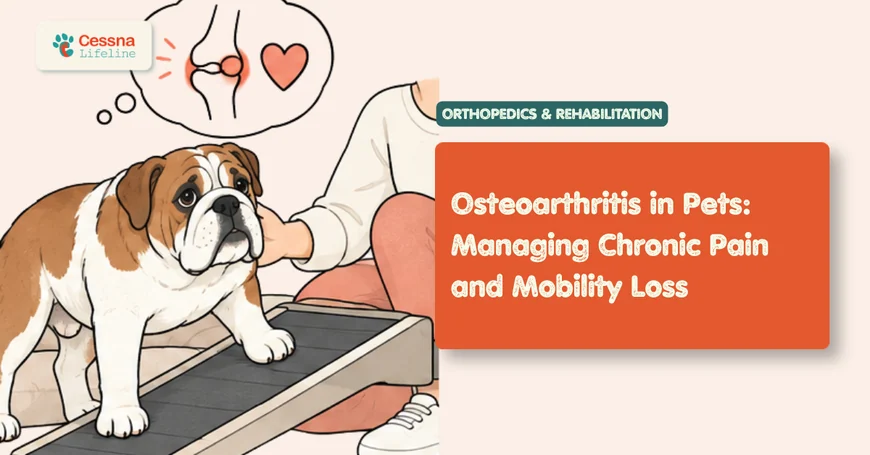
Osteoarthritis is the most common source of chronic pain in dogs and cats. It affects an estimated 20% of adult dogs overall and up to 80% of dogs over the age of 8 (Johnston, 1997). In cats, the prevalence is even higher by radiographic measure: approximately 90% of cats over the age of 12 show radiographic evidence of OA in at least one joint (Hardie et al., 2002). Despite these numbers, OA remains one of the most underdiagnosed and undertreated conditions in small animal practice, largely because chronic pain in animals is expressed subtly and attributed to aging rather than recognized as a treatable disease.
This article covers what OA looks like in dogs and cats, how it is diagnosed, and what the current treatment landscape, from NSAIDs to monoclonal antibodies to rehabilitation, can achieve for pets living with joint disease. senior dog health guide
What to Know Osteoarthritis affects up to 80% of dogs over 8 years and approximately 90% of cats over 12 years. It is a progressive but manageable disease. Multimodal management combining weight control, NSAIDs or anti-NGF monoclonal antibodies, physiotherapy, and environmental modification substantially reduces pain and extends quality of life across all severity stages (Johnston, 1997; Corral et al., 2021).
The Condition That Hides in Plain Sight
Osteoarthritis is the progressive degradation of articular cartilage within a joint, accompanied by synovial membrane inflammation, subchondral bone remodeling, and periarticular new bone formation (osteophytes). The result is a joint with roughened articulating surfaces, reduced lubrication, and chronic inflammation that produces pain with movement and at rest as disease advances.
The cartilage itself has no nerve supply, which is why early OA is often painless. Pain emerges as subchondral bone, synovial membrane, and periarticular structures become involved. This delay between the onset of joint damage and the onset of clinically detectable pain is one reason OA is often identified late: the disease has been present and progressing for months or years before the animal shows signs the owner notices.
One of the most useful concepts for understanding OA pain in dogs is the "warming up" phenomenon. Dogs with OA are classically stiff after rest and improve with gentle movement. This is not random fluctuation; it reflects synovial fluid rheology. During rest, synovial fluid viscosity increases and its lubricating properties decrease. Movement mechanically redistributes the fluid and restores lubrication, reducing friction and pain. This is why a dog that "seemed fine at the clinic" may have been significantly stiff when it first rose that morning, and why stopping exercise entirely in arthritic dogs worsens function rather than protecting it. Controlled, low-impact movement maintains synovial fluid quality better than extended rest.
The joints most commonly affected in dogs are the hips, elbows, stifles (knees), shoulders, and spine. In cats, the elbows, hips, and tarsal joints (ankles) are most frequently involved. Unlike dogs, cats rarely limp overtly on arthritic limbs; they adapt posture and activity level instead, making their OA substantially harder to identify.
What Are the Signs of Arthritis in Senior Dogs?
The signs of OA in senior dogs span behavioral, postural, and physical domains. None is pathognomonic; the pattern matters more than any single finding. signs of pain in dogs
Behavioral signs:
- Reduced willingness to walk, play, or exercise at previous intensity or duration
- Reluctance to climb stairs, jump into cars, or mount furniture
- Sleeping more and moving less between resting spots
- Irritability or withdrawing from handling around the affected joint
- Restlessness at night or difficulty finding a comfortable position
Physical and postural signs:
- Stiffness on rising that improves after a few minutes of movement (classic OA warming-up pattern)
- Visible or palpable muscle atrophy over the affected limb (hindquarters narrow in hip OA; forelimb musculature reduced in elbow OA)
- A shorter, stiffened gait or a subtle head-bob during movement
- Sitting "off" on one hip rather than squarely
- Bunny-hopping gait in bilateral hip OA (as described in hip dysplasia)
- Licking, chewing, or excessive attention to a specific joint area
Recognizing Arthritis Pain in Dogs and Cats
| Behavioral Sign | Dogs | Cats | Urgency Level |
|---|---|---|---|
| Stiffness after rest, improves with movement | Very common | Common | Evaluate within 2 weeks |
| Reduced willingness to exercise or play | Common | Common | Evaluate within 2 weeks |
| Reluctance to jump or climb | Moderate specificity | High specificity for OA | Evaluate within 1 week |
| Hind limb or forelimb muscle atrophy | Consistent OA sign | Common | Evaluate within 1 week |
| Reduced grooming of hindquarters or tail base | Uncommon | Classic feline OA sign | Evaluate within 1 week |
| Irritability or aggression when touched | Moderate | Very common in cats | Evaluate promptly |
| Limping or altered gait | Often present | Often hidden | Evaluate within 1 week |
| Pain at rest or nighttime restlessness | Severe OA sign | Severe OA sign | Urgent evaluation |
A critical practical point: dogs with chronic pain adapt their behavior to minimize it. A dog that has been managing its OA for 18 months does not look the same as a dog in acute pain. It may not vocalize, may not limp overtly, and may appear "normal" to an observer who does not know what to look for. The owner's longitudinal knowledge is the most sensitive tool: "this dog is not the same as it was two years ago" is clinically meaningful even when the exam room observation seems unremarkable.
Citation Capsule: Approximately 40% of dogs presented to general veterinary practices show signs consistent with OA on orthopedic examination, yet the condition is frequently not discussed or managed (Johnston, 1997). The discrepancy between radiographic and clinical prevalence reflects both the chronic, adaptive nature of OA pain in dogs and the absence of a standardized behavioral screening protocol for joint pain during routine wellness visits.
Why Do Joints Degenerate and What Accelerates It?
Primary OA develops without a specific underlying cause, driven by the cumulative mechanical and biological factors of aging joints. Secondary OA develops as a consequence of a known joint abnormality, including hip dysplasia, elbow dysplasia, CCL rupture, osteochondrosis, or joint trauma. In veterinary practice, secondary OA is far more common than primary OA, because the high prevalence of developmental orthopedic disease means most arthritic dogs can trace their joint pathology to a structural problem that predates their OA.
The key modifiable factors that accelerate OA progression in any joint:
Obesity: Excess body weight directly increases compressive load on articular cartilage with every step. Beyond mechanical loading, adipose tissue produces pro-inflammatory adipokines (leptin, adiponectin, resistin) that act systemically to increase joint inflammation and accelerate cartilage catabolism. Overweight dogs develop OA earlier, progress faster, and respond less well to treatment than lean dogs with equivalent joint disease. dog weight management
Inadequate muscle mass (sarcopenia): Periarticular muscle provides dynamic joint stabilization. Loss of muscle mass, whether from age, disuse, or inadequate nutrition, reduces the mechanical support around the joint and increases the load on cartilage and subchondral bone. This creates a vicious cycle: OA pain reduces activity, reduced activity accelerates muscle atrophy, muscle atrophy worsens joint stability, worsened stability accelerates OA. Breaking this cycle is the primary target of rehabilitation therapy.
High-impact repetitive exercise on hard surfaces: Cumulative mechanical trauma to articular cartilage, without adequate recovery time, accelerates degradation. High-impact activities such as repetitive jumping and ball-chasing (particularly the abrupt deceleration and landing forces) are disproportionately loading to arthritic joints compared to walking or swimming.
Citation Capsule: Weight loss in overweight dogs with OA consistently produces measurable improvements in gait and pain scores; a controlled study found that reducing body weight by 6 to 9% in overweight dogs significantly improved ground reaction force measurements and owner-assessed mobility scores, with effects comparable to NSAID administration alone (Marshall et al., 2010). This places weight management, alongside NSAIDs, as one of the two highest-evidence single interventions for canine OA management.
How Do Vets Diagnose and Grade Osteoarthritis?
Diagnosis begins with the history and a structured orthopedic examination. The examiner assesses gait symmetry, manipulates individual joints through their range of motion to identify pain, crepitus, reduced range, and effusion, and palpates periarticular structures and muscles for atrophy or tenderness. Localization of the most painful joint, or the joint with the most functional limitation, determines the imaging target.
Radiography reveals the structural changes of OA: periarticular osteophyte formation (new bone), subchondral bone sclerosis (increased bone density), joint space narrowing (reflecting cartilage loss), and soft tissue mineralization in chronic cases. Radiographs provide good evidence of established OA but underestimate early disease, because cartilage damage must be extensive before joint space narrowing becomes radiographically visible. Early OA with synovitis and cartilage damage may be nearly radiographically normal.
OA is often graded on a simple descriptive scale:
- Mild: Minimal osteophytosis, preserved joint space, subtle gait abnormality
- Moderate: Moderate osteophytosis, mild joint space reduction, consistent lameness or gait change
- Severe: Extensive osteophytosis, marked joint space reduction or subluxation, significant functional loss
CT and MRI provide more detailed characterization of joint structures and are used in referral settings for surgical planning or when the diagnosis is unclear from radiographs. Force plate gait analysis provides objective, quantitative measurement of limb loading that can track treatment response more precisely than subjective lameness scoring.
Pain scoring systems such as the Helsinki Chronic Pain Index (HCPI) and the Canine Brief Pain Inventory (CBPI) allow owners to score their dog's pain and function at home, providing longitudinal data that supplements clinic-based assessment. These validated tools have become increasingly important in OA clinical trials and are useful in clinical practice for monitoring treatment response over months. radiographs dogs explained
Citation Capsule: The Canine Brief Pain Inventory (CBPI) is a validated owner-completed questionnaire measuring pain severity and pain interference with daily activity; it has been used as a primary endpoint in OA drug approval trials including the pivotal bedinvetmab study and has demonstrated responsiveness to treatment effects comparable to force plate gait analysis in head-to-head comparisons (Brown et al., 2007). Owner-completed pain inventories capture the dog's behavior across the full day rather than a brief clinic observation, making them clinically superior for monitoring chronic pain management.
Which Treatments Work, and in What Combination?
The most important principle of OA management is that single-modality treatment is consistently inferior to multimodal combinations. No single drug, supplement, or therapy addresses all aspects of OA simultaneously; the most effective management stacks complementary interventions targeting different mechanisms.
NSAIDs remain the foundation of pharmacological OA management in dogs. Meloxicam, carprofen, grapiprant, and deracoxib each target the COX-mediated prostaglandin pathway that mediates both pain and joint inflammation. Long-term NSAID use is effective and well-tolerated in most dogs with twice-yearly renal and hepatic monitoring. Grapiprant (Galliprant) targets the EP4 prostaglandin receptor specifically rather than COX enzymes broadly, which may reduce GI side effects in sensitive dogs. In cats, long-term NSAID use requires particular care because of feline metabolic differences; meloxicam at low, licensed oral doses is the most evidence-supported NSAID for cats in most markets. long-term NSAIDs dogs
Anti-NGF monoclonal antibodies (Librela, Solensia) represent the most significant pharmacological advance in veterinary OA management in a decade. Nerve growth factor (NGF) plays a central role in OA pain sensitization; it drives central and peripheral sensitization, upregulates pain receptor expression, and contributes to the hypersensitivity that characterizes chronic OA pain. Bedinvetmab (Librela) for dogs and frunevetmab (Solensia) for cats are monthly subcutaneous injections that neutralize NGF and block this sensitization pathway. The pivotal canine trial demonstrated a 30 to 40% improvement in CBPI pain scores versus placebo (Corral et al., 2021). These agents do not require renal or hepatic monitoring, making them particularly valuable for dogs with concurrent kidney disease for whom NSAIDs are contraindicated.
Citation Capsule: Bedinvetmab (Librela), the first anti-NGF monoclonal antibody approved for canine OA, produced a 30 to 40% reduction in CBPI pain and interference scores versus placebo in its pivotal trial, with effects maintained over the full 6-month evaluation period and no significant safety signals requiring organ function monitoring (Corral et al., 2021). The anti-NGF mechanism specifically addresses central pain sensitization, which NSAIDs do not target, making Librela complementary rather than interchangeable with conventional COX-inhibition therapy.
Physiotherapy and rehabilitation address the musculoskeletal consequences of OA that pharmacological agents cannot. Muscle atrophy is a consistent finding in arthritic pets and is both a cause and consequence of joint pain. Hydrotherapy allows the pet to exercise muscles without full weight-bearing load. Land-based exercises targeting specific muscle groups, proprioceptive challenges, and joint range-of-motion work progressively rebuild the support structures around affected joints.
What rehabilitation specialists observe consistently: The dog that comes in for "weakness in the back legs" who improves dramatically after 4 to 6 weeks of structured hydrotherapy and targeted strengthening was not weak due to irreversible neurological or joint decline. The muscle atrophy driving that apparent weakness was a disuse consequence of pain-mediated activity reduction. The pain caused inactivity, inactivity caused muscle loss, muscle loss reduced joint stability, reduced stability amplified joint pain. Breaking this cycle with appropriately dosed exercise therapy often produces the most dramatic functional improvements visible in OA management, more visible in the short term than any medication change.
Supporting Mobility at Home: Environment and Daily Life
The environment a dog or cat navigates every day either supports or undermines their arthritic joints. Home modifications are not supplemental niceties; they reduce the cumulative mechanical stress on painful joints across thousands of daily movements.
Key environmental modifications that consistently improve daily function in arthritic pets:
Flooring: Slippery hard floors (tile, hardwood, laminate) are among the most destabilizing surfaces for arthritic dogs. Providing traction through yoga mats, rubber-backed rugs, or carpet runners in main movement areas eliminates the compensatory muscle tension arthritic dogs use to stabilize themselves on slippery surfaces, which itself is a pain source.
Ramps and steps: Ramp access to cars, sofas, and beds removes the high-impact jumping that loads arthritic joints abruptly. The loading rate (how fast force is applied) is as damaging to arthritic cartilage as the magnitude of load; the deceleration landing of a jump is far more cartilage-damaging than a gradual ramp descent of the same height.
Orthopedic bedding: Memory foam or orthopedic foam beds distribute body weight more evenly than flat padded surfaces, reducing pressure point formation and morning stiffness. Dogs should be provided beds large enough to fully extend rather than curl, because joint extension during rest reduces the stiffening that follows prolonged flexed positioning.
Raised food and water bowls: For large breed dogs with elbow, shoulder, or cervical spine OA, floor-level feeding requires sustained neck extension that loads affected joints. Raised bowls at approximately shoulder height eliminate this postural demand. For cats with hip or lumbar OA, lowering food stations to ground level and ensuring they are easily accessible without jumping is the equivalent modification.
Exercise structure: Complete rest is not the answer. Structured, controlled exercise on soft surfaces, prioritizing regularity over intensity, is more beneficial than alternating days of intense activity with days of sedation. The "weekend warrior" pattern, minimal activity Monday to Friday followed by a long walk Saturday, is particularly damaging to arthritic joints.
Citation Capsule: Environmental modification, including traction surfaces, ramp access, and orthopedic bedding, reduces the cumulative mechanical stress on arthritic joints from daily household navigation and is consistently recommended as part of multimodal OA management in consensus guidelines from the WSAVA Global Pain Council and the International Veterinary Academy of Pain Management (WSAVA Pain Guidelines, 2022). These modifications require no pharmacological interaction management and carry no adverse effects, making them the lowest-risk high-value components of any OA care plan.
Does Osteoarthritis in Cats Present Differently?
Yes, substantially so. Feline OA is one of the most underrecognized conditions in small animal medicine, and the gap between radiographic prevalence and owner recognition is stark: approximately 90% of cats over 12 show radiographic OA, but fewer than 4% of cat owners identify their cat as arthritic in prevalence surveys (Slingerland et al., 2011). This gap exists because cats do not limp the way dogs do. They stop jumping, reduce their activity radius, sleep in different (lower, more accessible) locations, and adapt their territory to avoid painful movements rather than attempting those movements and showing pain.
The single most reliable behavioral sign of feline hip, lumbar spine, or hindlimb OA that owners consistently notice, and most consistently attribute to something other than pain, is reduced or absent grooming of the hindquarters and the base of the tail. Cats are fastidious groomers. Grooming the hindquarters requires extending the hip and lumbar spine while simultaneously flexing the cervical spine and rotating the head posteriorly. When these movements are painful, the cat stops performing them. A previously well-groomed cat whose coat at the tail base has become unkempt, matted, or noticeably less maintained is almost certainly experiencing posterior pain. This finding is more specifically suggestive of feline OA than any single behavioral change in the front half of the cat's activity repertoire.
Other feline-specific OA indicators include reduced litter box use (if the box wall is too high to step over comfortably), altered facial expression captured by the validated Feline Grimace Scale, reduced interaction and hiding behavior, and sensitivity or aversion to being touched at the lumbar spine or hindquarters.
Treatment options in cats are more constrained than in dogs, partly due to feline metabolic differences. Long-term NSAIDs require careful dosing and monitoring. Frunevetmab (Solensia) has changed feline OA management significantly, providing a monthly injectable option that avoids NSAID metabolic concerns entirely. Weight management is equally important in cats as in dogs; lean body condition dramatically reduces joint load. Environmental modification is particularly impactful in cats because their home territory navigation is the primary daily functional challenge. cat pain management
Citation Capsule: Radiographic OA is present in approximately 90% of cats over the age of 12, yet fewer than 4% of cat owners identify their cat as having arthritis in population surveys, a gap that reflects feline behavioral adaptation rather than pain absence (Slingerland et al., 2011). Reduced grooming of the hindquarters and tail base is among the most owner-accessible behavioral signs of feline posterior OA, because the movement required to groom these regions directly loads the joints most commonly affected by feline OA.
Frequently Asked Questions
What are the first signs of arthritis in older dogs?
The earliest signs are often behavioral rather than physical: reduced enthusiasm for walks, reluctance to climb stairs or jump, slower rising from rest, and stiffness that improves within a few minutes of gentle movement. Physical signs include subtle gait changes, sitting "off" on one hip, and palpable muscle atrophy over the hindquarters or affected limb. Any combination of two or more of these signs in a dog over 7 years warrants a veterinary orthopedic evaluation. dog ramps and mobility aids
Can arthritis in dogs be cured?
No. Osteoarthritis involves permanent structural changes to cartilage, bone, and joint capsule that cannot be reversed. However, OA can be very effectively managed. Pain can be substantially reduced, function can be maintained or improved, and disease progression can be slowed with appropriate multimodal management. Many dogs with moderate to severe OA, properly managed, maintain excellent quality of life for years. The goal is not cure but comfort, function, and slowing the rate of progression.
How do I know if my dog is in pain from arthritis?
Key indicators are behavioral changes from normal baseline, the stiffness-then-improvement pattern after rest, sensitivity to touch near a joint, reduced activity engagement, and the physical signs of muscle atrophy. Validated owner tools like the Canine Brief Pain Inventory (CBPI) provide a structured way to score pain and function over time, which is more reliable than a single observation. If your dog is not the same dog it was 12 months ago in terms of energy, mobility, or willingness to move, that change warrants investigation.
Is it safe to use NSAIDs long-term for dog arthritis?
Yes, with appropriate monitoring. Long-term NSAID use in dogs requires baseline and twice-yearly serum chemistry and urinalysis to monitor renal and hepatic function. Most dogs tolerate veterinary NSAIDs well for months to years. Doses should be titrated to the lowest effective level, and GI protectants may be added in high-risk dogs. Dogs with pre-existing kidney disease or those on concurrent nephrotoxic drugs require individualized assessment; anti-NGF monoclonal antibodies (Librela) are an alternative for dogs in whom NSAIDs are contraindicated.
Should I walk an arthritic dog or let them rest?
Walk them. Controlled, regular, low-impact exercise is superior to rest for arthritic dogs. It maintains muscle mass (critical for joint support), maintains synovial fluid quality, reduces the stiffness of prolonged immobility, and prevents the pain-inactivity-atrophy cycle that amplifies disability over time. The key adjustments are surface (soft over hard), duration (shorter and more frequent over long and occasional), and intensity (walking and gentle swimming over running and jumping). A 15-minute walk on grass twice daily is more beneficial than one 60-minute walk on pavement every few days.
The Comfort That Is Available Right Now
Osteoarthritis does not have a cure, but it has a genuinely effective management toolkit that has expanded substantially in the past five years. Anti-NGF monoclonal antibodies have changed what is possible for dogs and cats who do not tolerate NSAIDs. Rehabilitation medicine has moved from an add-on to a core component of OA care. Environmental modification is recognized as a necessary, not optional, element of a complete management plan.
The dog that has been slowing down for two years, whose stiffness the owner has been watching, who has been attributed to "old age" at each wellness visit, is not beyond help. It is carrying undertreated pain that responds to treatment. The most accurate description of well-managed OA is not "comfortable despite the arthritis" but "comfortable because the arthritis is being managed." Those are different statements about what is available.