How to Read Pet Food Labels Like a Vet
How to read pet food labels: find the adequacy statement first, then judge pet food ingredients and the guaranteed analysis. What a dog food label hides.
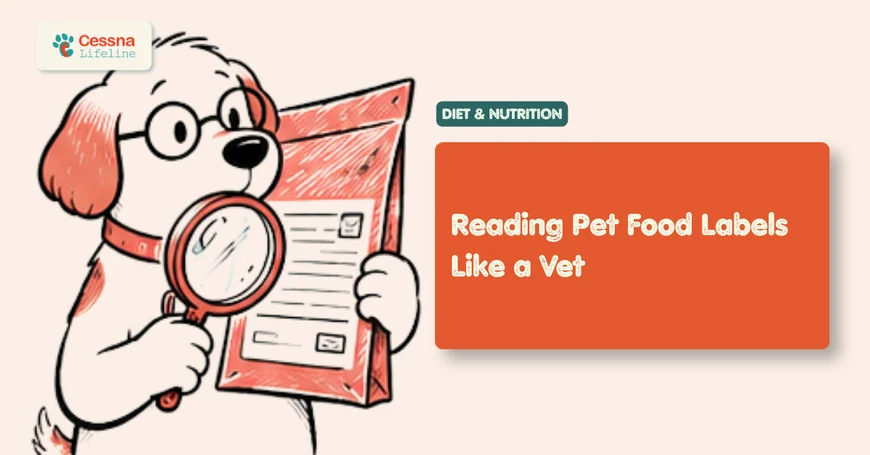
Learning how to read pet food labels means learning to ignore most of the bag. The front panel is marketing and is designed to be read first. The information that tells you whether a food will actually keep your pet healthy is on the back, in small print, in two or three specific places.
This guide goes through those places in the order a vet checks them, explains what the ingredient list can and cannot tell you, and covers the terms that sound meaningful but are not regulated at all.
What to Know Check the nutritional adequacy statement before anything else. It is one sentence, usually in small print on the back, and it tells you whether the food is complete and balanced and for which life stage. A food labelled complementary, or for intermittent or supplemental feeding only, is not a complete diet and should not be the main thing your pet eats. That single sentence rules out more unsuitable products than the entire ingredient list.
How to Read Pet Food Labels: What to Check First
Four checks, in this order. The first two do most of the work.
1. The nutritional adequacy statement. Look for wording that the food is complete and balanced for a named life stage, referencing AAFCO or FEDIAF. "Complete and balanced for maintenance of adult dogs" is what you want. "For intermittent or supplemental feeding only" means it is not a full diet. Many pouches and trays marketed as meals fall into that second category, and owners feed them as a sole diet without noticing.
2. The life stage. Growth, adult maintenance, and all life stages are not interchangeable. Puppies and kittens need higher energy, protein, and specific mineral ratios. "All life stages" food meets growth requirements, which means it is richer than an adult-only diet and can promote weight gain in a neutered middle-aged pet. Large-breed puppies need a diet formulated for large-breed growth, because calcium level and energy density genuinely affect skeletal development.
3. The guaranteed analysis. Minimum protein and fat, maximum fibre and moisture. The numbers are only comparable between foods of similar moisture content, which is the single most misread part of any label, covered below.
4. The feeding guide and calorie content. A calorie statement, usually kcal per kilogram or per cup, lets you work out actual portions. Feeding guides are generous starting points based on averages, not prescriptions, and most neutered indoor pets need less than the bag suggests.
| What to look at | Where it is | What good looks like |
|---|---|---|
| Nutritional adequacy statement | Small print, back or side | "Complete and balanced" plus a named life stage, AAFCO or FEDIAF |
| Life stage | Same statement | Matches your pet: growth, adult, senior, large-breed growth |
| Guaranteed analysis | Back panel table | Compare only against foods of similar moisture |
| Calorie content | Back panel, kcal/kg | Present at all. Its absence is a bad sign |
| Ingredient list | Back panel | Named animal proteins near the top |
| Manufacturer contact | Back or side | A real address and a phone number or email |
| Batch and best-before | Printed, not on the label artwork | Legible, so a recall can be traced |
How Do I Judge Pet Food Ingredients?
Ingredients are listed in descending order by weight before cooking, and that pre-cooking detail is what makes the list easy to misread.
Fresh meat is roughly 70% water. When a food lists "fresh chicken" first, much of that weight is water that disappears during processing, so the finished food contains far less chicken than its top position implies. A meat meal, which is already dried, contributes far more actual protein per unit of listed weight despite sounding less appealing. A food listing fresh chicken first and chicken meal fourth may be getting more of its protein from the fourth ingredient.
The related trick is ingredient splitting. A manufacturer can list peas, pea protein, pea fibre, and pea starch separately, each appearing modestly down the list, when together they would outweigh the first ingredient. Reading the list as a set rather than item by item is the defence: if four forms of the same plant appear, mentally combine them.
What is genuinely useful in the list: named animal protein sources, because "chicken" or "lamb meal" tells you what your pet is eating while "meat and animal derivatives" does not. Named fat sources, for the same reason. And whether the food contains something your pet has a diagnosed problem with.
What the list cannot tell you: digestibility, amino acid profile, mineral balance, whether the formulation was tested, or whether the food is any good. Those depend on formulation and quality control, which is why how to choose healthy dog food is not answerable from the ingredient panel alone.
By-products deserve rehabilitating. The term covers organ meats such as liver, kidney, and spleen, which are nutrient-dense and are exactly what a wild carnivore eats first. "By-product" is unappetising to humans and nutritionally sound for pets. It is not a marker of poor quality.
The most useful question about a pet food is not on the label at all: does the manufacturer employ a qualified veterinary nutritionist, do they own their production facilities, and do they run digestibility and feeding trials rather than formulating on paper? Those three answers separate products far more reliably than any ingredient list, and most owners never ask because the bag gives no hint. Call or email the manufacturer and ask directly. The quality of the answer, and whether you get one at all, is itself the most informative thing you will learn about that company.
How Do I Compare Two Foods Fairly?
You cannot compare the guaranteed analysis of a wet food and a dry food as printed, and this trips up almost everybody.
A dry food might show 26% protein and a wet food 8%, which looks like the dry food has three times more. It does not. The wet food is about 78% water and the dry about 10%, so most of what you are measuring in the wet food is moisture. To compare, convert both to a dry matter basis: subtract the moisture percentage from 100 to get the dry matter, then divide the nutrient by that dry matter figure and multiply by 100.
Worked through: the dry food at 26% protein and 10% moisture has 90% dry matter, so 26 divided by 90 times 100 gives about 29% protein on a dry matter basis. The wet food at 8% protein and 78% moisture has 22% dry matter, so 8 divided by 22 times 100 gives about 36%. On a like-for-like basis the wet food is the higher-protein product, which is the opposite of what the front of the tin suggests.
The same conversion applies to fat, fibre, and every other analysed nutrient. Any time you compare foods of different moisture content, do this first or the comparison is meaningless.
Calories are the other common comparison error. Per-cup figures are not comparable between foods because kibble density varies, so a cup of one food can carry considerably more energy than a cup of another. Compare kcal per kilogram, and measure portions by weight using kitchen scales rather than by scoop.
What Do the Marketing Terms Actually Mean?
Most of the vocabulary on the front of the bag has no regulated definition in pet food.
These mean nothing in particular: holistic, premium, super-premium, human-grade, gourmet, ancestral, biologically appropriate, and natural. "Natural" has a loose definition in some jurisdictions and is widely used beyond it. None of these terms indicate anything measurable about nutritional quality, and a food carrying all of them can be a worse choice than a plain-looking bag with a good adequacy statement.
A few descriptors do carry rules worth knowing. Product naming conventions govern how much of a named ingredient must be present: a food called "Chicken Dog Food" must contain substantially more chicken than one called "Dog Food with Chicken", and "chicken flavour" may contain almost none. Those thresholds vary by jurisdiction, but the principle holds that the grammar of the product name is regulated while the adjectives around it are not.
"Grain-free" is accurate as a description and widely misunderstood as a benefit. It means no cereal grains, not low carbohydrate, since the starch is replaced by potato or pulses. grain-free pet food
"Vet recommended" and "vet formulated" are not regulated claims and do not indicate that a qualified veterinary nutritionist was involved. Ask who formulated it.
How Do I Read a Cat Food Label Differently?
Cats are obligate carnivores with specific requirements that a dog food label does not need to address, so how to read cat food ingredients involves a few extra checks.
Taurine should be present. Cats cannot synthesise enough of it and deficiency causes dilated cardiomyopathy and retinal degeneration. Any complete cat food will supply it, but its presence confirms the food was formulated for cats rather than adapted.
Animal protein should dominate. Cats have higher protein requirements than dogs and cannot meet their amino acid needs from plant protein, so a cat food leaning on pea protein for its protein figure is a worse choice than the same strategy in a dog food.
Check the adequacy statement names cats. Dog food is not toxic to cats but is not formulated for them, and a cat fed dog food long-term will become deficient in taurine and arachidonic acid.
Moisture is worth weighing for cats more than dogs, because cats have a weak thirst drive and get most of their water from food. wet vs dry pet food
What Are the Warning Signs on a Label?
Specific things that should make you put a bag down:
- No nutritional adequacy statement anywhere, or only "for intermittent or supplemental feeding"
- No life stage named
- No calorie content given
- No manufacturer address or contact details
- Generic protein descriptions only, such as "meat and animal derivatives", with nothing named
- Several forms of the same plant ingredient spread through the list
- Health claims that read as treatment, such as curing or preventing a disease
- A life stage that does not match your pet, particularly all-life-stages food for a neutered middle-aged pet
- Illegible or absent batch and best-before codes
That last one matters more than it looks. Batch traceability is how a recall reaches you, and a manufacturer that prints it badly is telling you something about their quality systems.
A label can look flawless and the food can still be wrong for your pet, which is the limit of label reading. A food that is complete, balanced, well made, and appropriate on paper can still be the wrong choice for an animal with kidney disease, a food allergy, or significant excess weight. Those decisions need a clinical assessment, not a better reading of the bag, and persistent vomiting, diarrhoea, itching, or weight change on an apparently suitable diet is a red flag that needs a veterinary exam rather than another brand change.
Frequently Asked Questions
How do I read pet food labels properly?
Start with the nutritional adequacy statement, which tells you whether the food is complete and balanced and for which life stage. Then check the life stage matches your pet, look at the guaranteed analysis, and find the calorie content so you can portion accurately. The ingredient list comes last and tells you less than most owners assume.
What to look for on pet food labels first?
The adequacy statement. One sentence in small print tells you whether this is a complete diet or a complementary product, and it rules out more unsuitable foods than anything else on the bag. Anything labelled for intermittent or supplemental feeding only should not be your pet's main diet, however it is marketed on the front.
Are the first pet food ingredients the most important?
They matter, but less than it appears. Ingredients are listed by pre-cooking weight, and fresh meat is about 70% water, so "fresh chicken" first can contribute less actual protein than a dried meal further down. Manufacturers can also split one plant into several entries. Read the list as a set rather than ranking the top item.
Are by-products bad in pet food?
No. By-products are largely organ meats such as liver, kidney, and spleen, which are nutrient-dense and are what a wild carnivore eats first. The term is unappealing to humans rather than indicative of poor quality. A food containing named by-products can be a better choice than one relying on plant protein to raise its figures.
How do I compare a dog food label against a wet food tin?
Convert both to a dry matter basis, because you cannot compare the printed percentages. Subtract the moisture from 100 to get the dry matter, then divide the nutrient by that figure and multiply by 100. A wet food listing 8% protein often works out higher in protein than a dry food listing 26% once the water is removed.
How do I choose healthy dog food from the label?
Confirm it is complete and balanced for the right life stage, check named animal protein sources, find the calorie content so you can portion by weight, and ask the manufacturer whether they employ a qualified nutritionist and run feeding trials. Then judge by your dog's body condition, coat, stool quality, and energy over several weeks.
Does "premium" or "human-grade" mean anything?
Not in any regulated sense. Holistic, premium, super-premium, human-grade, gourmet, ancestral, and biologically appropriate have no defined meaning in pet food and tell you nothing measurable about quality. A plain bag with a solid adequacy statement and a manufacturer who answers questions is the better purchase.
Next Steps
If you are standing in a shop comparing bags, the two things worth checking are the adequacy statement and the calorie content. Everything else can wait until you are home.
If the decision is tied to something clinical, a pet that is overweight, itching, vomiting, or has diagnosed kidney, liver, or heart disease, label reading will only take you so far. Arrange veterinary guidance on choosing a pet food with the Cessna Lifeline team, and bring a photograph of the current food's back panel with you, since that is the part that matters.
You can also book an appointment for a body condition score and a portion calculation. Getting the quantity right does more for a pet's long-term health than changing the brand, and most owners are feeding more than the pet in front of them needs.