Best Brush for Dogs and Cats by Coat Type
The best brush for dogs depends on coat structure, not breed popularity. A vet guide to slicker brushes, undercoat brushes and matting prevention by coat type.
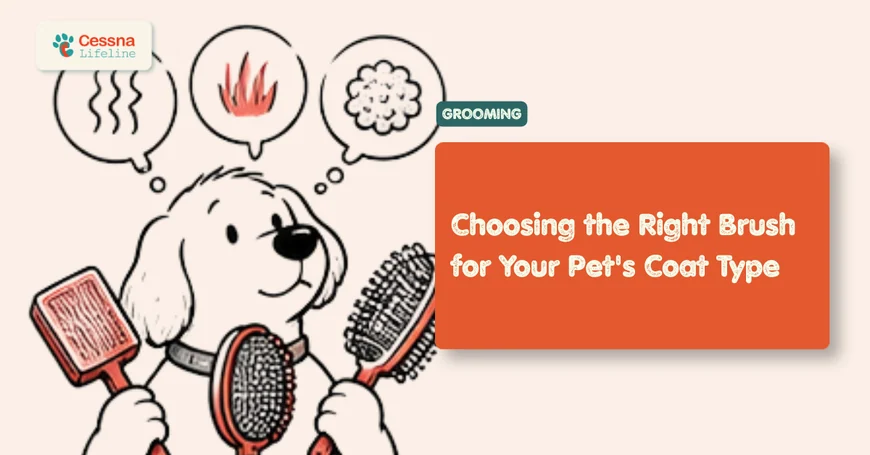
The best brush for dogs is the one that matches the coat in front of you, and coat structure varies far more between breeds than most product marketing admits. A brush sold as universal will do real work on perhaps a third of the dogs it is bought for. On the rest it either achieves nothing or damages the coat it was supposed to maintain.
This guide is about brush selection for routine coat maintenance and matting prevention. If your concern is specifically seasonal shedding volume, the tool logic is slightly different and covered separately. deshedding tools for dogs
What to Know Brush choice follows coat structure, not breed name or price. The two decisions that matter are whether the coat has an undercoat, and whether it mats. Coats that mat need a comb before any brush touches them, because a slicker dragged across an existing mat tightens it against the skin instead of opening it. Pressing any wire brush firmly against skin causes a friction injury groomers call brush burn, and it appears over bony areas first.
What Is the Best Brush for Dogs? The Six Types Explained
Six dog brush types cover almost everything sold, and each does one mechanical job.
| Brush type | What it does | Right for | Wrong for |
|---|---|---|---|
| Wide-tooth metal comb | Finds and separates tangles before anything else touches the coat | Every medium, long, curly, or matting coat, as the first pass | Nothing, if used gently |
| Slicker brush | Fine angled wires lift loose hair and open soft tangles near the surface | Medium and long coats, feathering, curly and wool coats | Short smooth coats; pressing hard on any coat |
| Undercoat brush or rake | Long rounded pins reach under the guard coat to pull out dead undercoat | Double coats in or near a moult | Single coats, which have no undercoat to find |
| Pin brush | Smooths and finishes without removing bulk | Long silky single coats | Use as a primary detangling or deshedding tool |
| Bristle brush | Distributes skin oils and lifts surface dust | Short coats, and as a finishing pass on any coat | Detangling, which it cannot do |
| Rubber curry or mitt | Grips short loose hair by friction, stimulates circulation | Short smooth coats, and for bathing | Long coats, where it tangles the hair |
The wide-tooth comb is the most undervalued item on that list. It costs little, it is the correct first tool for any coat that mats, and it finds problems your fingers and eyes miss: early mats, grass seeds, ticks, scabs, and lumps. Groomers reach for it first on almost every dog.
The slicker is the most over-used. It is genuinely good at what it does, which is working loose hair and soft tangles out of the upper coat, and genuinely bad at what owners often ask of it, which is forcing through a formed mat.
Which Brush Should I Use for My Dog's Coat?
Work out the coat structure first, then the brush follows.
Check whether there is an undercoat by parting the hair at the shoulder. A double coat shows a dense, soft, often paler layer beneath the coarser outer hair. A single coat looks the same all the way to the skin. Then check whether the coat mats by looking at the friction points: behind the ears, in the armpits, in the groin, and under the tail. Coats that mat need a comb-first routine regardless of length.
| Coat | Breeds | Routine | Frequency |
|---|---|---|---|
| Short smooth | Labrador, Beagle, Boxer, Indie dogs | Rubber curry, then bristle finish | 1 to 2 times weekly |
| Short double | German Shepherd, Indian Spitz | Undercoat brush, then curry on short areas | 2 to 3 times weekly |
| Long double | Golden Retriever, Samoyed, Husky | Comb friction points, undercoat rake, slicker on feathering | 2 to 3 times weekly, daily in a moult |
| Long silky single | Maltese, Shih Tzu, Yorkshire Terrier | Wide comb, then slicker, then pin brush | Daily or every other day |
| Curly or wool | Poodle, Doodle crosses, Bichon | Wide comb to the skin, then slicker, professional clipping | Every day or two, no exceptions |
| Wire | Schnauzer, many terriers | Slicker plus comb; hand-stripping or clipping | 2 times weekly plus trims |
| Hairless or near-hairless | Chinese Crested | No brush; skin care instead | Skin cleaning, sun protection |
Curly and wool coats are where owners get caught out, and the reason is a marketing claim. Poodles and Doodles are widely sold as non-shedding. They shed at a normal rate, but the curl traps the dead hair inside the coat rather than dropping it on the floor. Nothing appears on your furniture and nothing looks wrong, until the retained hair felts into a mat lying flat against the skin. These coats need more frequent combing than a Labrador, not less, and the comb has to reach the skin rather than gliding over the top.
The most common matting pattern we clip out is a coat that looks completely fine from above. Owners brush the back and head, which is what the dog enjoys and what is visible, while the mats form in the armpits, the groin, behind the ears, and the trousers on the hind legs. Those are the sites the dog cannot reach itself, the sites that rub, and the sites owners skip because the dog objects. A coat that looks well kept on the topline and is matted in the armpits is a brushing-routine problem, not a coat-type problem, and it is fixed by changing which parts of the dog you start with.
What Is a Slicker Brush and When Should You Use It?
A slicker brush is a flat or slightly curved pad set with dense, fine, bent wires. Those wires catch hair that has already worked loose and open soft tangles in the upper layers of the coat. On a Golden Retriever's tail feathering, a Doodle's leg hair, or a Shih Tzu's coat after combing, it is exactly right.
Technique is the whole story with a slicker. Light, repeated passes in the direction of hair growth, letting the wires do the work, with the pad held nearly flat rather than dug in at an angle. Keep the free hand on the dog to feel for skin beneath the coat. Stop the moment you see pink skin and move elsewhere.
The failure mode is pressure. Dense fine wires pressed hard and dragged repeatedly over one area abrade the skin surface and leave a red, tender, sometimes weeping patch. It appears first where bone sits close under skin, so hips, elbows, and the tail base are the usual sites. It is painful, it teaches the dog to fight grooming, and it is entirely avoidable.
The other failure mode is using it on a mat. A formed mat is a tangle that has tightened into a mass with its own structure. Pulling a slicker through it transmits that pull to the skin, which hurts and achieves nothing. Mats get combed open from the outer edge inward if they are still loose, and clipped out if they are not.
What Brush Works Best for Cats?
Most cats need less equipment than most dogs, and the limiting factor is skin rather than coat.
Feline skin is thin, mobile, and tears more easily than canine skin. That single fact drives every recommendation here. A fine-toothed metal comb is the most useful cat brush for the majority of cats, including long-haired breeds, because it lifts loose hair and finds early tangles without the abrasion a firmly used slicker causes. A soft rubber brush or grooming mitt suits short-haired cats well and most of them enjoy it.
For the best brush for long haired cats, the honest answer is two tools rather than one: a wide-tooth comb to separate, then a fine comb over the same area. A small slicker has a place on a Persian or Maine Coon coat, used briefly and lightly on the body, never on the belly or near the armpits where the skin is thinnest.
Never cut a mat out of a cat with scissors. Cat skin lifts into the base of a mat in a way that makes cutting skin instead of hair genuinely easy, and lacerations from owners attempting this are a recurring presentation that often needs sedation and sutures. Tight mats are clipped out by someone who can see the skin underneath. cat grooming
How Do I Stop My Dog's Coat From Matting?
Prevention comes down to a short list you can actually keep to:
- Comb the friction points first, before the back and head
- Comb often enough that trapped hair leaves before it twists
- Dry the coat properly after any bath, swim, or rain
- Keep the coat clipped to a length you can realistically maintain
- Clip the armpits and groin short, since those mat fastest
- Run your hands over the whole body before any tool touches it
Matting is a sequence, and you can interrupt it at any stage.
Loose hair detaches from the follicle but stays trapped in the coat. Movement and friction twist it around the hair still growing. Moisture, from a bath, a swim, or rain, tightens the twist as it dries. The tangle becomes a mat with structure of its own, and the mat then lies flat against the skin, holding warmth and moisture against it.
Prevention follows the sequence. Comb often enough that trapped hair comes out before it twists, and comb the friction points rather than only the easy areas. Dry a coat properly after any wetting, because drying is when a loose tangle becomes a fixed one. Keep the coat clipped to a length you can actually maintain, which for many working-owner households means shorter than the breed standard and that is a sensible trade. Clip the hair in the armpits and groin short, since those sites mat fastest and are hardest to work on.
What matted skin hides is the clinical argument for taking this seriously. Under a mat the skin stays damp and warm, which encourages bacterial and yeast overgrowth. Mats conceal wounds, hot spots, parasites, and lumps. A dog clipped out of a badly matted coat quite often has inflamed, infected skin underneath that nobody could see. If a coat has reached that stage, clipping is the treatment and a veterinary exam of the skin afterwards is worth the visit.
Can the Wrong Brush Damage My Pet's Skin?
Yes, and it accounts for a steady share of grooming-related consultations.
Brush burn is the most common. Fine slicker wires pressed firmly and worked repeatedly over one spot abrade the skin surface, leaving a red, tender area that can weep and scab. It concentrates over hips, elbows, and the tail base.
Over-stripping is the second. An undercoat rake or blade tool used frequently on a coat without a heavy undercoat thins the coat the animal needs. The outer coat is insulation against heat as well as cold and a barrier against sun, so a stripped coat is a real problem rather than a cosmetic one.
Working over existing disease is the third and most consequential. Brushing an inflamed, infected, or injured area hurts, worsens the inflammation, and teaches the animal that grooming is painful. That is how a tolerant dog becomes one that snaps at a brush.
Three habits prevent nearly all of it. Run your hands over the whole body before you start, so lumps, scabs, and mats are found by fingers rather than wire. Keep the tool nearly flat and let it work rather than pressing. Stop at pink skin, every time.
A grooming brush is a maintenance tool for healthy skin. If the skin is already red, scabby, smelly, or losing hair in patches, no brush is the right answer. That is a red flag set and needs a veterinary exam first, because brushing over a skin disease delays its diagnosis. persistent itching in pets
Frequently Asked Questions
What is the best brush for dogs?
There is no single answer, because it depends on whether the coat has an undercoat and whether it mats. Double coats need an undercoat brush, matting coats need a wide-tooth comb before any brush, and short smooth coats need a rubber curry. If you buy only one tool for a coated dog, buy the comb.
Which brush should I use for my dog's coat?
Part the hair at the shoulder. If there is a dense soft layer beneath the outer hair, it is a double coat and needs an undercoat brush. If it looks the same to the skin but tangles behind the ears and in the armpits, it is a matting coat and needs a comb first, then a slicker. Short and smooth means a curry.
What is a slicker brush used for?
A slicker lifts loose hair and opens soft tangles in the upper layers of a medium, long, or curly coat. Use light repeated passes with the pad held nearly flat. It should never be forced through a formed mat, and pressing it firmly against skin causes a painful abrasion called brush burn, usually over the hips, elbows, or tail base.
What is the best brush for long haired cats?
Two tools rather than one: a wide-tooth metal comb to separate tangles, then a fine-toothed comb over the same area. A small slicker can be used briefly and lightly on the body of a Persian or Maine Coon, but not on the belly or armpits. Feline skin is thin, so technique matters more than the tool.
What is the best brush for double coated dogs?
The right brush for double coated dogs is an undercoat brush of the rake type, with long rounded pins that pass through the guard coat and pull out detached undercoat beneath. Follow it with a slicker on feathered areas such as the tail and legs, and a comb at the friction points. Tooth length matters far more than the width of the head.
Do I need more than one brush?
For a short smooth coat, one curry plus an occasional bristle brush is enough. Any coat that mats needs at least two: a wide-tooth comb and a slicker. Double coats need a comb, an undercoat brush, and a slicker. Buying one expensive universal brush generally works out worse than two cheap correct ones.
Can I use a dog brush on my cat?
The tool categories overlap, but the technique does not transfer. Cat skin is thinner and tears more easily, so cats need lighter pressure, shorter sessions, and finer teeth. A fine comb or soft rubber brush suits most cats. Aggressive rakes and blade-style deshedding tools are best kept away from cats entirely.
Next Steps
If you are unsure what coat type you are working with, or you have mats you cannot comb open, that is a five-minute conversation with a groomer rather than a guessing game with a drawer full of brushes. Our groomers will show you the correct tool sequence for your specific dog or cat and the sites to start with.
Book a coat-specific grooming session with the Cessna Lifeline grooming team. Badly matted coats are clipped out safely, with a look at the skin underneath.
If the coat problem comes with red, scabby, or smelly skin, patchy hair loss, or persistent scratching, start on the clinical side instead. Those signs point to a skin disease that brushing will not fix and may aggravate. Arrange a consultation for a skin examination first.