Chronic Enteropathy in Dogs: More Than a Sensitive Stomach
50–65% of dogs with chronic GI signs have food-responsive disease, yet many go undiagnosed for months. Learn to recognize, diagnose, and treat canine CE in 2026.
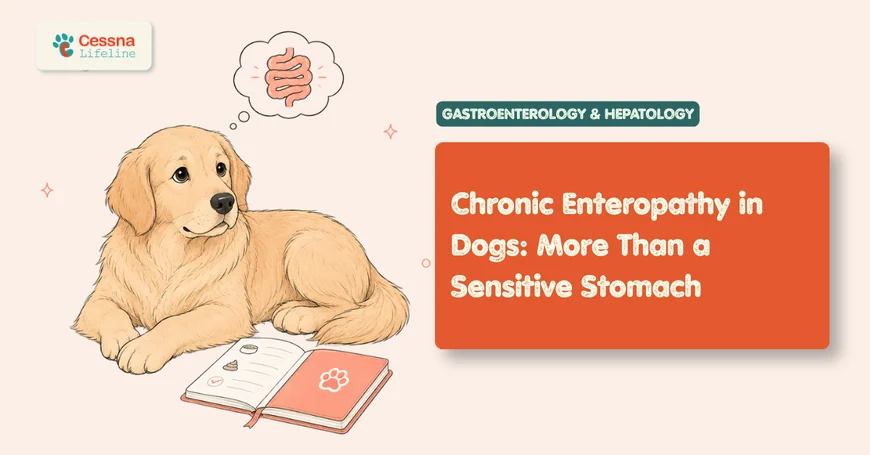
Most dog owners have been there: loose stools for a few days, maybe some vomiting, and the reasonable assumption that something disagreed with the dog at the park. A week passes. Then three. The stool never quite firms up. The dog picks at his food. He's lost a little weight, but he's still wagging, still seemingly okay. So you wait.
Chronic enteropathy (CE) is what happens when that waiting game turns into a pattern, and the pattern turns into a disease process reshaping your dog's gut for months. It accounts for 4.4% of all dogs presenting with gastrointestinal signs at specialist animal hospitals, yet it's also one of the most frequently misattributed conditions in small animal medicine (PMC9219460, 2022). "Sensitive stomach" is a description. Chronic enteropathy is a diagnosis, and the difference matters enormously for what comes next.
What to Know Between 50% and 65% of dogs diagnosed with chronic enteropathy have food-responsive disease, meaning a properly conducted dietary trial can resolve signs in as little as two weeks (Frontiers in Veterinary Science, 2022). But getting to that answer requires understanding the full spectrum of CE, from mild dietary intolerance to life-threatening protein-losing enteropathy. This article walks through what the condition actually is, why it looks different in every dog, and what it takes to reach a diagnosis when weeks of diarrhea aren't improving on their own.
What Is Chronic Enteropathy in Dogs?
The word "enteropathy" simply means disease of the intestine. In dogs, it becomes "chronic" when gastrointestinal signs persist for more than three weeks, recur repeatedly, or fail to respond to basic symptomatic treatment (MSD Veterinary Manual). That's a deliberately broad definition, and there's a reason for it: CE is not a single disease. It's an umbrella covering several distinct subtypes that share similar symptoms but require fundamentally different management.
At the mild end sits food-responsive enteropathy (FRE), where the problem is an inappropriate immune reaction to a dietary protein. Most dogs in this category respond dramatically to an elimination diet trial. Further along the spectrum is dysbiosis-responsive enteropathy (historically called antibiotic-responsive enteropathy), where disruption of the gut microbiome drives the inflammation. True immune-mediated inflammatory bowel disease (IBD) sits past that. And at the serious end is protein-losing enteropathy (PLE), where intestinal damage is so severe the gut can no longer retain protein in the bloodstream.
What makes CE genuinely tricky is that these subtypes don't announce themselves. A dog with early IBD looks nearly identical to a dog with FRE on a bad week. The differentiation happens through a structured diagnostic process, not through intuition or trial-and-error at home.
Worth knowing: Dogs with CE often compensate well enough that owners mistake disease stability for recovery. The dog still greets you at the door and goes for walks. But weight loss occurring over weeks at even half a pound per month can accumulate into significant muscle wasting, and owners frequently underestimate how much has quietly disappeared until they feel the spine clearly through the skin. The wagging tail is not a reliable indicator of internal stability.
understanding canine gut health
Why "Sensitive Stomach" Misses the Point
The phrase "sensitive stomach" functions as a catch-all in casual conversation, and it has a legitimate use: some dogs do have constitutionally reactive digestive systems requiring consistent management without representing true disease. But when a dog has experienced loose stools, soft feces, or frank diarrhea for more than three weeks without a clear dietary cause, applying the "sensitive stomach" label is a clinical mistake with real consequences.
A 2024 study published in Frontiers in Veterinary Science documented the caregiver burden that builds when chronic enteropathy goes unmanaged, finding that owners reported feeling powerless, struggling to maintain normal social routines, and describing significant planning overhead around the dog's unpredictable GI symptoms (PMC11747720, 2024). When asked whether veterinarians were adequately addressing this burden, the answers were mixed at best.
Part of that gap likely comes from how CE is framed. If both owner and clinician treat recurring loose stools as a personality trait rather than a pathology, the full diagnostic workup never happens. The dog spends months on one "sensitive stomach" food after another, the underlying inflammation continues, and by the time a real diagnosis lands, the disease may have progressed into a harder-to-treat form.
The practical implication is clear: if your dog's diarrhea hasn't resolved in three weeks despite a home food trial and basic symptomatic care, you are past the "wait and see" window.
How Long Before Chronic Diarrhea in Dogs Demands a Vet Visit?
What does it actually mean when a dog's diarrhea isn't improving over weeks? Gastrointestinal disease accounts for roughly 9.4% of all presentations in general veterinary practice (PMC9219460). That's a substantial slice of primary care caseload, and CE represents only a fraction of those cases, but it's the fraction where the stakes are highest if the diagnosis is delayed.
There's an important clinical distinction between small intestinal and large intestinal diarrhea, and it informs both the diagnosis and the likely CE subtype. Small intestinal diarrhea tends to come in large volumes, less frequently, and often accompanies weight loss and vomiting. Large intestinal disease produces frequent, urgent, smaller stools, often with visible mucus or streaks of fresh blood, without the same degree of weight loss.
Most chronic enteropathy, including most FRE and IBD, involves the small intestine. That's where the most clinically significant damage occurs, because the small intestine is where protein, fat, and nutrients are absorbed. When absorption breaks down at that level, everything from body condition to immune function suffers downstream.
A common pattern: Dogs reaching specialist referral often have a history of intermittent improvement. The dog responded to a few days of plain chicken and rice or a short course of metronidazole, then relapsed within two to four weeks. Owners frequently interpret these partial responses as evidence that the problem is manageable at home. What they actually indicate is that the underlying driver hasn't been addressed: symptomatic treatment suppresses inflammation temporarily without resolving its source.
So when should you stop waiting and call the vet? Any dog showing soft to liquid stool for more than three weeks, any dog that has relapsed after apparent resolution within a month, and any dog showing concurrent weight loss or appetite changes should be seen for a structured diagnostic evaluation, not another round of bland diet.
How Do Vets Diagnose Chronic Enteropathy in Dogs?
Reaching a diagnosis in chronic enteropathy isn't a single test. It's a sequential process of ruling things out, and the order matters. The goal is to identify the most treatable, least invasive explanation first before escalating to procedures that carry cost and procedural risk.
The first rung involves ruling out common, curable causes of chronic GI signs: endoparasites (Giardia and whipworm are classically underdetected on single fecal tests), obvious dietary triggers, and secondary GI disease from systemic conditions like hypoadrenocorticism or exocrine pancreatic insufficiency. A complete blood count, serum biochemistry panel, urinalysis, fecal testing (ideally three samples collected on separate days), and sometimes a serum B12/folate and trypsin-like immunoreactivity (TLI) panel cover this ground.
If routine bloodwork and fecal testing come back unremarkable, abdominal ultrasound becomes the next key tool. Ultrasound can identify mucosal irregularities, intestinal wall thickening, abnormal tissue layering, or enlarged lymph nodes that suggest inflammatory or neoplastic disease. It won't confirm CE, but it directs the investigation considerably.
Definitive diagnosis of chronic inflammatory enteropathy requires intestinal biopsy. This is the step that produces histopathology confirming what type of inflammatory cell infiltrate is present: lymphocytic-plasmacytic, eosinophilic, or granulomatous. Biopsy can be obtained via endoscopy (less invasive, excellent for mucosal disease) or via full-thickness surgical sampling (required when transmural or mesenteric involvement is suspected or when lymphoma is on the differential).
The Canine Inflammatory Bowel Disease Activity Index (CIBDAI) is widely used to quantify clinical severity before and during treatment. It scores six variables: attitude/activity, appetite, vomiting, stool consistency, stool frequency, and weight loss. Scores of 6 or above indicate moderate to severe disease (Vetlexicon). Research has confirmed strong correlation between CIBDAI scores and both histological findings and laboratory markers of inflammation (correlation r = 0.82), making it a practical monitoring tool throughout treatment.
According to research published in the Journal of Veterinary Internal Medicine, normalization of both CIBDAI score and plasma albumin concentration within 50 days of initial treatment was associated with longer survival time in CE dogs (PMC11256150, 2024). That finding gives the scoring index clinical weight beyond just documentation: it can tell you whether a treatment protocol is working before the next biopsy.
Why Does CE Treatment in Dogs Start with Diet?
The therapeutic ladder for chronic enteropathy mirrors the diagnostic one: start with the least invasive, most reversible intervention first. For most dogs, that intervention is dietary.
Food-responsive enteropathy represents 50 to 65% of all chronic enteropathy cases, and response to a properly conducted elimination diet trial is often the diagnostic confirmation clinicians need, alongside the treatment (Frontiers in Veterinary Science, 2022). Two diet approaches are in common use: novel protein diets (where the protein and carbohydrate source are genuinely new to the dog's immune history) and hydrolyzed protein diets (where protein molecules are broken into fragments too small to trigger an immune response). Hydrolyzed diets appear to produce slightly better clinical responses in practice. An 88% stool consistency improvement rate was observed in one clinical series after switching to hydrolyzed protein as the sole dietary change (PMC12053874, 2024).
The key word is "properly conducted." A dietary trial fails when a dog receives treats, flavored chew toys, flavored toothpaste, or bites of human food during the trial window. Any novel protein exposure resets the immune exposure and invalidates the test. The trial runs four to six weeks, with most food-responsive dogs showing clear improvement within two weeks of strict adherence.
Long-term outcomes for food-responsive dogs are genuinely good. Studies report remission rates of 66 to 97% over a 36-month follow-up period in dogs who respond to dietary management (PMC9534534). That outcome compares favorably to any drug-based treatment currently available.
<figcaption>Approximate distribution of chronic enteropathy subtypes in dogs. FRE is by far the most common, which is why dietary trial comes before immunosuppression in the treatment ladder.</figcaption> </figure>
What happens when a dog doesn't respond to diet? The failure itself becomes diagnostic information. It suggests the disease is not primarily dietary, shifting the clinical focus toward dysbiosis-responsive or immune-mediated disease.
elimination diet trials for dogs
When Does IBD in Dogs Require Immunosuppression?
True immune-mediated inflammatory bowel disease, where the dog's immune system mounts an inappropriate and persistent response to intestinal contents, requires immunosuppressive therapy. Corticosteroids (most commonly prednisone) remain the first-line drug, typically combined with continued dietary management. In cases where steroids alone are insufficient or where side effects become limiting, additional agents like azathioprine, cyclosporine, or chlorambucil are added.
This is also where it's worth understanding what IBD in dogs actually means diagnostically: it's a diagnosis of exclusion. You don't confirm IBD until you've ruled out infections, parasites, dietary causes, and secondary GI disease, obtained a tissue biopsy showing intestinal inflammation, and confirmed the inflammation is benign (not lymphoma, which can look histologically similar on initial biopsy). This process takes time. It's part of why a dog can have genuine IBD for months before reaching a confirmed diagnosis.
Treatment response in immunosuppressive-responsive disease is good in terms of initial improvement, but long-term outcomes are more variable than in FRE. Some studies report a lack of response in up to 43% of cases over extended follow-up, compared to those 66 to 97% remission rates in food-responsive disease (PMC9534534). Dogs requiring long-term steroids face familiar complications: increased thirst and urination, weight gain, muscle atrophy, and elevated infection risk.
Getting the subtype right before reaching for immunosuppressants matters for precisely this reason. Steroid-loading a food-responsive dog doesn't fix the underlying dietary trigger, adds drug side effects, and delays the simple intervention that would have resolved things.
One emerging area of interest is fecal microbiome transplantation (FMT) as an adjunct therapy in CE. Early studies are cautiously optimistic, but evidence remains preliminary and FMT is not yet a standard treatment recommendation in most CE cases (PMC9578606). It's worth watching, particularly as understanding of gut dysbiosis in CE continues to expand.
<figcaption>Long-term remission rates across CE subtypes. Food-responsive enteropathy carries the best long-term prognosis, reinforcing why dietary trial comes before immunosuppression in the treatment sequence.</figcaption> </figure>
What Is Protein-Losing Enteropathy in Dogs?
Protein-losing enteropathy represents a smaller but critically important subset of CE cases. In PLE, intestinal damage has progressed to the point where the gut wall can no longer prevent protein from leaking into the intestinal lumen and being lost. The result is hypoalbuminemia (low blood albumin), which creates its own cascade: fluid accumulation in the abdomen or chest cavities, reduced blood oncotic pressure, and impaired drug binding.
The prognosis for PLE is, bluntly, guarded to poor. A 2024 study documenting in-hospital mortality found that median survival times across published literature vary dramatically, ranging from one month to 44 months depending on the underlying cause (PMC11256150, 2024). Dogs with PLE secondary to intestinal lymphangiectasia or lymphocytic-plasmacytic enteritis can do better than those with small-cell lymphoma or granulomatous disease, but none of these diagnoses carry an easy trajectory.
A 2025 multicenter study comparing outcomes in pugs versus other breeds found median survival of just 104 days in pugs with PLE, against 759 days in non-pug dogs (PMC12081830, 2025). Breed predispositions matter considerably in CE: Yorkshire Terriers, soft-coated Wheaten Terriers, Norwegian Lundehunds, and German Shepherds all carry elevated risk for specific CE subtypes, and some of those breed-specific forms are notoriously resistant to standard management.
What separates PLE clinically from other CE subtypes is the pace of progression once protein loss becomes significant. Weight loss accelerates visibly. The dog may develop a swollen abdomen from ascites. Weakness follows. If PLE is on the differential, a dietary trial alone is not adequate: concurrent diagnostic workup and nutritional intervention (often with ultra-low-fat dietary management and sometimes plasma transfusion or albumin infusion) are urgent rather than elective.
What Living with CE Looks Like
The clinical picture of chronic enteropathy rarely resolves cleanly, even in well-managed dogs. Dietary management typically involves permanent restriction. Drug therapy, when needed, involves regular rechecks. The 2024 Frontiers study found that CE owners reported specific practical disruptions: difficulty leaving the dog alone, planning social activities around GI episodes, and a persistent background anxiety about whether today would be a bad day (PMC11747720, 2024).
A 2025 JAVMA study went further, documenting that dogs with CE and low disease activity still showed signs consistent with compromised emotional health compared to matched healthy control dogs. The implication is that the burden of chronic GI disease extends beyond acute episodes: disrupted daily routines, chronic low-grade discomfort, and the owner's accumulated anxiety all shape the dog's experience of the condition over time.
That's not an argument for pessimism, and it shouldn't be read as one. Dogs who reach a correct diagnosis and find an effective treatment protocol often do well for years. The key phrase is "correct diagnosis." A dog managed indefinitely under the "sensitive stomach" label with no structured workup isn't being managed: it's being kept comfortable through episodes without anyone looking for what's actually driving them. And chronic enteropathy doesn't tend to resolve spontaneously.
monitoring a dog with chronic GI disease
Frequently Asked Questions
How long does diarrhea have to last before it's considered chronic in dogs?
The clinical threshold is gastrointestinal signs persisting for more than three weeks, or signs that recur repeatedly within a short timeframe. A single acute episode that resolves within one to two weeks is unlikely to represent CE. If loose stools continue past the three-week mark despite basic dietary management, structured veterinary evaluation is warranted. Some dogs relapse after initial improvement, which also meets the clinical threshold for further investigation (MSD Veterinary Manual).
Is IBD in dogs the same as IBD in humans?
The terminology overlaps, but the conditions aren't identical. Canine IBD is a histological diagnosis requiring biopsy to confirm intestinal inflammation, and it's defined by exclusion: all other causes must be ruled out first. Unlike human Crohn's disease, canine IBD doesn't carry the same association with extraintestinal manifestations such as joint or eye disease. Both share the feature of inappropriate immune activity in the gut, but treatment protocols and genetic underpinnings differ significantly. A 2025 comparative review found meaningful parallels in pathophysiology but distinct differences in treatment targets (PMC12854167, 2025). comparing human and canine IBD
What does a hydrolyzed protein diet actually do for a dog with CE?
Hydrolyzed protein diets break dietary proteins into fragments too small for the immune system to recognize as allergens. In food-responsive enteropathy, the dog's gut mounts an immune response to intact protein molecules. Removing those molecules from the diet eliminates the immune trigger, allowing inflammation to subside. One clinical series found 88% of dogs showed reduced stool consistency scores after switching to a hydrolyzed diet as the sole therapeutic change (PMC12053874, 2024). The trial requires strict exclusion of all other food sources to be valid.
Can a dog with chronic enteropathy live a normal life?
Many do, particularly those with food-responsive disease. Long-term remission rates for FRE reach 66 to 97% over three years with appropriate dietary management (PMC9534534, 2022). Dogs with immune-mediated IBD often require long-term medication but can maintain good quality of life when the disease is controlled. PLE carries a significantly more guarded prognosis, with median survival varying widely depending on the underlying cause. The outcome depends heavily on which CE subtype is present, which reinforces why reaching the correct diagnosis is the foundational step in management.
What breeds are most at risk for chronic enteropathy?
Certain breeds carry well-documented elevated risk for specific CE subtypes. Yorkshire Terriers and soft-coated Wheaten Terriers are predisposed to protein-losing enteropathy. German Shepherds and Shar Peis have elevated rates of immunosuppressant-responsive IBD. Norwegian Lundehunds suffer from a particularly severe and often fatal form of intestinal lymphangiectasia. The 2022 Swedish hospital study found that German Shepherd Dogs were significantly overrepresented among CE cases, appearing in 14.9% of the CE cohort versus 4.9% of general hospital admissions (PMC9219460, 2022). Breed history should inform clinical suspicion, particularly when CE occurs in a young dog of any of these breeds without an obvious dietary trigger. breed-specific GI disease risks
The Window That Matters
Chronic enteropathy in dogs sits at an awkward intersection: serious enough to cause genuine suffering and, in some forms, to shorten life significantly, but often mild enough in early presentation that it's easy to dismiss as something the dog will work through. The "sensitive stomach" framing isn't malicious. It comes from a real pattern where many dogs do have manageable dietary sensitivities that never progress to frank disease.
The problem is applying that frame to every dog who has loose stools for a month. Some of those dogs have food-responsive enteropathy waiting to resolve on a properly conducted dietary trial. Others have IBD that needs immunosuppressive medication to control. A few have PLE that has been eroding their protein reserves week by week while everyone waits for things to settle down.
What they all share is a gut telling you something is wrong, and a three-week mark that signals when watching should give way to investigating. Getting a diagnosis isn't pessimism. It's the starting point for getting the dog better, and in CE, the sooner you start there, the more options remain on the table.