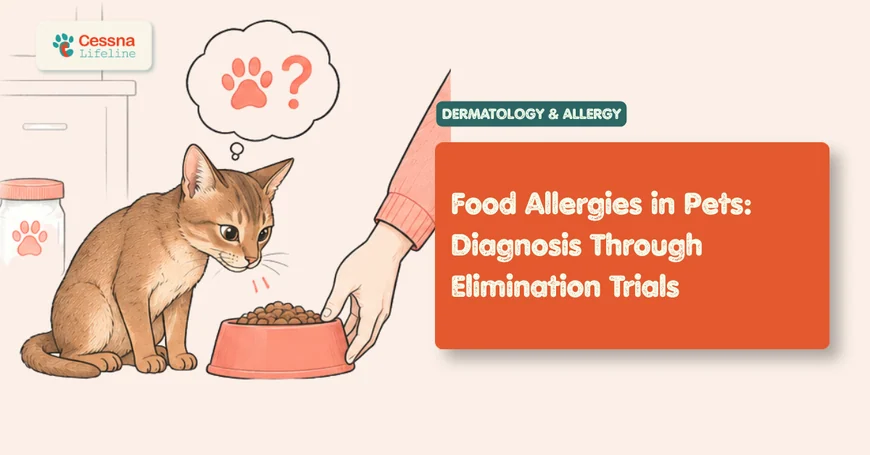
Food Allergies in Pets: Diagnosis Through Elimination Trials
Food allergy in dogs causes chronic skin and GI signs with no seasonal pattern. The only reliable diagnosis is an 8 to 12-week elimination diet trial.
Most owners who suspect their pet has a food allergy have already tried changing the food. They switched from chicken to salmon, or from dry to wet, or to a brand marketed as "sensitive skin." The pruritus continued. This outcome is predictable: food allergy in dogs and cats is not a sensitivity to a category of food or a commercial brand. It is a specific immune-mediated reaction to an individual dietary protein, and diagnosing which protein requires a controlled elimination trial that excludes every protein the animal has previously eaten. A "salmon diet" is not an elimination diet for a dog that has eaten salmon for two years; it is a continuation of potential allergen exposure. The diagnostic method is more demanding than a food switch, and nothing else reliably replaces it. dog allergies atopic dermatitis vs. food allergy guide
What to Know Food allergy in dogs and cats is an immune-mediated reaction to a dietary protein, not a food intolerance. It produces chronic non-seasonal pruritus, recurrent ear infections, and sometimes gastrointestinal signs. The only reliable diagnostic method is an 8 to 12-week elimination diet using a protein the pet has never consumed. Blood tests for food allergy are not diagnostically reliable in pets.
The Diagnosis That Requires a Diet, Not a Blood Test
Food allergy is formally classified as a cutaneous adverse food reaction (CAFR) when it presents with skin signs. The terminology distinguishes immune-mediated reactions (true allergy, IgE and non-IgE mediated) from food intolerances (non-immune pharmacological reactions) and food aversions. In clinical practice, the distinction between IgE-mediated and non-IgE-mediated food hypersensitivity is rarely determinable without skin biopsy and specialized testing; the diagnostic and management approach is identical regardless of the immunological subtype, and the clinical literature treats them together.
The reason food allergy requires a dietary trial rather than a blood test is mechanistic. The immune response to dietary proteins in food-allergic pets occurs primarily in the gastrointestinal-associated lymphoid tissue and skin, and the specific IgE and T-cell responses that drive it are tissue-level phenomena that circulating serum IgE measurements do not reliably capture. The proteins most commonly involved in canine food allergy (beef, chicken, dairy) are also proteins present in most commercial foods that the vast majority of dogs have eaten, which means virtually every dog has serum IgE against these proteins at some measurable level. The presence of measurable serum IgE against beef does not distinguish a clinically food-allergic dog from a non-allergic dog that has simply eaten beef-containing food throughout its life.
Food allergy in dogs affects approximately 1 to 2% of the general dog population but represents a disproportionately higher fraction of dogs presenting for dermatological evaluation. Among dogs diagnosed with chronic pruritus, food allergy accounts for approximately 10 to 20% of cases at veterinary dermatology referral centers. The condition has no breed predisposition comparable to the strong breed associations of atopic dermatitis, though German Shepherds, Labrador Retrievers, Golden Retrievers, and West Highland White Terriers are consistently overrepresented in published food allergy populations.
What Are the Symptoms of Food Allergy in Dogs and Cats?
The clinical presentation of food allergy overlaps substantially with atopic dermatitis, which is why differentiating them requires systematic investigation rather than clinical examination alone. No sign or combination of signs reliably distinguishes food allergy from atopy on examination.
In dogs, the dominant clinical sign is pruritus, present in approximately 80% of food-allergic cases. The distribution of pruritus varies but commonly involves the face, paws, ventral trunk, groin, axillae, and ears, essentially identical to the distribution seen in atopic dermatitis. Perianal pruritus and perianal erythema are more common in food allergy than in atopy and, when present, are useful clinical pointers; perianal pruritus in an atopic dog without food allergy is relatively unusual. Gastrointestinal signs (increased defecation frequency, soft or loose stool, intermittent vomiting, flatulence) occur in approximately 30 to 40% of food-allergic dogs and are often mild enough that owners do not volunteer them as a complaint unless specifically asked.
Non-seasonal presentation is the most useful clinical differentiator from atopic dermatitis with purely seasonal sensitization. A dog that itches equally in January and July, or that began itching in winter (when ambient allergen loads from pollens are low), is a dog whose pruritus is more likely to have a non-environmental trigger. However, most atopic dogs develop perennial symptoms as sensitization broadens over time, so non-seasonality alone does not confirm food allergy.
In cats, food allergy most commonly presents as miliary dermatitis (multiple small crusted papules distributed across the dorsum and neck), eosinophilic granuloma complex lesions, or head and neck pruritus. Gastrointestinal signs are more consistently present in cats than in dogs. Feline food allergy shares the same absence of reliable serum-based diagnostic tests and requires the same dietary trial approach.
Citation Capsule: Food allergy in dogs produces a clinical presentation indistinguishable from atopic dermatitis on physical examination alone; approximately 30% of food-allergic dogs present with gastrointestinal signs in addition to cutaneous signs, and approximately 10 to 15% present with gastrointestinal signs as the sole or primary manifestation without any skin disease; perianal pruritus is more consistently associated with food allergy than with atopic dermatitis and, when present alongside generalized pruritus, increases the clinical index of suspicion for food as the primary driver (Gaschen and Merchant, 2011). The co-occurrence of skin and GI signs in the same patient should prompt food allergy evaluation before atopy investigation.
Which Foods Most Commonly Cause Allergic Reactions in Pets?
Food allergy in pets develops to proteins that the animal has been exposed to previously, not to proteins encountered for the first time. Sensitization requires prior exposure, typically over months to years. This means the "new food" that coincides with the onset of allergy symptoms is rarely the culprit; the culprit is typically a protein in the diet the animal has consumed for a significant period. hydrolyzed protein diet dogs guide
Beef and chicken are the most common allergens in dogs because they are the most ubiquitous proteins in commercial dog food. A dog fed commercial food for its entire life has almost certainly been exposed to beef and chicken in some formulation, making sensitization to these proteins the statistically most probable outcome if food allergy develops. The frequency of sensitization mirrors the frequency of exposure in the pet food supply, not any intrinsic immunological property that makes these proteins more allergenic than others.
Cross-reactivity between proteins is clinically significant and often unrecognized. A dog sensitized to beef may react to lamb or venison because shared protein epitopes exist across ruminant species. A dog sensitized to chicken may react to turkey or duck through shared avian proteins. When selecting a novel protein for an elimination trial, the protein must be novel to the individual animal and ideally from a species not taxonomically related to previously consumed proteins.
Citation Capsule: Beef is the most commonly identified food allergen in dogs in European and North American studies, followed by chicken, dairy products, wheat, and egg; the ranking reflects frequency of exposure in commercial pet food rather than intrinsic allergenicity; fish is significantly more common as a primary allergen in cats than in dogs, reflecting the higher prevalence of fish-based foods in feline commercial diets; sensitization requires prior exposure over months to years, and the allergen causing current disease is typically a protein the animal has eaten for a substantial portion of its life, not a recently introduced ingredient (Kennis, 2006). This means the elimination diet must be designed around the individual animal's specific dietary history.
How Does an Elimination Diet Trial Work?
The elimination diet trial is the gold standard for food allergy diagnosis. Its logic is straightforward: remove every protein the animal has ever eaten, provide a diet containing only proteins never previously encountered, maintain this for 8 to 12 weeks, and assess whether symptoms resolve.
Elimination Diet Options: Comparison
| Diet Type | Protein Size | Contamination Risk | Palatability | Cost | Best For |
|---|---|---|---|---|---|
| Hydrolyzed protein (veterinary) | Peptides < 3.5 kDa | Low (single facility) | Good | High | Most reliable option; preferred for initial trial |
| Novel protein (home-cooked) | Intact protein | Very low (owner-controlled) | Excellent | Moderate | Dogs with poor hydrolyzed diet response; history of many commercial foods |
| Novel protein (commercial) | Intact protein | Moderate (shared facility) | Good | Moderate | Practical maintenance after diagnosis; less reliable for trial |
| Hydrolyzed protein (OTC) | Peptides variable | Higher (shared facility) | Variable | Low | Not recommended for diagnostic trial |
Step 1: Complete dietary history. Before selecting a diet, document every protein source the animal has been fed throughout its life, including primary foods, treats, table scraps, flavored medications, flavored supplements, and dental chews. The elimination diet must contain no protein from any previously consumed source.
Step 2: Diet selection. Two evidence-supported options exist.
Hydrolyzed protein diets use enzymatic hydrolysis to reduce intact protein molecules to peptides below approximately 3.5 kilodaltons, below the molecular weight threshold needed to cross-link IgE on mast cells and trigger degranulation. The rationale is that the immune system cannot recognize and react to proteins it cannot "see" as intact antigens. Veterinary-formulated hydrolyzed protein diets (Royal Canin Hydrolyzed Protein, Purina Pro Plan Veterinary HA, Hill's z/d) are manufactured under controlled conditions to minimize cross-contamination.
Home-cooked novel protein diets use a single protein source the animal has never consumed (rabbit, kangaroo, venison, crocodile) combined with a single carbohydrate source (white potato, tapioca, or white rice in dogs without prior exposure). Home cooking eliminates manufacturing cross-contamination risk and provides certainty about ingredient composition that commercial foods cannot fully guarantee. The limitation is nutritional completeness: home-cooked diets for a trial lasting 8 to 12 weeks are appropriate without supplementation, but longer-term feeding requires veterinary nutritionist formulation to ensure completeness. elimination diet for dogs how to guide
Step 3: Strict trial maintenance (8 to 12 weeks minimum). Eight weeks is the minimum trial duration based on evidence that a proportion of food-allergic dogs require 6 to 8 weeks to show significant symptom reduction; trials terminated at 4 to 6 weeks risk false-negative results in slow-responders. Twelve weeks is recommended when there is incomplete but partial improvement at 8 weeks.
What veterinary dermatologists observe consistently: The most common cause of elimination diet failure is inadvertent allergen exposure that the owner does not recognize as exposure. Heartworm preventatives (beef-flavored chewables), flea and tick preventatives (flavored tablets), training treats used for pill administration, flavored toothpaste, flavored glucosamine supplements, rawhide chews, and pig ear treats all contain protein allergens. A dog receiving beef-flavored heartworm medication monthly during a beef-elimination trial will not achieve diagnostic remission regardless of diet compliance. The protocol review at diet initiation must cover every flavored product the animal receives, every flavored medication, and the potential for counter-surfing or access to the food of other household pets. Owners who report "perfect compliance" and no improvement should be asked specifically about flavored medications before the trial is considered negative.
Step 4: Assessment and provocation challenge. A dog that achieves 50% or greater pruritus reduction on the elimination diet is considered a positive responder, and food allergy is the provisional diagnosis. The definitive diagnostic step is the provocation challenge: re-introduce the original food after remission is confirmed, and document whether symptoms return within 1 to 2 weeks. A positive provocation (symptoms return with original diet, resolve again on return to elimination diet) converts the diagnosis from provisional to confirmed. dog allergy testing IDAT serum guide
Citation Capsule: An 8 to 12-week elimination diet trial achieves clinically meaningful symptom reduction (50% or greater improvement in pruritus score) in approximately 50 to 60% of dogs with suspected food allergy; partial responders (30 to 50% improvement) at 8 weeks should continue the trial to 12 weeks before the result is interpreted as negative, because a proportion of food-allergic dogs require extended trial duration for full symptom resolution; strict adherence to the diet with no additional treats, flavored medications, or table scraps is the most critical determinant of trial validity (Olivry and Mueller, 2017). A failed trial should prompt review of inadvertent allergen sources before the food allergy diagnosis is excluded.
Why Do Serum Food Allergy Tests Fail to Diagnose Food Allergy?
Commercial serum tests for food allergy in pets (measuring allergen-specific IgE or IgG against food proteins) are widely available and frequently recommended. They are also well-documented to lack clinical reliability for diagnosing food allergy in dogs and cats.
The immunological explanation is that measurable serum IgE against common food proteins (beef, chicken, wheat) is present in the majority of dogs regardless of whether they are clinically food-allergic. Because these proteins are ubiquitous in commercial diets and most dogs are exposed to them throughout their lives, serum IgE exists as a consequence of normal dietary exposure. The presence of this IgE is not pathological in the non-allergic dog; it becomes pathological only in the context of a sensitized immune system that mounts a disproportionate Th2 response to allergen challenge. Serum IgE measurement cannot distinguish between the non-allergic dog with normal dietary-exposure IgE and the food-allergic dog with pathological food hypersensitivity.
Multiple controlled studies comparing serum food allergy test results against dietary trial outcomes in dogs have found sensitivities ranging from 30 to 50% and specificities ranging from 50 to 70%. At these values, the tests produce approximately as many false positives as true positives, and eliminating all positive-test proteins from the diet does not reliably produce diagnostic remission. IBD in dogs diagnosis and treatment guide
The provocation challenge after confirmed elimination diet remission is the most underused and most diagnostically valuable component of the food allergy workup. A dog that improves on an elimination diet may have improved for reasons unrelated to food: a concurrent Staphylococcal infection resolved during the trial period, a seasonal pollen burden decreased, or a Malassezia flare cleared with concurrent topical treatment. Improvement during the trial is consistent with food allergy but does not confirm it. Deliberate re-introduction of the original food with documented return of symptoms within 1 to 2 weeks (the provocation challenge) converts the diagnosis from "possible food allergy" to "confirmed food allergy." This distinction matters because it determines whether the animal requires lifelong dietary restriction based on a confirmed pathophysiological mechanism versus indefinite restriction based on coincidental improvement. Owners who understand the provocation challenge and who document the re-introduction response have a confirmed diagnosis; those who do not are managing a presumed diagnosis that may or may not be correct.
Citation Capsule: Serum allergy testing for food-specific IgE or IgG in dogs demonstrates sensitivity ranging from approximately 30 to 50% when compared against dietary elimination trial outcomes as the reference standard; specificities are similarly unreliable, meaning positive test results frequently identify proteins that the dog tolerates without symptoms on provocation, while negative test results fail to identify proteins confirmed as causative by dietary challenge; veterinary dermatology guidelines consistently recommend against using serum food allergy tests as a diagnostic tool and in favor of dietary elimination trials as the only validated diagnostic method (Jeffers et al., 1991). Serum food allergy test results should not determine which proteins are eliminated or included in the trial diet.
Managing a Food-Allergic Pet Long-Term: What Owners Need to Know
Once food allergy is confirmed by a positive elimination trial with successful provocation challenge, long-term management requires identifying the minimum dietary restriction necessary to maintain remission and finding a practical feeding approach the owner can sustain for the animal's lifetime.
Single-protein sequential challenge is the most rigorous approach to identifying specific culprit proteins. After confirmed remission, individual proteins are re-introduced one at a time every 2 weeks. A protein that triggers symptom return within 2 weeks is confirmed as a culprit allergen. A protein that does not trigger symptoms is tolerated and may be included in the long-term diet. This process identifies exactly which proteins must be excluded rather than restricting the diet to a single protein indefinitely.
Commercial maintenance diets: Once the culprit proteins are identified, a commercial food that excludes them can replace the home-cooked trial diet or veterinary therapeutic food for long-term maintenance. The challenge with commercial foods is that ingredient labeling allows proteins to be present from multiple manufacturing sources, and manufacturing cross-contamination is not declared on ingredient lists. Dogs with severe food allergy may react to trace cross-contamination. For these patients, either home-cooked maintenance with veterinary nutritionist formulation or a veterinary hydrolyzed protein diet represents the most reliable long-term approach.
Coexisting atopy: A clinically important finding in food allergy investigation is that food allergy and atopic dermatitis coexist in approximately 20 to 30% of allergic dogs. A dog that improves 60% on the elimination trial but does not achieve full remission likely has concurrent atopic dermatitis driving the residual 40% of pruritic burden. Managing the food component alone will not produce full remission; the atopic component requires separate investigation and treatment. recurrent ear infections dogs underlying cause guide dog skin infections pyoderma guide
Can Food Allergy Cause Ear Infections and Skin Problems in Dogs?
Food allergy is one of the most common unidentified primary causes of recurrent otitis externa and secondary skin infections (pyoderma) in dogs. The mechanism is not that food allergens damage the ear or skin directly; it is that food allergy generates an inflammatory microenvironment in the ear canal and skin that permits secondary Malassezia and Staphylococcus overgrowth.
A food-allergic dog whose diet does not change continues to generate this inflammatory microenvironment indefinitely. Topical and systemic treatment of the secondary infections produces temporary resolution; the inflammatory substrate regenerates the microenvironment within weeks, and the infection returns. This cycle explains why some dogs receive antibiotic courses quarterly for years without permanent resolution: the culprit is in the food bowl, not in the ear canal.
The diagnostic significance of ear infections in the food allergy context is that bilateral chronic otitis without identified parasitic cause in a dog under 6 years of age is one of the strongest clinical indications for initiating an elimination diet trial. Dogs in this category whose otitis resolves during the elimination trial and returns with the provocation challenge have achieved a confirmed food allergy diagnosis through a sign that appeared to be an infectious ear problem. Their long-term management is dietary, not antibiotic. recurrent ear infections dogs underlying cause guide
Frequently Asked Questions
How long does a food allergy elimination diet take in dogs?
A minimum of 8 weeks and ideally 10 to 12 weeks. Eight weeks is the evidence-based minimum because a proportion of food-allergic dogs require 6 to 8 weeks to show significant symptom reduction; shorter trials risk false-negative results. Dogs showing partial but incomplete improvement at 8 weeks should continue the trial to 12 weeks before concluding. The 12-week timeline is the most common reason owners abandon valid trials prematurely.
What is the best food for a dog with food allergies?
There is no universally best food. The best food for a food-allergic dog is one that excludes the specific proteins confirmed as causative by the elimination-provocation trial. Before that confirmation, the best option for the diagnostic trial is a veterinary hydrolyzed protein diet or a single-source home-cooked novel protein diet that excludes every protein previously consumed. After confirmation, the diet must exclude only confirmed culprit proteins, which may permit a broader commercial food selection than the trial diet.
Can dogs develop new food allergies over time?
Yes. Sensitization requires repeated allergen exposure, and a previously tolerated protein can become an allergen if the immune system develops a hypersensitivity response to it. Dogs managed on a novel protein diet for several years may develop sensitization to that novel protein if it is fed continuously long enough. Sequential protein challenge after remission allows the diet to be periodically reassessed, and maintaining dietary variety within the tolerated protein set may reduce cumulative exposure to any single protein.
Is grain-free food better for dogs with allergies?
Grain is less commonly an allergen in dogs than animal proteins, and most food-allergic dogs are not sensitized to grain. Grain-free commercial foods are not more appropriate for food allergy management than grain-containing foods unless the specific culprit allergen identified by the elimination trial is a grain (wheat, barley, or corn). Switching to a grain-free food without performing an elimination trial is not a diagnostic or therapeutic intervention for food allergy.
Can food allergy in dogs go away on its own?
Spontaneous resolution of food allergy without dietary change is uncommon. Unlike some human food allergies (particularly childhood egg and milk allergy), canine food allergy is not well-documented to undergo spontaneous immunological tolerance development with age. Management is lifelong restriction of confirmed culprit proteins rather than anticipating natural resolution. A dog that improves while fed an exclusionary diet and then deteriorates when the original diet is reintroduced has the same food allergy it had before the trial; the condition has not resolved.
The Answer That Was Already on the Plate
Food allergy is the condition whose diagnosis and treatment are the same action: find the protein, remove the protein, confirm the removal worked. There is no medication required for the diagnosis. There is no imaging or biopsy needed to confirm it. The elimination trial is demanding in its duration and its discipline, but it is also self-correcting: a dog that achieves remission on the trial and returns to pruritus on the original food has provided its own diagnostic answer. The answer to the chronic itch that has not responded to anything was in the food bowl the entire time.