Raw Food Diet for Dogs: Is It Actually Safe?
A raw food diet for dogs carries pathogen and balance risks that cooking removes. What the evidence shows, who should never raw feed, and how to reduce risk.
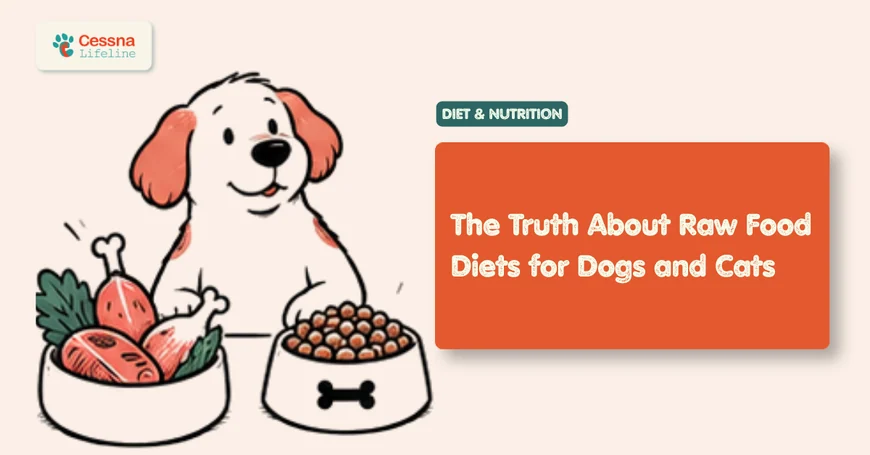
A raw food diet for dogs is one of the few nutrition topics where the gap between owner conviction and published evidence is genuinely wide. Owners who raw feed often report real improvements in coat, stool, and energy, and those reports deserve to be taken seriously rather than dismissed. The difficulty is that the measurable risks of raw feeding are well documented, while the measurable benefits largely are not, and several of the reported improvements have explanations other than the rawness of the food.
This article sets out what the evidence actually supports, the two risk categories that matter, the households where raw feeding should not happen at all, and how to reduce risk substantially if you have decided to do it anyway.
What to Know The two documented risks are pathogen contamination and nutritional imbalance. Raw meat carries Salmonella, Campylobacter, Listeria, and E. coli at rates well established by surveys of commercial raw pet food, and pets can shed these organisms in their stool whether or not they appear unwell. That makes raw feeding a household risk, not only a pet risk. Homemade raw diets are frequently unbalanced, most often in calcium to phosphorus ratio and vitamin content, and the consequences in growing animals can be permanent.
What Is a Raw Food Diet?
Raw feeding means feeding uncooked animal products as the main part of the diet. Several approaches sit under that heading and they differ in how much risk they carry.
The BARF diet, standing for biologically appropriate raw food or bones and raw food, combines raw muscle meat, raw edible bone, organ meat, and a proportion of vegetable matter. Prey model raw feeds whole or near-whole carcasses with no plant material, aiming to approximate what a wild carnivore eats. Commercial raw pet food is sold frozen or freeze-dried, formulated by a manufacturer, and some products are formulated to meet AAFCO or FEDIAF profiles while others are not. Partially cooked or gently cooked diets are a separate category that retains some of the appeal while removing most of the pathogen risk.
From a pet food safety standpoint, the distinction that matters most is not which school you follow but whether the diet is complete and balanced and how the raw material is handled. A commercial raw diet from a manufacturer that formulates to a recognised profile and applies pathogen reduction is a materially different proposition from meat and bone assembled at home from recipes found online.
Is a Raw Food Diet for Dogs Safe?
Safety splits into two questions with different answers.
Pathogen risk is well documented. Surveys of commercial raw pet food across multiple countries have repeatedly isolated Salmonella, Listeria monocytogenes, Campylobacter, and antimicrobial-resistant E. coli. Freezing does not reliably kill these organisms; it suspends them. A dog or cat eating contaminated food can become ill, and can also carry and shed the organism in stool while appearing entirely healthy, which is how the risk reaches the people in the house. Documented human infections have been traced to raw pet food and to contact with raw-fed pets. Antimicrobial resistance adds a second dimension, because a resistant organism circulating in a household is harder to treat if it does cause disease.
Nutritional risk depends on the diet. Analyses of homemade raw diets have found a high proportion to be unbalanced, with calcium to phosphorus ratio the most frequent problem, along with vitamin A and D excess or deficiency and inadequate trace minerals. In an adult dog, mild imbalance may go unnoticed for a long time. In a growing puppy it does not: incorrect calcium and phosphorus during skeletal development causes bone deformity that does not reverse. This is the risk that produces the most serious cases.
Then the mechanical risk from bone. Raw bone is softer than cooked bone and less prone to splintering, which is a genuine point in its favour, but it still causes fractured teeth, oesophageal obstruction, gastrointestinal perforation, and constipation from excessive bone content. Raw does not mean safe to chew, it means safer than cooked. foreign body ingestion in pets
The honest summary on is a raw diet safe for dogs: it can be done with acceptable risk by an informed owner using a properly formulated product and strict hygiene, in a household without vulnerable members. It is not safe when assembled at home from recipes, fed to a growing animal without professional formulation, or handled casually in a kitchen shared with immunocompromised people, infants, or elderly relatives.
What Are the Raw Feeding Pros and Cons for Pets?
| Claim | What the evidence supports |
|---|---|
| Shinier coat, better skin | Commonly reported. Often attributable to higher fat content, which can be achieved in a cooked diet |
| Smaller, firmer stools | Real and expected. Reflects high digestibility and low fibre, not superior nutrition |
| Better dental health | Partly supported. Chewing has a mechanical benefit, offset by fractured teeth and the fact that it does not replace brushing |
| More energy, better muscle | Anecdotal. Not demonstrated in controlled comparison against a complete cooked diet |
| Resolves allergies | Not supported as a property of rawness. Improvement usually reflects a changed protein source, which a cooked novel-protein diet achieves without the risk |
| More natural or ancestral | Not a health argument. Domestic dogs have adapted to digest starch, and wild carnivores have short lifespans with parasite burdens |
| Pathogen contamination | Well documented in commercial and homemade raw food, with onward household transmission |
| Nutritional imbalance | Well documented in homemade diets, most often calcium to phosphorus |
| Bone-related injury | Documented: fractured teeth, obstruction, perforation, constipation |
| Risk to people in the household | Documented, including infections traced to raw pet food and to raw-fed pets |
Reading that table fairly: several reported benefits are genuine observations with explanations other than rawness, which means you can usually obtain the benefit without accepting the risk. The firmer, smaller stool is real and follows from digestibility. The coat improvement often follows the fat content. The allergy improvement usually follows the protein change. A gently cooked, properly formulated novel-protein diet delivers all three.
The most informative question to ask an owner who reports a transformation on raw feeding is what the pet ate before. In the great majority of cases the comparison is not raw against a good cooked diet, it is raw against an inexpensive dry food, fed by the scoop, often in excess. The change involved a better protein source, a higher fat content, an accurately measured portion, and frequently a slimmer pet. Those four things explain the improvement comfortably, and all four are available in a cooked diet. The observation is real; the attribution is the part worth examining.
Who Should Never Feed a Raw Diet?
Some situations move this from a risk calculation to a clear no.
- Households with infants, children under about five, pregnant women, elderly or immunocompromised people, including anyone on chemotherapy or immunosuppressive medication
- Pets that are themselves immunosuppressed, on chemotherapy, or on long-term steroids
- Puppies and kittens, unless the diet is formulated for growth by a qualified veterinary nutritionist
- Pets with pancreatitis or a history of it, given the typical fat content
- Pets with significant kidney or liver disease, where protein and mineral levels need controlling
- Pets that visit hospitals, care homes, or schools as therapy animals, since many such schemes exclude raw-fed animals for infection control reasons
- Households unable to maintain strict separation of raw pet food from human food preparation
The therapy animal point surprises owners, but it follows directly from the shedding evidence and is written into the policies of many visiting-animal programmes.
What Are the Risks of a Raw Diet for Cats?
A raw diet cats are fed raises two specific issues beyond the general ones.
Toxoplasma gondii is the first. Cats are the definitive host, and a cat that eats raw meat containing tissue cysts can become infected and shed oocysts in its faeces. Toxoplasmosis matters particularly for pregnant women and immunocompromised people, which makes raw feeding a cat in such a household a poor decision regardless of other precautions.
Thiaminase is the second. Some raw fish contains an enzyme that destroys thiamine, vitamin B1. A diet built substantially on raw fish can produce thiamine deficiency, which causes neurological signs including weakness, head tilt, and seizures. This is a diet-composition problem rather than a pathogen one, and it is avoidable by not building a feline diet around raw fish.
Cats are also obligate carnivores with narrow requirements, taurine in particular, so a homemade raw diet for a cat needs to get more things right than a dog's. Taurine is heat-labile, which is a genuine argument for raw feeding cats, but commercial cooked cat food supplements taurine precisely because of that, so the practical advantage disappears.
Among the risks of raw food for cats, the one owners underestimate is bone. Cats are efficient at stripping meat and less discriminating about swallowing bone fragments, and raw bone still causes oesophageal obstruction and constipation.
How Do I Reduce the Risk if I Choose to Raw Feed?
If you have weighed this and decided to proceed, these measures reduce risk meaningfully. They do not eliminate it.
- Use a commercial raw pet food from a manufacturer that formulates to AAFCO or FEDIAF and applies a pathogen reduction step such as high pressure processing
- If feeding homemade, have the recipe formulated by a qualified veterinary nutritionist and reviewed when the pet's age or health changes
- Never feed a homemade raw diet to a puppy or kitten without professional formulation for growth
- Keep raw pet food frozen until use and thaw in the fridge, never on a counter
- Use dedicated bowls, boards, and utensils for raw pet food, washed separately at high temperature
- Disinfect all surfaces after preparation and wash hands thoroughly
- Pick up and dispose of stool promptly, and wash hands after any contact
- Keep the pet away from the faces of young children, and discourage face licking
- Avoid raw feeding any animal that visits vulnerable people
- Tell your vet, because it changes how certain illnesses are investigated and which antibiotics are sensible
That last point deserves emphasis. A raw-fed pet presenting with diarrhoea is investigated differently from a conventionally fed one, and a vet who knows the diet can reach the right test sooner. Vomiting, bloody diarrhoea, lethargy, or fever in a raw-fed pet is a red flag that needs a veterinary exam promptly rather than home management. blood in pet stool
Frequently Asked Questions
Is a raw diet safe for dogs?
It can be made reasonably safe with a properly formulated commercial product and strict hygiene, in a household without vulnerable members. It is not safe when assembled at home from online recipes, fed to a growing puppy without professional formulation, or handled casually in a shared kitchen. The pathogen and imbalance risks are both well documented.
What are the main raw feeding pros and cons for pets?
The reliable benefits are smaller firmer stools and often a better coat, both of which have explanations other than rawness and are achievable in a cooked diet. The documented harms are pathogen contamination with household transmission, nutritional imbalance in homemade diets, bone-related injury, and risk to vulnerable people in the home.
Does raw feeding cure allergies?
Not as a property of rawness. Improvement in an itchy pet after switching to raw usually reflects a change in protein source rather than the food being uncooked. A gently cooked novel-protein or hydrolysed diet achieves the same result without the pathogen risk, and a supervised elimination trial is the way to identify the trigger.
What are the risks of raw food for cats?
Beyond the general pathogen and balance risks, cats can acquire Toxoplasma gondii from raw meat and shed oocysts, which matters for pregnant and immunocompromised people. Raw fish fed regularly introduces thiaminase, which destroys vitamin B1 and causes neurological disease. Raw bone also causes oesophageal obstruction and constipation in cats.
Is raw pet food safer if I freeze it first?
No. Freezing suspends bacterial activity rather than killing the organisms, so Salmonella, Listeria, and Campylobacter survive and become active again on thawing. Freezing does reduce some parasite risk, which is useful, but it is not a pathogen control step. Thaw in the fridge rather than on a counter, and never refreeze.
Can puppies eat a BARF diet?
Not without formulation by a qualified veterinary nutritionist. Growing animals need a correct calcium to phosphorus ratio, and homemade raw diets get this wrong frequently. Errors during skeletal development cause bone deformity that does not reverse once growth is complete, which makes this the single highest-consequence mistake in raw feeding.
What should I tell my vet if I raw feed?
Tell them plainly, because it changes clinical reasoning rather than inviting a lecture. A raw-fed pet with diarrhoea is investigated differently, certain organisms become more likely, and antibiotic choice may change. Knowing the diet helps your vet reach the right test faster, which is in your pet's interest regardless of anyone's view on raw feeding.
Next Steps
If you are considering raw feeding, or already doing it and want to check the diet is actually balanced, that is a conversation worth having properly rather than on a forum. A nutrition consultation can review a commercial product against your pet's life stage, assess a homemade recipe for the errors that matter, and set out the hygiene measures for your specific household.
Arrange evidence-based nutrition advice with the Cessna Lifeline team, or book an appointment to have your pet's current diet and body condition reviewed.
If your pet is raw fed and now has vomiting, bloody diarrhoea, fever, or lethargy, have it seen promptly and say that it is raw fed when you call. That single piece of information changes which tests are run first.