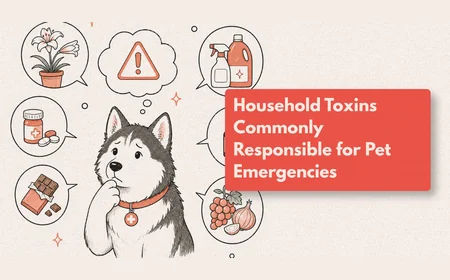
When Is It Actually a Pet Emergency?
Breathing changes, a straining male cat and unproductive retching cannot wait. How to tell a go-now problem from a morning one, and what to do in the first ten minutes.
The list of common pet emergencies is shorter than most owners expect, and the direct answer to the question is this. It is an emergency when breathing, consciousness, circulation or urination is affected, when bleeding will not stop, when the abdomen is swelling, or when your animal is in pain that nothing settles. Those categories account for the great majority of what comes through the door after hours. Nearly everything else can wait for a morning appointment.
The difficulty is that the list does not match instinct. An owner whose dog has cut a pad and left blood across the floor will drive straight in. An owner whose cat has spent the evening sitting upright in a corner, breathing a little faster than usual and refusing food, will often decide to see how it looks in the morning. The cut pad is rarely life-threatening. The cat may have fluid around its lungs or a failing heart, and in that state a night is a long time. Blood is visible. Oxygen is not.
This article covers the signs that mean leave the house now, the signs that can honestly wait, what to do in the first ten minutes at home, the mistakes owners make on the way in, and how to prepare so the decision takes seconds rather than an hour of searching the internet.
What to Know Treat any change in breathing as an emergency until a vet says otherwise. A cat breathing with its mouth open, a dog breathing with obvious effort from the belly, or gums that are pale, blue, grey or brick red all mean leave now. A male cat straining in the tray and passing nothing has hours, not days. A deep-chested dog retching repeatedly without bringing anything up may have a twisted stomach. Never give human painkillers: paracetamol is lethal to cats in tiny amounts, and ibuprofen damages the stomach and kidneys of dogs. Do not make a pet vomit unless a vet instructs you to. Phone ahead so the team is ready when you arrive.
What Actually Counts as a Pet Emergency?
Four systems decide urgency: the airway and lungs, the brain, the circulation, and the urinary tract. A problem in any of them is time-critical because the body keeps almost no reserve in hand. A dog that cannot move oxygen has minutes. A cat that cannot pass urine has hours. An animal bleeding internally sits somewhere between the two. Very little else on the long list of things that worry owners moves at that speed.
Leave for the hospital straight away for any of the following:
- Difficulty breathing, noisy breathing, or a cat breathing with its mouth open
- Gums that are pale, white, blue, grey or brick red
- Collapse, unresponsiveness, or inability to stand
- A seizure lasting longer than five minutes, or repeated seizures in one day
- Bleeding that does not stop with five minutes of firm pressure
- Repeated unproductive retching, especially with a swelling abdomen
- A male cat straining in the litter tray and producing little or no urine
- Known or suspected poisoning, including human medicines and rodenticide
- A bite wound from an unknown dog, cat or monkey
- Suspected heatstroke: panting that will not settle, wobbling, bright red gums
- A road traffic accident, a fall from height, or any crush injury
- Straining in labour for more than half an hour without producing a puppy or kitten
- A bulging, punctured or suddenly cloudy eye
- Snake bite, or a sudden swelling of the face after a sting
That list is deliberately blunt. Nobody triages well at eleven at night with an unwell animal in front of them, and a list that needs interpretation is no use. If you can tick one line, go.
The second group matters more, because these presentations look mild and are not.
| Presentation | What owners usually assume | Actual priority |
|---|---|---|
| Deep cut on a leg, bleeding freely | Emergency | Urgent, but usually stable once pressure is applied |
| Cat sitting upright in a corner, breathing faster, hiding | Probably sulking | Immediate |
| Male cat in and out of the tray, passing drops | Cystitis, can wait | Within hours |
| Repeated retching with nothing produced | Trying to be sick | Immediate |
| Gums that look pale or feel tacky and dry | Nothing much | Immediate |
| Limping on one leg but bearing some weight | Emergency | Next working day |
| One episode of vomiting, otherwise bright and drinking | Emergency | Watch at home, call if it repeats |
| Mild diarrhoea in a bright adult dog | Emergency | Watch, call if blood or lethargy appears |
The pattern is consistent. Owners overestimate the urgency of things they can see and underestimate the urgency of things they can only infer. Learning to read gum colour and breathing effort corrects most of that in a single evening of practice on a healthy animal.
How Do I Tell a Go-Now Problem From a Morning One?
Four checks, in this order, settle most decisions at home. Practise them on your pet while it is well, so you know what normal looks like on your own animal rather than on a diagram.
Breathing. Watch the chest and belly from the side while the animal is resting, not panting from excitement. Count the breaths over thirty seconds and double it. A sleeping dog or cat normally breathes comfortably below thirty times a minute. A resting rate consistently above about forty, or any breathing that involves visible effort from the abdomen, is a reason to telephone tonight.
Gums. Lift the lip and look at the colour of the gum above the canine tooth. Healthy gum is salmon pink and moist. Press it with a fingertip, release, and the colour should flood back almost at once. Pale or white suggests blood loss or poor circulation. Blue or grey suggests oxygen is not reaching the tissues. Brick red suggests sepsis or heatstroke. Yellow suggests jaundice. Any of those colours is an emergency, regardless of how the animal is behaving.
Responsiveness. Call the animal's name. A pet that lifts its head, tracks you and responds normally is in a better place than one that stares through you, presses its head into a wall, circles, or does not react at all. Sudden changes in awareness are brain, circulation or toxin problems, and all three are urgent.
Urination. Ask yourself when you last saw urine. For a male cat, this is the single most useful question an owner can answer. A blocked bladder is painless to watch and fatal to ignore.
If all four checks are normal and your pet is eating, drinking and interacting, you probably have time. If any one of them is abnormal, you do not. Pain is the fifth consideration, and it does not fit a checklist. An animal that cannot settle, that cries when touched, that stands with an arched back, or that adopts a praying position with the chest down and the rear up, is telling you something hurts a great deal. Pain of that intensity needs veterinary attention the same night, both for its own sake and because it usually has a serious cause.
Which Breathing Signs Mean We Should Not Wait?
Respiratory distress is the presentation where delay costs the most, and it is the one owners most often misread as behaviour.
In dogs, look for an extended neck, elbows held away from the chest, nostrils flaring with each breath, and a belly that heaves in and out rather than a chest that rises smoothly. Noisy breathing matters too. A honking cough, a harsh rasp on breathing in, or a sudden change in the sound of a brachycephalic dog's breathing all suggest a narrowing airway. Pugs, Shih Tzus, French bulldogs, Boxers and Lhasa Apsos have very little airway margin to begin with, and a hot afternoon or a few minutes of excitement can tip them over.
In cats, the rules are different and more urgent. Cats do not pant for comfort. A cat breathing with its mouth open is in trouble, and a cat sitting hunched with its elbows out and its head extended is in serious trouble. Cats compensate for lung disease quietly and for a long time, then decompensate quickly. By the time the breathing is visibly abnormal, the margin is thin.
Handling matters as much as speed. A cat in respiratory distress can arrest from the stress of being chased around a room and pushed into a basket. Lift the cat calmly, place it in a carrier with a removable lid, cover the carrier with a light cloth, keep the car quiet and cool, and do not open the carrier to check on it repeatedly. Do not attempt to open the mouth, give water, or hold an oxygen source against the face. Tell the team on the phone that the cat is struggling to breathe so a quiet oxygen space is ready.
One widespread misconception needs correcting. Many owners believe that a pet which is still walking, still wagging or still purring cannot be critical. Purring is a self-soothing behaviour in cats and occurs in pain and in severe illness. A dog will walk into the consulting room on a ruptured spleen. Function is not a reliable measure of reserve.
What Are the Most Common Pet Emergencies We See?
The mix in Bengaluru is reasonably predictable across the year. Road traffic injuries and dog bite wounds are constant. Heatstroke clusters in the dry months and around festival weekends when dogs are walked at the wrong time of day. Poisoning runs steadily: rodenticide, human painkillers, chocolate, xylitol-sweetened products, insecticides and houseplants. Urinary blockage in male cats arrives year-round and is nearly always preceded by two or three days of signs an owner did not recognise. Severe tick-borne disease rises after the monsoon, and some of those dogs arrive profoundly anaemic and collapsing rather than simply off colour.
What separates them is the size of the window you have to act in.
A few of these deserve naming properly, because recognising them early is most of the battle.
Gastric dilatation and volvulus. The stomach fills with gas and rotates. Deep-chested breeds such as Great Danes, Dobermanns, German Shepherds and Boxers are most at risk, often within a couple of hours of a large meal. The dog retches repeatedly and brings nothing up, paces, cannot settle, and the abdomen behind the ribs becomes tight and drum-like. This is surgical and the clock is short.
Urethral obstruction. Male cats have a narrow urethra that blocks with crystals, mucus and inflammatory debris. The cat visits the tray again and again, strains, may cry, and may lick at itself. Owners frequently read the straining as constipation. Within a day or two, potassium rises and the kidneys begin to fail. A blocked cat seen early does well. A blocked cat seen on day three often does not.
Poisoning. Rodenticides remain widely available and are swallowed readily by dogs. Human medicine cabinets are the other major source. Decontamination is far more effective in the first hour or two than later, which is why telephoning immediately beats watching to see what happens.
Bite wounds. A puncture from another dog looks trivial and is not. The skin seals over crushed and contaminated tissue underneath, and infection develops in the dead space. Chest and abdominal punctures can be far deeper than they appear. Every bite wound needs veterinary attention, and in India a bite from an unknown animal also raises rabies exposure for the pet and for anyone who handled it.
Do Bengaluru's Heat and Monsoon Change the Risk?
Yes, and in ways that are easy to plan around once they are named.
Heat is the first. Bengaluru is milder than much of the country, which makes owners complacent, but heatstroke needs only a warm afternoon, high humidity and a dog that will not stop. The highest-risk combination is a flat-faced breed, a midday walk and an enthusiastic temperament. Tarmac at three in the afternoon can burn pads, and a parked car becomes dangerous within minutes even in shade with the windows cracked. Walk in the early morning or after dark, carry water, and judge the pavement with the back of your hand before setting off.
The monsoon brings its own pattern. Standing water around compounds and roadsides carries leptospirosis, shed in rat urine, which causes kidney and liver failure in dogs and is transmissible to people. A dog that has been swimming in or drinking from floodwater and then becomes jaundiced, lethargic and off food needs to be seen urgently, and anyone handling its urine should wear gloves. Ticks surge as the rain eases, and with them Ehrlichia and Babesia infections. The fever is rarely what brings these dogs in. The danger sits in the anaemia and low platelet count that follow: pale gums, nosebleeds, pinpoint bruising under the belly, and sudden weakness. Those dogs sometimes need a transfusion.
Snakes move during and after heavy rain, into gardens, garages and storerooms. If you suspect a bite, keep the animal as still as possible, carry it rather than letting it walk, do not cut, suck, wash vigorously or apply a tourniquet, and telephone ahead so antivenom and supportive care are ready. Note the time and, if it is safe to do so from a distance, the appearance of the snake. Never attempt to catch or kill it.
Rabies deserves a plain statement. The disease remains present in India, and an unprovoked bite or deep scratch from a street dog, a cat or a monkey is handled as a potential exposure rather than a wound. Your pet needs the wound managed properly and its vaccination status reviewed the same day. Any person who was bitten, scratched or who handled the wound without gloves should seek their own medical care immediately. Do not clean and dress a bite at home and wait to see whether it becomes infected.
Traffic and water are the last practical point. During a heavy downpour, the drive that normally takes fifteen minutes can take an hour. If you have a high-risk animal, a brachycephalic dog, a cat with a history of blockage, an epileptic, or a bitch due to whelp, know your route and your alternative route before the rain starts.
What Should I Do in the First Ten Minutes?
Your job at home is to keep your pet alive, keep yourself uninjured, and get moving. Treatment is not your job.
- Telephone the hospital first. Thirty seconds on the phone lets a team prepare oxygen, fluids, a trolley and a surgical kit. It also lets us tell you whether to come now or in the morning, which saves some journeys entirely.
- Protect yourself. Pain makes gentle animals bite, and an owner with a hand injury helps nobody. Handle a frightened cat through a thick towel. Lift a small dog with both hands supporting the chest and rear.
- Control bleeding with pressure. Place a clean cloth or gauze over the wound and press firmly for five uninterrupted minutes. Do not keep lifting it to check. Add more material on top rather than removing the soaked layer. Never apply a tourniquet.
- Cool a suspected heatstroke patient on the way. Move into shade and airflow, then pour or hose cool tap water over the body, concentrating on the neck, chest, armpits and inner thighs. Keep air moving over the wet coat. Avoid ice and ice baths, which close down surface vessels and trap heat in the core. Do not drape a wet blanket over the dog, as it insulates. Continue cooling in the car with the windows down.
- Make a seizure safe rather than stopping it. Move furniture away, dim the lights, keep the room quiet and note the start time. Do not put your hands near the mouth and do not try to hold the animal still. If the seizure passes five minutes, or a second one follows, leave for the hospital.
- Bring the evidence. The packaging, the plant, the tablet strip, a photograph of the label, or a sample of vomit in a sealed bag will often determine treatment. Guesswork costs time.
- Withhold food and water. An animal that may need sedation, anaesthesia or surgery is safer with an empty stomach, and a choking or collapsed animal can inhale anything you offer.
- Move a suspected spinal injury flat. Slide the animal onto a board, a baking tray, a stiff piece of cardboard or a rolled blanket used as a stretcher, keeping the back as straight as you can, and support it on the drive.
Keep a muzzle in the kit for dogs, and understand the limit. A muzzle is reasonable for a painful but normally breathing dog. Never muzzle a dog that is struggling to breathe, retching, vomiting or overheating.
What Should I Never Do on the Way to the Hospital?
Most of the harm done in the first hour comes from well-intentioned home treatment. These are the ones we see repeatedly.
| Do not | Why |
|---|---|
| Give paracetamol, ibuprofen or diclofenac | Paracetamol is lethal to cats in minute amounts; both damage the stomach and kidneys of dogs |
| Make your pet vomit without instruction | Caustics and petroleum products cause more injury coming back up, and a drowsy animal can inhale it |
| Give milk, ghee, oil or salt as an antidote | None neutralises a poison; some speed absorption, and salt can be dangerous in its own right |
| Apply a tourniquet to a bleeding limb | Cuts off circulation and frequently costs the limb; firm direct pressure is safer and works |
| Use ice or an ice bath for heatstroke | Constricts surface vessels and traps heat in the core; cool tap water with airflow is correct |
| Pull out a stick, needle or other embedded object | It may be tamponading a vessel, and removal can cause sudden bleeding |
| Push a prolapsed eye back in | Crushes the globe; cover with gauze soaked in sterile saline and travel in |
| Pull on thread hanging from a cat's mouth or rear | Linear foreign bodies saw through the intestinal wall when tension is applied |
| Hand-feed water to a collapsed or choking animal | Risks inhalation pneumonia and delays departure |
| Wait because the animal has gone quiet | Quiet can mean relief, or it can mean the animal is too weak to protest |
Human first-aid instinct is the thread running through that table. People reach for the drug, the tourniquet and the ice because those things exist in the human world. The useful instinct in veterinary emergencies is simpler. Stop the bleeding, keep the airway clear, cool if overheated, keep still, telephone, and drive.
How Should I Prepare Before Anything Happens?
Preparation converts a frantic hour into a calm twenty minutes. Do it on a quiet weekend.
| Item | Why it matters |
|---|---|
| Hospital number saved under one obvious name | Removes the worst five minutes of any emergency |
| Current weight written down | Needed for dose calculations before anything is given |
| One-page record: vaccinations, medicines, conditions | Avoids guesswork if your usual vet is unavailable |
| Carrier with a removable lid, kept accessible | A breathless cat can be examined without being pulled out |
| Thick towel and a well-fitting muzzle | Safe handling of a painful animal |
| Gauze, conforming bandage, surgical tape | Pressure dressings for bleeding |
| Blunt-ended scissors and a tick remover | Routine jobs that turn urgent at inconvenient times |
| Digital thermometer and lubricant | An objective number to report on the phone |
| Rolled blanket or a stiff board | Improvised stretcher for a spinal or pelvic injury |
| Printed route and an alternative route | Monsoon flooding closes the obvious road |
Two decisions are better made in advance than in a corridor. The first is who takes the pet in. Somebody has to drive and somebody has to hold, and arguing about that in the hallway wastes real minutes. The second is a conversation about how far you would want us to go. Families who have discussed resuscitation, and roughly what they could manage financially, make clearer decisions under pressure and regret fewer of them afterwards. We would far rather have that conversation at a routine health check than at two in the morning.
Learn your own animal's baseline while it is well. Count the resting breathing rate on a few evenings. Look at the gums. Feel the pulse inside the thigh. Know what a normal belly feels like. Owners who know these things give us genuinely useful information on the telephone, and it changes what we have ready when the car pulls in.
What Happens When We Arrive at the Hospital?
Emergency work is triaged, not run in order of arrival. A dog that walked in after you may be taken through first because it is not moving oxygen, and an animal that looks dramatic may wait because it is stable. That can feel wrong when you are the one waiting. It is the system working.
Expect your pet to be taken through to the treatment area quickly and before the paperwork. Oxygen, intravenous access, pain relief and a rapid assessment of heart, lungs and perfusion come first, because stabilising a patient is what makes investigation survivable. You may be asked a short set of questions at the door, then asked to wait while that happens. The full history comes afterwards.
Expect the first answer to be a problem rather than a diagnosis. Early on we can usually say what system is failing and how urgent it is. The cause often needs bloodwork, radiographs, ultrasound or a period of observation. Being told that your dog has low blood pressure and free fluid in the abdomen, with the cause still unconfirmed, is normal and useful.
Expect costs to be discussed in stages. A reasonable estimate for stabilisation and initial diagnostics comes first, with a revised plan once we know more. Ask for the estimate in writing, ask what the alternatives are at each step, and say plainly if a limit applies. A clinician who knows your ceiling can plan sensibly within it. One who finds out halfway through cannot.
Frequently Asked Questions
When is it actually a pet emergency?
Breathing difficulty, collapse, prolonged seizures, uncontrolled bleeding, a swelling abdomen, inability to pass urine and pain that will not settle are all emergencies. Each affects a system with no reserve, so delay changes the outcome. Limping with weight-bearing, a single vomit or mild diarrhoea in a bright, drinking animal can usually wait for a morning appointment.
What are the most common pet emergencies in dogs and cats?
Road traffic injuries, dog bite wounds, heatstroke, poisoning, urinary blockage in male cats, twisted stomachs in deep-chested dogs, seizures, whelping difficulties and severe tick-borne disease account for most after-hours work in Bengaluru. Breathing problems cut across all of them and are the single commonest reason a patient is taken straight through on arrival.
Should I wait until morning if my dog seems to have settled?
Animals hide illness well, and a quiet pet is not always a comfortable one. Settling can mean the pain has eased, or that the animal is becoming too weak to protest. Gums that are pale, blue or grey, fast shallow breathing and cold feet all argue strongly against waiting. Telephone the hospital and describe exactly what you see.
How do I know if my cat is struggling to breathe?
Cats in respiratory distress sit upright with the elbows held away from the chest, the neck extended and the mouth open. The movement looks like effort rather than panting, and the belly often works harder than the chest. Avoid handling or chasing the cat; place it in a carrier, keep the room quiet and travel in immediately.
What should I do if my dog has eaten something poisonous?
Telephone the hospital at once and bring the packaging, plant or label with you. Do not try to make your dog sick unless a vet instructs you to, because some substances cause worse injury coming back up. Milk, ghee and oil are not antidotes. Timing dominates the outcome, and the first hour or two is far more productive than later.
Can I give my pet a human painkiller while we wait?
Human painkillers are among the most frequent causes of poisoning seen in practice. Paracetamol is lethal to cats in very small amounts and can cause severe liver damage in dogs. Ibuprofen and diclofenac cause stomach ulceration and kidney injury in both species. Nothing from a human medicine cabinet should be given to an animal without veterinary instruction.
How do I cool a dog with suspected heatstroke?
Move the dog into shade and moving air, then pour or hose cool tap water over the body, concentrating on the neck, chest, armpits and inner thighs. Avoid ice and ice baths, which constrict surface vessels and trap heat in the core. Do not cover the dog with a wet blanket. Start cooling before leaving and continue in the car.
Next Steps
If anything on the go-now list applies to your pet right now, stop reading and telephone us. Describe the breathing, the gum colour and what you last saw your animal eat, drink or pass, then set off. Bring packaging or a photograph of any medicine or plant involved, and leave food and water out of it.
If your pet is bright, eating, drinking and breathing comfortably, and the problem is a limp, a single vomit, a small wound or a change you cannot quite pin down, book an examination for the next working day and keep watching the four checks above. Write down what you notice and when, because a timeline is often more diagnostic than the examination itself.
The best time to sort this out is while your animal is well. Our emergency and critical care team is happy to walk you through the four checks on your own pet at a routine visit, show you where the pulse is, tell you what your animal's normal gum colour looks like, and go through your emergency kit and route. Ten minutes at a health check buys back an hour on the night it matters.