Arthritis in Senior Pets: Keeping Them Moving
Arthritis in senior pets is under-diagnosed because dogs slow down quietly and cats stop jumping. The signs, the management package, and what helps most.
Arthritis in senior pets is probably the most under-treated painful condition in small animal practice, and the reason is not that it is hard to diagnose. It is that the signs look like ageing. An owner watching a ten-year-old dog take the stairs more slowly, or a twelve-year-old cat stop getting onto the windowsill, reaches a reasonable conclusion: he is getting old. That conclusion is half right. The dog is older, and it is also in pain that is diagnosable and treatable.
This article covers what to look for in each species, why cats are missed more often than dogs, and the management package that works, in order of how much difference each part makes.
What to Know Osteoarthritis is a progressive, painful disease, not a cosmetic consequence of age. Dogs rarely cry with it and cats almost never limp with it, so pain presents as reduced activity instead. The single most effective intervention in an overweight arthritic animal is weight reduction, which frequently improves lameness measurably before any medication is added. Never give a pet human painkillers: ibuprofen and paracetamol are both dangerous, and paracetamol can kill a cat at an ordinary human dose.
How Common Is Arthritis in Senior Pets?
| Species | Why it gets missed | The sign owners actually notice |
|---|---|---|
| Dogs | Rarely vocalise; slowing down reads as ageing | Reluctance on stairs or into the car |
| Cats | Usually bilateral, so no limp; conceal weakness | Stopped jumping to a favourite high place |
| Both | No daily activity being formally measured | Reduced play and interaction |
Arthritis in dogs and arthritis in cats present so differently that they are worth treating as two separate recognition problems, which the next two sections do.
What Are the Signs of Arthritis in Older Dogs?
Dogs with osteoarthritis usually present as dogs doing less, not dogs in obvious distress.
- Slower to rise, particularly after sleeping or on cold mornings
- Stiffness that eases after a few minutes of movement
- Reluctance on stairs, or taking them one at a time
- Hesitating before jumping into a car or onto furniture, or stopping altogether
- Lagging on walks, or wanting to turn back earlier
- A changed sit, often with one hind leg swung out to the side
- Licking persistently over a joint
- Muscle loss over the hindquarters, so the back end looks narrower
- Reduced interest in play or in greeting people at the door
- Irritability when touched over the hips or lower back
- Difficulty posturing to toilet, or soiling because getting outside takes too long
- Panting or restlessness at night without an obvious cause
The pattern worth recognising is stiffness that is worst after rest and improves with gentle movement. That is characteristic of osteoarthritis, and it is the opposite of what owners expect, which is why many assume exercise is making it worse.
Two things get missed consistently. A changed sit, with a hind leg out to the side, is a specific and early sign that most owners never mention because it does not look like pain. And panting or pacing at night is frequently reported as a behaviour problem or cognitive decline when it is unmanaged pain.
How Do I Help a Cat With Arthritis, and How Is It Different?
Cats are missed far more often than dogs, and the reason is that the sign everyone looks for, limping, is usually absent.
Feline osteoarthritis is typically bilateral, affecting both sides of the body similarly, so there is no asymmetry to produce a limp. The cat simply moves less. On top of that, cats are evolutionarily inclined to conceal weakness, and most cats have no daily activity that an owner formally monitors in the way a dog's walk is monitored.
What to watch for instead:
- No longer jumping to previously favoured high places, or jumping in stages via a chair
- Hesitating at the top or bottom of a jump
- Sleeping in new, lower, more accessible spots
- Reduced grooming, especially over the lower back and rump, producing a scurfy or matted patch
- Difficulty getting into a litter tray with high sides, or soiling beside it
- Reluctance to be stroked over the back or hips, or sudden irritability
- Less interaction, less play, more time alone
- Overgrown claws, because the cat has stopped using its scratching post
- A matted or greasy coat over the areas it can no longer reach
That grooming sign deserves emphasis. A senior cat with a scurfy rump is quite often an arthritic cat, because the twisting needed to reach the back end has become painful. Owners read it as untidiness. It is a mobility finding. cat grooming
The most useful diagnostic tool for feline arthritis costs nothing: ask the owner to film the cat at home on a phone, specifically getting onto its favourite surface and using the litter tray. Cats in a consulting room are frozen, flat to the table, and reveal almost nothing about how they move. A fifteen-second clip of a cat approaching a jump, pausing, changing its mind, and taking a two-stage route instead shows more than a full orthopaedic examination of a tense cat. Owners also routinely under-report, because they have watched the decline happen gradually and recalibrated what normal looks like. The video defeats that.
How Is Arthritis Diagnosed?
Diagnosis combines history, examination, and imaging, and the history carries more weight than owners expect.
The clinical history establishes what the animal has stopped doing and when, which is often more informative than anything found on the table. Specific questions work better than general ones: can he still jump into the car, does she still get onto the bed, how does he sit.
Physical examination assesses each joint for range of motion, pain on manipulation, thickening, and crepitus, along with muscle mass comparison between limbs and gait observation. A tense or painful animal examines poorly, which is a real limitation, particularly in cats.
Radiographs show the structural changes of osteoarthritis: narrowed joint space, new bone formation at the joint margins, and sclerosis. A caveat worth knowing is that radiographic severity and clinical pain correlate loosely. Some animals with dramatic radiographs cope well and some with modest changes are very painful, so imaging supports the diagnosis rather than grading the suffering.
Blood and urine tests are often run before starting long-term medication, to check kidney and liver function, and to rule out other causes of reduced activity. That matters because several conditions mimic arthritis in older animals: hyperthyroidism in cats, spinal disease, cruciate injury, and in cats hypertension or cardiac disease.
A diagnostic trial of analgesia is genuinely useful, particularly in cats. If a cat starts jumping onto the windowsill again after two weeks of appropriate pain relief, that answers the question better than any image.
What Helps Pet Joint Pain Most?
The components in order of impact.
Weight control comes first for any overweight animal, and it is not a soft recommendation. Reducing load on arthritic joints frequently improves lameness measurably, sometimes before medication is added, and it costs nothing but discipline. In an overweight arthritic dog, this is the highest-value thing an owner can do. pet weight management
Analgesia comes second. Prescribed anti-inflammatories remain the mainstay for dogs, with newer options including monoclonal antibody injections that target nerve growth factor and are available for both dogs and cats. Cats have fewer licensed options and need more careful selection, which is exactly why feline arthritis should be managed with a vet rather than improvised. Bloodwork before and during long-term treatment is standard.
Controlled exercise comes third, and the principle is little and often. Several short lead walks daily beat one long one, and consistency beats intensity. A long weekend walk after a quiet week is a reliable way to produce a sore dog. Avoid ball-throwing and sudden turns, which load joints unpredictably.
Environmental changes are cheap and underused. Non-slip runners on smooth flooring, a ramp into the car, steps up to a favoured sofa, raised food and water bowls, a supportive bed away from draughts, and for cats a litter tray with a low entry and access routes to high places broken into stages.
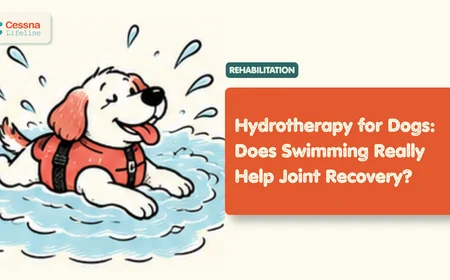
Rehabilitation adds structured strengthening, range of motion work, and hydrotherapy. It is particularly valuable where muscle wasting has set in, because rebuilding the muscle that supports a joint improves its stability. hydrotherapy for dogs
Joint supplements come last deliberately. Evidence for glucosamine and chondroitin is weak and inconsistent. Omega-3 fatty acids at therapeutic doses have better support for a modest anti-inflammatory effect. None of them substitute for the five items above, and a pet on supplements alone is usually under-treated.
What Exercises Help Dogs With Arthritis?
Exercises for dogs with arthritis aim to maintain range of motion and rebuild supporting muscle without provoking pain. These should be set up by a vet or physiotherapist for your specific dog, and the descriptions below are to show what the work looks like rather than to replace a plan.
Controlled lead walking on a flat, non-slip surface is the foundation, in short frequent sessions. Sit-to-stand repetitions build hindlimb strength and are effectively a canine squat, done slowly in small sets. Weight-shifting, gently rocking the dog side to side while it stands square, activates the stabilising muscles. Slow walking over low obstacles encourages deliberate limb placement and improves awareness of where the limbs are. Gentle passive range of motion, moving a joint through its comfortable range while the dog is relaxed, maintains mobility and is useful after rest. Walking on grass or sand adds resistance without impact.
Three rules govern all of it. Stay within the pain-free range, because pushing into pain achieves nothing and teaches the dog to resist. Progress one variable at a time rather than adding duration and difficulty together. And stop if the dog is more lame the next day, which means the dose was too high.
What to avoid: ball and frisbee throwing, which involves sprinting and sudden turns; stairs where avoidable; jumping on and off furniture or into cars; rough play with other dogs; and long walks after several sedentary days.
When Should I See a Vet About Senior Pet Mobility?
Do not wait for limping, which in cats may never come. Book an assessment for:
- Any reluctance to jump, climb stairs, or get into a car
- Stiffness after rest, especially in the morning
- A changed sitting position, or difficulty posturing to toilet
- Reduced grooming in a cat, or a scurfy patch over the rump
- Muscle loss over the hindquarters
- New irritability when touched or lifted
- Soiling indoors in a previously clean animal
- Night-time restlessness or panting
- Overgrown claws, indicating reduced activity
- Any sudden worsening, which may indicate something other than arthritis
Sudden severe lameness, an inability to bear weight at all, dragging a limb, or loss of coordination in the hind legs are red flag signs. Those point to cruciate rupture, fracture, or spinal disease rather than gradual osteoarthritis, and they need a veterinary exam urgently rather than at the next convenient appointment.
Frequently Asked Questions
What are the signs of arthritis in older dogs?
Slower to rise, stiffness after rest that eases with movement, reluctance on stairs or jumping into the car, lagging on walks, and a changed sit with one hind leg out to the side. Muscle loss over the hindquarters and night-time restlessness are also common. Dogs rarely cry with arthritis, so reduced activity is the main sign.
How do I help a cat with arthritis?
Knowing how to help a cat with arthritis starts with a veterinary assessment, because cats need carefully chosen analgesia and have fewer licensed options. Then adapt the home: a litter tray with a low entry, steps to favourite high places, raised bowls, and soft bedding. Take over grooming the lower back, and keep claws short since arthritic cats stop using scratching posts.
Why is arthritis in cats so often missed?
Because feline arthritis is usually bilateral, so there is no asymmetry to cause a limp, and cats conceal weakness instinctively. Owners also have no daily routine to measure a cat against, unlike a dog's walk. The signs are behavioural: not jumping, sleeping lower, grooming less, and struggling with the litter tray.
What exercises help dogs with arthritis?
Controlled short lead walks on non-slip ground, slow sit-to-stand repetitions, gentle weight-shifting while standing square, walking over low obstacles, and passive range of motion work. Stay within the pain-free range and progress one variable at a time. Avoid ball throwing, jumping, and long walks after sedentary days.
Do joint supplements work for pet joint pain?
Evidence for glucosamine and chondroitin is weak and inconsistent. Omega-3 fatty acids at therapeutic doses have better support for a modest anti-inflammatory effect. Supplements are the lowest-impact part of arthritis management and do not substitute for weight control, prescribed analgesia, controlled exercise, or rehabilitation.
Can I give my dog human painkillers for arthritis?
No, never. Ibuprofen causes gastrointestinal ulceration and kidney damage in dogs, and paracetamol is dangerous to dogs and lethal to cats at ordinary human doses. Veterinary anti-inflammatories are formulated and dosed for the species. If your pet seems painful, call for a prescription rather than reaching for the human medicine cabinet.
Does losing weight really help arthritis?
Yes, more than almost anything else. Excess weight increases load on every joint, and weight reduction alone frequently produces measurable improvement in lameness, often before medication is added. In an overweight arthritic animal it is the single highest-value intervention, and it works alongside pain relief rather than instead of it.
Next Steps
Arthritis responds much better to a plan than to a single treatment. A rehabilitation assessment measures joint range and muscle mass, sets a home exercise programme you can keep to, and tracks whether it is working rather than guessing.
Arrange rehabilitation for arthritis and mobility with the Cessna Lifeline team, including hydrotherapy where it suits the case.
If your pet has not been assessed yet, start there, because several conditions mimic arthritis in older animals. Book an appointment, and for a cat, film a short clip at home of it approaching a jump and using the litter tray. That video is often more informative than the examination itself.
Sudden severe lameness, an inability to bear weight, or wobbliness in the hind legs is a different problem from gradual arthritis and needs seeing urgently.