Pet Amputation Recovery: Adapting on Three Legs
Pet amputation recovery is usually faster than owners fear. What the first weeks involve, how a three legged dog adapts, and the long-term care that matters.
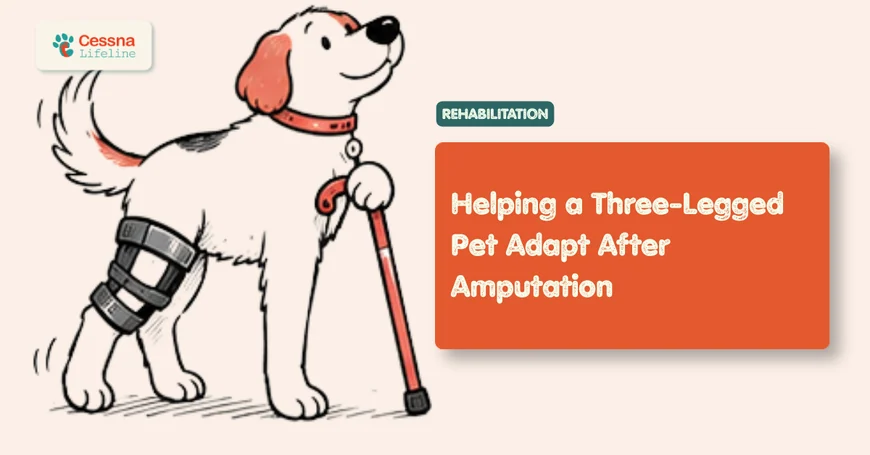
Pet amputation recovery is the area where owner expectation and clinical reality diverge most sharply. Owners facing the decision often describe it as unthinkable, and then describe the same animal six weeks later as being back to itself. Animals do not experience limb loss as a loss of identity, they experience it as a mechanical problem, and they solve it quickly.
That does not make it trivial. The long-term work is real: the remaining limbs carry more load, the joints that take that load develop arthritis sooner, and weight control stops being a general recommendation and becomes central. This guide covers the decision, the first weeks, how adaptation actually happens, and the care that matters over years.
What to Know Most dogs and cats bear weight on three legs within a day or two of surgery and walk reasonably within one to two weeks. Adaptation is usually easier for cats and small dogs than for large heavy dogs, and front limb amputation is harder than hind, because the forelimbs carry roughly sixty percent of body weight. The highest-value thing an owner can do for the next several years is keep the animal lean, because every excess kilogram now passes through three limbs instead of four.
Why Would a Pet Need an Amputation?
The common reasons fall into four groups.
Bone tumours, osteosarcoma in particular, are the most frequent indication in dogs. The tumour is painful and destroys bone, and removing the limb removes the source of that pain, which is why amputation is often described as a pain-relieving procedure as much as a cancer treatment.
Severe trauma is the next. A limb damaged beyond reconstruction by a road accident, a crush injury, or a degloving wound sometimes cannot be saved, and attempting repair would mean months of surgery with a poor functional result.
Non-healing or non-functional limbs account for many of the rest: a fracture that has failed to heal despite repair, an irreparable nerve injury leaving a limb the animal drags and injures, or chronic infection in bone that has not responded to treatment.
Severe, intractable pain in a limb that cannot be managed any other way is the fourth. A limb that is painful, non-functional, and getting repeatedly injured is doing the animal harm.
The framing worth holding onto is that amputation is almost always a decision to remove a source of pain. An animal with a painful, useless limb is better off without it, and that is how most animals behave afterwards.
What Happens in the First Weeks of Pet Amputation Recovery?
The timeline is faster than most owners expect.
| Stage | What to expect | What you do |
|---|---|---|
| First 24 to 48 hours | Groggy from anaesthesia, significant pain relief on board, may attempt to stand | Confined warm space, non-slip flooring, support with a sling or towel under the body |
| Days 2 to 7 | Most animals bearing weight on three legs and taking a few steps | Short supported trips outside, wound checks twice daily, medication on schedule |
| Days 7 to 14 | Walking reasonably, stronger each day, sutures out around day 10 to 14 | Gradually increase short walks, keep the collar on, maintain restriction |
| Weeks 2 to 6 | Building endurance and balance, learning new movement strategies | Build walk length slowly, begin structured rehabilitation exercises |
| Beyond 6 weeks | Largely adapted, may tire faster than before | Ongoing conditioning, weight control, monitoring the remaining limbs |
What is normal in the early days: bruising and swelling around the surgical site, which can be extensive and often looks worse than it is; fluid accumulation under the skin, which is common after a large surgical space is created; some phantom-limb twitching, where the animal moves a limb that is no longer there; and a few days of reluctance to eat.
What is not normal: discharge that is yellow, green, or smells; a wound that opens; swelling that is increasing after day three or is hot; pain that is worsening; refusal to eat beyond a day or two; or an animal that will not attempt to stand at all by two to three days.
Non-slip flooring is the one environmental change to make before the animal comes home. A three-legged animal that slips has nothing to catch itself with, and a fall in the first fortnight is both frightening and a genuine injury risk. Runners, yoga mats, or rugs over smooth flooring make more difference than any equipment you can buy. pet post surgery care
How to Care for a Three Legged Dog as It Adapts
Adaptation is mechanical, and which limb was removed changes the problem substantially. Pet mobility after amputation depends far more on which leg went than on anything else.
A dog's forelimbs carry roughly sixty percent of body weight, so a front limb amputation is the harder adaptation. The dog shifts its centre of gravity backwards and develops a characteristic bobbing gait, swinging the head and neck to help with each step. That head and neck action means the muscles of the neck and shoulders work considerably harder than before, and stiffness there is common.
Hind limb amputation is generally easier. The dog takes more weight through the forelimbs and the remaining hind leg, which moves toward the midline to sit under the centre of mass. The spine does additional stabilising work.
Either way, compensations follow. The remaining limb on the amputated side takes markedly more load and its joints are at higher risk of arthritis. Spinal and core muscles work harder to stabilise an asymmetric body. Endurance falls, so a dog that managed an hour before may manage half of that comfortably. Turning toward the missing side is harder and some dogs circle wide.
Size and condition drive the outcome more than anything else. Lean, fit, young, small animals adapt remarkably well. Large, heavy, older animals with existing arthritis in the remaining limbs have a harder time, and for them the pre-operative conversation should include an honest assessment of the other three legs, because that is what will carry them.
How Is Helping a Cat After Amputation Different?
Cats generally adapt faster and more completely than dogs, and the practical issues differ.
Their advantages are real: they are light, flexible, and naturally good at redistributing weight, and most cats are walking and manoeuvring confidently within days. Many three legged cats end up functionally unrestricted indoors.
The complications are mostly about management. Cats climb, so confinement in the early weeks has to account for a cat that will attempt a wardrobe. Jumping is the main adaptation challenge, and a cat that could reach a windowsill in one leap may now need a staged route, so provide intermediate steps rather than removing access. Litter trays need low entries, since stepping over a high side on three legs is awkward. A protective collar can prevent a cat eating or using a tray comfortably, so a surgical suit is often the better choice, and it is worth checking that a collared cat is actually managing.
Cats also conceal pain thoroughly, so look for hunched posture, hiding, reduced grooming, a tense face, and reluctance to move rather than waiting for vocalisation. A cat that stops eating after surgery needs a call rather than patience.
One feline specific: never give a cat any human pain relief. Paracetamol is lethal to cats at ordinary human doses.
The part of amputation recovery that is genuinely harder than owners expect is not the first fortnight, it is month eighteen onward. Early recovery goes well and reassures everybody, and then the compensations quietly accumulate: the remaining limb on the amputated side develops arthritis, the neck or lumbar spine stiffens from years of asymmetric work, and endurance falls further. Those changes are gradual and easy to attribute to ageing. Booking a mobility review every six to twelve months, specifically to examine the remaining limbs and spine rather than the amputation site, catches them while they are still manageable. The surgical site is almost never the long-term problem; the other three legs are.
What Does Rehabilitation After Pet Amputation Involve?
Amputation rehabilitation has a different purpose from rehabilitation after a repair. There is no limb to restore function to, so the work is about protecting and conditioning what remains.
Four goals. Building strength in the remaining limbs so they can take the redistributed load. Developing core and spinal stability, because an asymmetric body needs more trunk work to stay level. Improving balance and proprioception for the new configuration. And identifying compensatory patterns early, before they produce secondary problems.
The practical work includes controlled lead walking built up gradually as the foundation, standing balance work, weight shifting, and sit-to-stands for the remaining hind limbs. Cavaletti poles encourage deliberate placement. Core work builds the trunk muscles doing the extra stabilising. Hydrotherapy is particularly useful here, because an underwater treadmill lets the animal work the remaining limbs with reduced load, which is exactly the right trade for a body already carrying more per leg. hydrotherapy for dogs
Environmental support matters as much as exercise. Non-slip flooring throughout, ramps rather than jumps into cars and onto furniture, raised food and water bowls for front-limb amputees to reduce neck strain, and a supportive bed. Harnesses with a handle help an owner assist a large dog on steps. Prosthetics and carts exist and suit a small number of cases, usually multiple-limb or specific partial amputations, and are not needed by most three-legged animals.
Weight control runs through all of it and is the single highest-value long-term intervention. pet weight management
What Long-Term Care Does a Three Legged Pet Need?
Plan for several things over years rather than weeks.
- Lifelong weight management, which protects the remaining joints more than anything else
- Monitoring the remaining limbs for arthritis, especially the limb on the amputated side
- Attention to the neck and shoulders in front-limb amputees, and the lumbar spine in hind-limb amputees
- Regular low-impact conditioning to maintain muscle, rather than sporadic bursts
- Non-slip flooring maintained permanently, not just during recovery
- Ramps and steps instead of jumping
- Accepting reduced endurance, and planning shorter more frequent walks
- Six to twelve monthly mobility reviews examining the other three limbs
- Paw and nail care, since loading changes and claws may wear unevenly
- Where the amputation was for cancer, the oncology follow-up schedule continues separately
Seek advice if a three-legged pet develops a new lameness in a remaining limb, becomes reluctant to walk distances it previously managed, struggles to rise, or shows pain on being touched over the neck or back. Those are red flag signs that the compensations have become a clinical problem and need a veterinary exam rather than being accepted as the animal slowing down.
Frequently Asked Questions
How long does pet amputation recovery take?
Most dogs and cats bear weight on three legs within one to two days and walk reasonably within one to two weeks, with sutures out around day ten to fourteen. Building endurance and balance continues over roughly six weeks. Cats and small lean dogs adapt fastest; large, heavy, or older animals take longer.
How do I care for a three legged dog at home?
Put non-slip runners over smooth flooring, since a three-legged dog that slips cannot catch itself. Use ramps instead of jumps into cars and onto furniture, raise food bowls for front-limb amputees, and build walks up gradually in shorter more frequent outings. Keep the dog lean, which protects the remaining joints.
Is amputation cruel?
Animals do not experience limb loss the way people imagine. Amputation is usually performed to remove a source of severe pain, such as a bone tumour or an irreparable injury, and most animals are more comfortable afterwards than before. The honest concern is not cruelty but whether the remaining three limbs can carry the animal, which is assessed beforehand.
Which is harder, front or hind limb amputation?
Front limb amputation is generally harder, because the forelimbs carry roughly sixty percent of body weight. Front-limb amputees develop a head-bobbing gait and work their neck and shoulder muscles considerably harder. Hind limb amputation is usually easier, with the remaining hind leg moving toward the midline and the spine doing more stabilising work.
How do I help a cat after amputation?
Provide staged routes to favourite high places rather than removing access, use a litter tray with a low entry, and consider a surgical suit instead of a collar so the cat can eat and toilet comfortably. Watch for hunching, hiding, and reduced grooming as pain signs, and never give a cat human pain relief.
Will my pet be in pain long term?
Most are considerably more comfortable after amputation than before, because the painful limb has gone. Some experience phantom-limb sensations early on, and occasional twitching of the missing limb is normal. The realistic long-term pain risk is arthritis in the remaining limbs from the extra load, which is why weight control and conditioning matter.
Does my pet need a prosthetic or a cart?
Most three-legged animals do not. Prosthetics and carts suit a minority of cases, typically multiple-limb involvement or specific partial amputations where a residual limb can bear a device. For most animals, non-slip flooring, ramps, maintained muscle, and a lean body weight achieve more than any equipment.
Next Steps
The work that protects a three-legged animal is conditioning the limbs it still has, and that benefits from a structured plan rather than guesswork. A rehabilitation assessment examines the remaining limbs and spine, sets a conditioning programme, and gives you a baseline to track over the years.
Arrange rehabilitation after pet amputation with the Cessna Lifeline team, including hydrotherapy where it suits the case.
If you are still weighing the decision, that conversation is worth having properly, because the assessment of the other three limbs is what determines how well your pet will manage. Book an appointment to discuss it.
If your three-legged pet has developed a new lameness, is struggling to rise, or is reluctant on walks it used to manage, have it seen rather than putting it down to age. That is usually a treatable compensation problem in a remaining limb.