Hydrotherapy for Dogs: Benefits and Risks
Hydrotherapy for dogs uses buoyancy to load muscle without loading joints. How it differs from swimming, who benefits, and when it is the wrong choice.
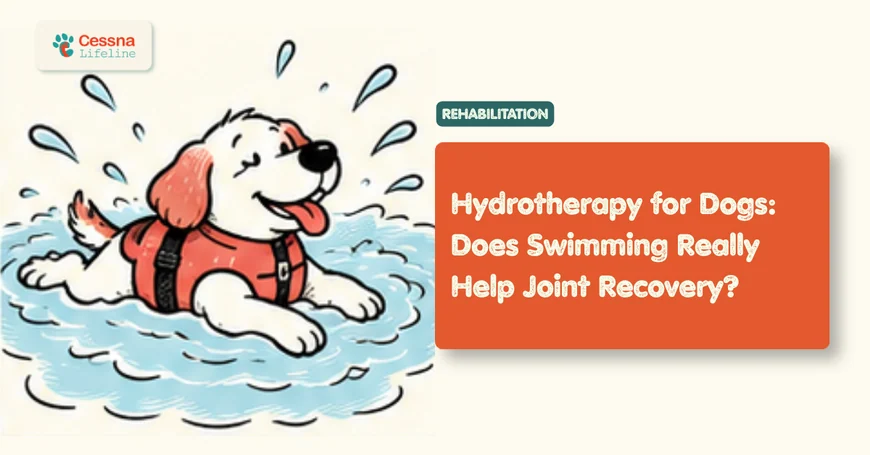
Hydrotherapy for dogs works on a straightforward physical principle: water supports a proportion of body weight, so a dog standing in it carries less load through its joints while its muscles still have to work against the resistance of moving through water. That combination, less joint load with more muscular demand, is difficult to achieve on land and is the entire reason hydrotherapy exists as a treatment.
What it is not is swimming. The distinction matters clinically, and conflating the two is how dogs get hurt in water that was supposed to help them.
What to Know An underwater treadmill and a swimming pool are different treatments with different indications. On an underwater treadmill the dog walks, which reproduces a normal gait pattern with reduced weight bearing and is the usual choice after orthopaedic surgery and for arthritis. Swimming involves no weight bearing at all and a very different movement pattern, with vigorous hip and shoulder extension that is actively unsuitable for some conditions, including certain back and hip problems. Hydrotherapy should follow a veterinary referral, not a decision that the dog likes water.
How Does Hydrotherapy for Dogs Actually Work?
Four physical properties of water do the work.
Buoyancy reduces effective body weight. The deeper the water, the less load passes through the limbs, which lets a dog that cannot tolerate walking on land walk in water. That is the property that makes early mobilisation possible after surgery.
Hydrostatic pressure, the inward pressure of water on a submerged limb, helps reduce swelling and may improve the dog's sense of where its limb is in space, which matters after neurological injury.
Viscosity means water resists movement. Every step requires more muscular effort than the same step on land, so muscle is being loaded even while the joint is being spared. This is how hydrotherapy builds strength without impact.
Warmth matters too. Therapy water is warmer than a swimming pool, typically in the high twenties to low thirties Celsius, which relaxes muscle, reduces stiffness, and makes a painful dog more willing to move through range.
Those four together produce the clinical effect: a dog can work harder, earlier, with less pain and less joint loading than any land-based exercise would allow at the same stage.
Does Hydrotherapy Help Dogs With Arthritis?
Yes, and the mechanism fits the disease well.
Osteoarthritis creates a self-reinforcing cycle. The joint hurts, so the dog uses the limb less, so the muscle supporting that joint wastes, so the joint becomes less stable and hurts more. Breaking that cycle needs exercise, but land exercise at a useful intensity hurts an arthritic joint, which is the trap.
Hydrotherapy sidesteps it. Reduced weight bearing means the painful joint is loaded less, warmth reduces stiffness, and the water's resistance builds the supporting muscle that stabilises the joint. Dogs frequently show better range of motion and willingness to move after a course of sessions.
It is an adjunct rather than a cure. Osteoarthritis management works as a package: weight control, which is usually the single highest-value element, appropriate analgesia, controlled land exercise, environmental changes such as ramps and non-slip flooring, and rehabilitation. Hydrotherapy slots into that package and does not replace any of it. In particular, a dog that is overweight will benefit more from losing the excess weight than from any other single intervention, and the two work well together because hydrotherapy allows exercise while the weight comes down. arthritis in senior pets
| Condition | Hydrotherapy useful? | Which modality |
|---|---|---|
| Osteoarthritis | Yes, well suited | Underwater treadmill, warm water |
| After cruciate surgery | Yes, once cleared by the surgeon | Underwater treadmill, staged protocol |
| After fracture repair | Yes, timing set by the surgeon | Underwater treadmill |
| Neurological cases, including IVDD recovery | Often, with close supervision | Treadmill or supported swimming |
| Muscle wasting from disuse | Yes | Either, depending on the primary problem |
| Weight reduction alongside diet | Yes, as the exercise component | Either |
| Hip dysplasia | Yes, for muscle support | Treadmill preferred |
| Uncontrolled heart disease | No | Not suitable |
| Open or healing wounds, or recent sutures | No, wait until healed | Postpone |
| Respiratory compromise, brachycephalic distress | Usually not | Needs veterinary judgement |
| Infectious or gastrointestinal illness | No | Postpone |
| Fear of water or extreme anxiety | Rarely productive | Land-based rehabilitation instead |
Is Swimming for Dogs the Same as Hydrotherapy?
No, and treating them as equivalent is the commonest misunderstanding in this area.
Swimming for dogs is non-weight-bearing. The limbs move through a paddling pattern quite unlike walking, with vigorous extension at the hips and shoulders. It is excellent cardiovascular exercise and many dogs love it. It does not reproduce a normal gait, so it does not retrain walking, and that extension pattern is a genuine problem in some conditions. Dogs with certain back problems, some hip conditions, and some shoulder injuries can be made worse by swimming.
An underwater treadmill has the dog walking on a moving belt in a chamber filled to a chosen depth. The gait pattern is normal walking, just with less weight through it. Depth is adjustable, so weight bearing can be increased session by session as the dog progresses. Speed and duration are controlled and recorded, so the exercise is measurable rather than approximate.
That measurability is the clinical advantage. A treadmill protocol can specify water depth, belt speed, session length, and number of repetitions, then progress each variable deliberately. Swimming in a pool is hard to dose: the dog swims until it is tired, which is both unmeasurable and a good way to overdo a first session.
Recreational swimming has real value for a healthy dog. It is simply not the same intervention as swimming therapy for dogs delivered under supervision as part of a rehabilitation plan.
When Can Hydrotherapy Start After Surgery?
Timing is set by the surgeon, and the gating factor is usually the wound rather than the repair.
Water and a healing incision do not mix. Submerging a wound that has not fully closed risks infection and breakdown, so hydrotherapy after orthopaedic surgery generally waits until the incision is healed and sutures are out, commonly around the two-week mark. Some protocols begin land-based physiotherapy well before that, with water work added later.
The repair itself also dictates timing. A cruciate stabilisation, a fracture fixation, and a spinal decompression each have their own loading schedule, and the surgeon knows what the construct will tolerate. A rehabilitation plan written without reference to the surgical report is guesswork.
A typical staged approach for hydrotherapy for dogs after surgery: passive range of motion and controlled lead walking in the first fortnight, then short shallow treadmill sessions once the wound is healed, then progressively greater depth, speed, and duration over subsequent weeks, with the dog reassessed as it goes.
Two points owners should insist on. The hydrotherapist should have the surgical report and the surgeon's clearance, not just a verbal account. And the first session should be short, because enthusiasm in session one produces a stiff, sore dog in session two and sets the whole course back. pet post surgery care
The most consistent predictor of a good outcome in a rehabilitation course is not the number of water sessions. It is whether the owner does the small daily home exercises between visits. A dog attending twice a week is being treated for perhaps an hour out of a hundred and sixty-eight, and what happens in the other hundred and sixty-seven decides the result. Owners reliably over-value the water and under-value the five minutes of sit-to-stands and weight-shifting they were asked to do at home. When a case plateaus, the home programme is nearly always where the gap is, not the pool.
What Happens in a Hydrotherapy Session?
A first appointment is an assessment rather than a swim.
The therapist takes the history and the surgical or veterinary report, watches the dog walk to assess gait and which limb is being spared, measures joint range of motion and often limb circumference as a proxy for muscle mass, and checks the dog's response to water. Those baseline measurements are what later progress is judged against, and a service that does not take them cannot demonstrate improvement.
Sessions themselves are short, particularly early on. A few minutes of walking at low speed in shallow water is a normal starting point for a post-operative dog, which surprises owners expecting a workout. A buoyancy aid is used where appropriate, the dog is supervised in the chamber throughout, and the session ends before the dog is tired rather than when it is.
Afterwards, the dog is dried thoroughly, including the ears, since repeated wetting predisposes to ear infection in dogs with pendulous ears. Mild tiredness that evening is expected. Increased lameness the following day means the dose was too high and the plan needs adjusting, which is useful information rather than a failure.
Frequency is commonly once or twice weekly for a defined course, with reassessment every few weeks and a home exercise programme between sessions.
When Is Hydrotherapy the Wrong Choice?
It is a treatment, and treatments have contraindications. These need veterinary clearance or rule it out:
- Open, healing, or recently sutured wounds, until fully closed
- Uncontrolled cardiac disease, where the demand is unsafe
- Respiratory compromise, including brachycephalic dogs in distress
- Active infectious disease, or diarrhoea, for the dog's sake and everyone else's
- Fever or systemic illness
- Uncontrolled epilepsy, given the obvious risk in water
- Severe, unmanaged pain, which needs addressing first
- Fear of water severe enough that the session is distressing
- Certain back, hip, and shoulder conditions where swimming specifically is contraindicated
- Incontinence or recent urinary surgery, pending veterinary advice
- Ear infections, until treated
A dog that becomes more lame, more painful, or markedly reluctant after sessions is telling you the dose or the modality is wrong. That is a red flag worth raising promptly rather than pushing through, and it should prompt a veterinary exam and a revised plan.
Frequently Asked Questions
Does hydrotherapy help dogs with arthritis?
Yes. Reduced weight bearing lets an arthritic dog exercise without loading the painful joint, warm water reduces stiffness, and the water's resistance builds the muscle that stabilises the joint. It works as part of a package alongside weight control, analgesia, and environmental changes rather than as a standalone treatment.
Is swimming for dogs the same as hydrotherapy?
No. Swimming is non-weight-bearing with a paddling pattern and strong hip extension, which is unsuitable for some back, hip, and shoulder conditions. An underwater treadmill has the dog walking with partial weight bearing at an adjustable depth, which retrains normal gait and can be dosed precisely. They are different treatments with different indications.
When can hydrotherapy for dogs after surgery begin?
Usually once the incision has fully healed and sutures are out, commonly around two weeks, though the surgeon sets the date based on the repair. Land-based physiotherapy often starts earlier. The hydrotherapist should have the surgical report and written clearance rather than a verbal account of what was done.
How many hydrotherapy sessions will my dog need?
It depends on the condition and the goal, but a defined course of once or twice weekly sessions with reassessment every few weeks is typical. What matters more than the session count is the home exercise programme between visits, which is where most of the week's rehabilitation actually happens and where plateauing cases are usually falling short.
Is dog hydrotherapy safe?
It is safe when it follows a veterinary referral, the dog is screened for contraindications, and sessions are supervised and dosed conservatively. It is not safe for dogs with open wounds, uncontrolled heart disease, respiratory compromise, active infection, or uncontrolled epilepsy. Swimming specifically is unsuitable for certain spinal and hip conditions.
Can I just take my dog swimming in a lake instead?
Recreational swimming is good exercise for a healthy dog but is not canine rehabilitation. It cannot be dosed, it is not supervised by someone assessing gait, and the swimming pattern is wrong for some conditions. For a dog recovering from surgery or managing arthritis, unsupervised open water risks overdoing it and the water itself carries infection risk.
Will my dog need to like water for hydrotherapy to work?
Most dogs adapt with a gentle introduction, and a good therapist spends the first session on acclimatisation rather than exercise. A dog that remains genuinely frightened will not benefit, because a tense, braced animal is not moving normally. In those cases land-based joint rehabilitation achieves similar goals without the distress.
Next Steps
Hydrotherapy works best as one component of a rehabilitation plan built around a specific diagnosis, with baseline measurements, a staged progression, and a home exercise programme you can actually keep up between visits.
Arrange hydrotherapy and canine rehabilitation with the Cessna Lifeline team. Bring the surgical report or referral details, since the plan depends on what was done and what the repair will tolerate.
If your dog has not yet been assessed, start there rather than with water. Lameness has many causes, and the right rehabilitation plan depends on which one. Book an appointment for an orthopaedic assessment, and if your dog is suddenly non-weight-bearing or in obvious pain, treat that as needing a veterinary exam the same day.